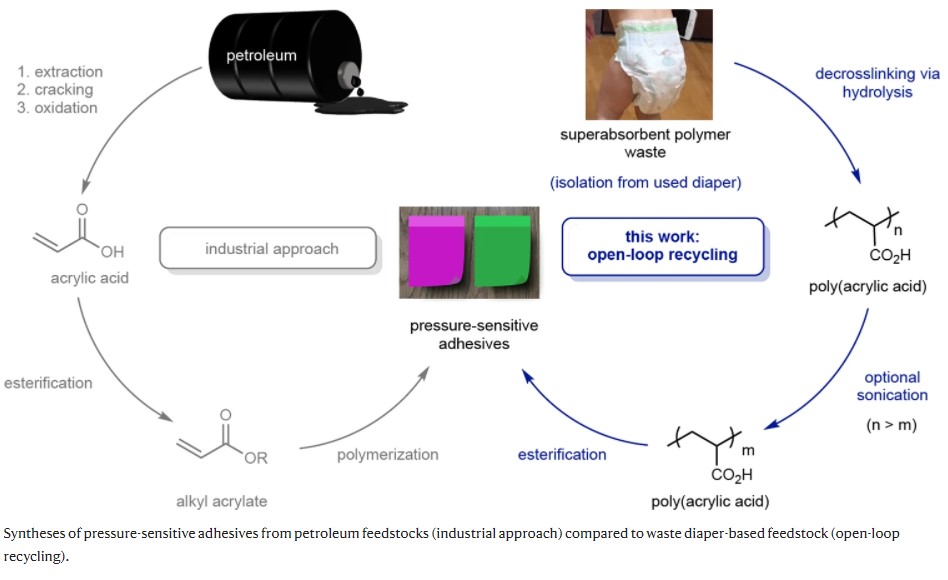



Diapers are not what you'd think about first when you consider recycling. The CBC estimates the number at billions of disposable diapers entering landfills in North America. With this much waste, recycling these absorbent plastics might seem like a good idea. The super-absorbent material inside diapers is made up of long-chain polymers. Unfortunately, they don't get put into recycling bins because the composition of these materials is too complex to break down and recycle traditionally. The problem with diapers is that we haven't found a way to recycle them into something useful. At least, until now.

Light that goes into that black hole doesn’t come out, so we shouldn’t be able to see anything behind one, but if a black hole is warping space, bending light and twisting magnetic fields around itself, then according to Einstein's theory of general relativity direct observation of light from behind a black hole should be possible.

Now it has happened

Material falling into a supermassive black hole powers the brightest continuous sources of light in the universe, and as it does so, forms a corona around the black hole. This light – which is X-ray light – can be analyzed to map and characterize a black hole.
Smartphones tout 'dark mode' as an energy-saving feature, because darker-colored pixels use less power than lighter-colored pixels.

It's mostly an intellectual placebo, finds a new study, because of the way most people use their phones on a daily basis. The study looked at six of the most-downloaded apps on Google Play: Google Maps, Google News, Google Phone, Google Calendar, YouTube and Calculator. The researchers analyzed how dark mode affects 60 seconds of activity within each of these apps on the Pixel 2, Moto Z3, Pixel 4 and Pixel 5.
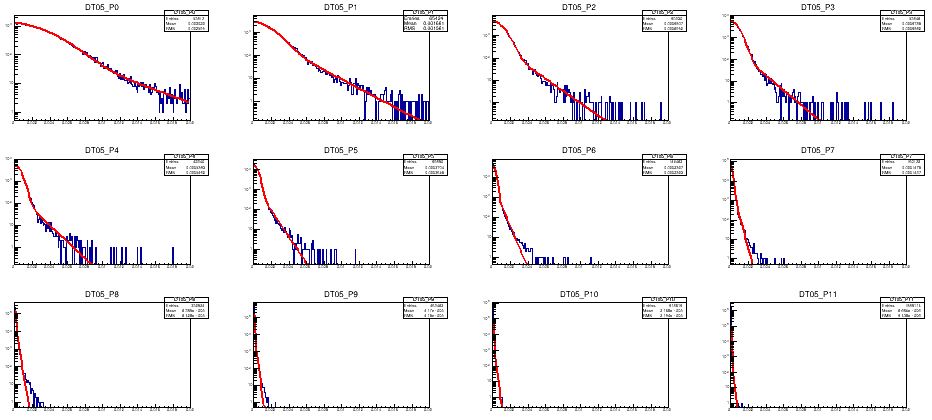
When subnuclear particles traverse matter they give rise to a multitude of physical phenomena. The richness of the different processes is a crucial asset for the construction of sensitive particle detectors, and it is interesting in its own right. Indeed, it has been a very vigorously pursued field of research of its own ever since the end of the nineteenth century, with the discovery of X rays
(produced when electrons released their kinetic energy as they reached the cathode of an accelerating tube), and then after Rutherford's team bombarded gold foils with alpha particles (helium nuclei) emitted by a radioactive substance.

Pessimistic scenari

Nearly 70 years ago, results of a Swedish experiment, now called the Vipeholm studies, correlated frequent candy consumption and tooth decay. With the benefit of scientific hindsight, this is no surprise. What is a surprise is how different cultures reacted. 

For example, instead of public awareness campaigns highlighting the effects of carbohydrates on oral health, as Americans might expect, Sweden asked people to cut back on candy drastically, to eating candy one day per week. Thus was born lördagsgodis - “Saturday sweets.” Parents only let their kids eat candy on Saturday.
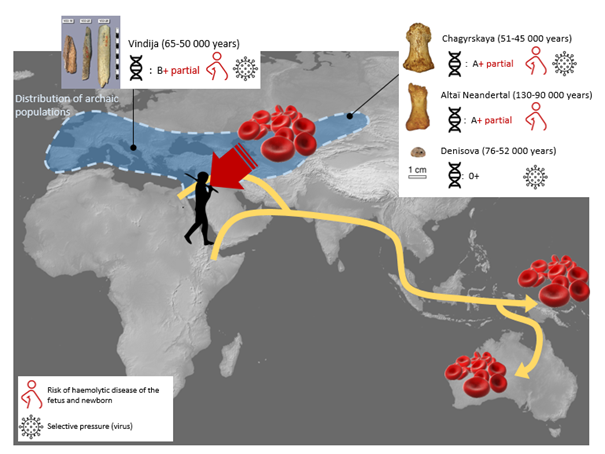
A recent blood group analysis of three Neanderthals and one Denisovan confirm their African origin, Eurasian dispersal, and interbreeding with early Homo sapiens. Intriguingly, it also added evidence of low genetic diversity and possible demographic fragility.

Neanderthals and Denisovans are extinct hominin lineages but were present throughout Eurasia from 300,000 to 40,000 years ago. This paper isn't the first time they have been sequenced but using the genes underlying blood groups in previously sequenced genomes of one Denisovan and three Neanderthal females who lived 100,000 to 40,000 years ago allowed scholars to identify their blood groups.
Blood pressure is a risk factor for a heart event and angiotensin-converting enzyme (ACE) inhibitors and angiotensin receptor blockers (ARBs) are common prescriptions.

Both types of medicines work on the renin-angiotensin-aldosterone system, a group of related hormones that act together to regulate blood pressure. ACE inhibitors lower blood pressure by blocking an enzyme early in the system so that less angiotensin, a chemical that narrows blood vessels, is produced, and blood vessels can remain wider and more relaxed. ARBs block receptors in the blood vessels that angiotensin attaches to, diminishing its vessel-constricting effect. 
"Shark Week" is a Discovery Channel event each summer, unsurprisingly about sharks. It came into existence because "Jaws" the book and then the film were huge hits and they never left the public consciousness after that.

Now Shark Week is much the same, a part of the cultural lexicon. They used to market it, one year they even killed me off in a shark attack as part of their promotional stunt, but now I bet they don't have to do much at all. Yet when you grow to be important, you are going to those who want to bring you down a little. Big tree fall hard, as the saying goes.
A short while ago a prominent physicist made the offhand claim that bees were dying because of a class of pesticides called neonicotinoids - seed treatments that protect plants from pests at their most vulnerable stage and result in far less chemical use than mass spraying. It's not true, and bees are not dying off anywhere, but that claim was still made by environmental fundraising brochures and lawyers hoping to sue so it's no surprise Mother Jones readers believe it.

But a scientist?  That should be odd. Yet it isn't.


