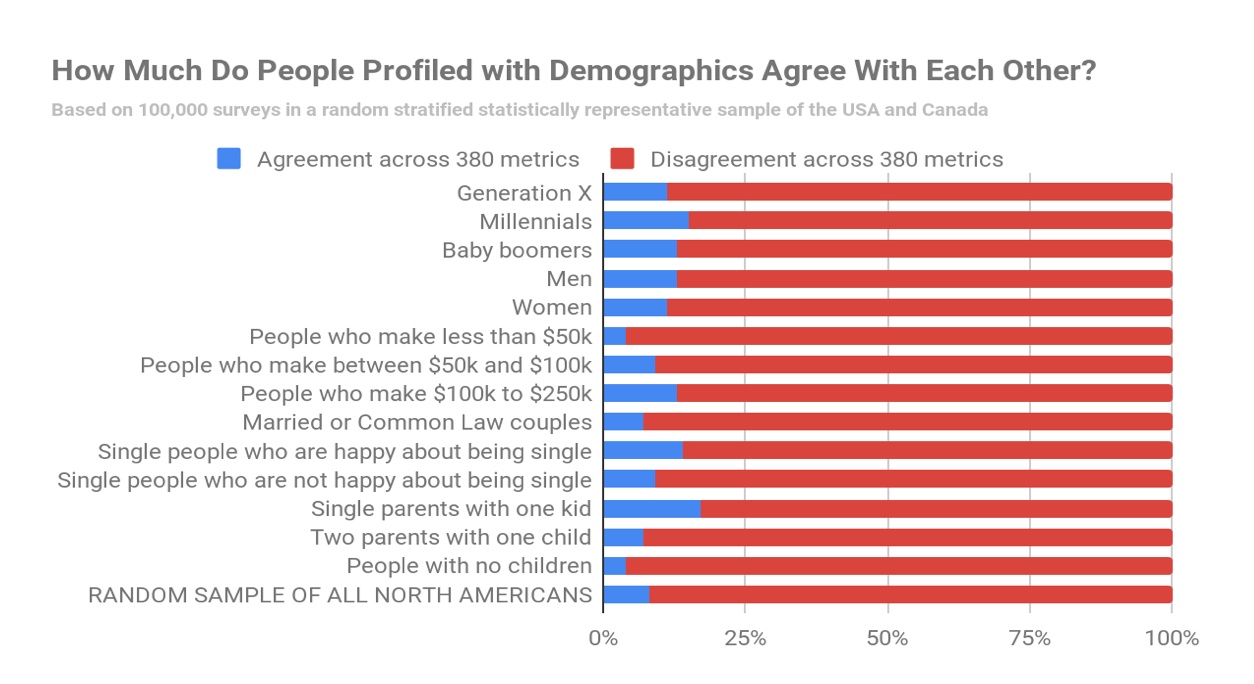
If you want to annoy someone in their late 30s, joke that all they care about are avocado toast points or beard grooming or running off to Coachella when a project needs to be finished. Because they are millennials.
You can also stereotype Baby Boomers or Generation X(1) and get a rise out of them. Everyone seems to know that these "generation" classifications were entirely manufactured by advertisers, but they caught on and have become part of the lexicon. Advertisers created these sweeping generalizations based on demographics.
Yet they may not be right at all. They may even be shockingly wrong.
If you have cooked a steak or a hamburger you know that by the time you are ready to serve it, and certainly after you cut or bite into it, there will be liquid that oozes out of it.
Anti-meat groups know it isn't blood(1) but they use that imagery to try and sway people to their cause. And groups who make substitutes for meat also use that imagery, because they think that's important to meat eaters. Because marketing groups have long used it, people think it's blood, and even use the term "bloody."
Were dinosaurs green? You'd think so going by pop culture imagery but there is no way to know if they were green or grey or something else.
Have you read this week a claim by the Harvard School of Public Health that Food Z is linked to cancer or from our U.S. National Institute of Environmental Health Sciences (NIEHS) claims Chemical X is linked to Harm Y?
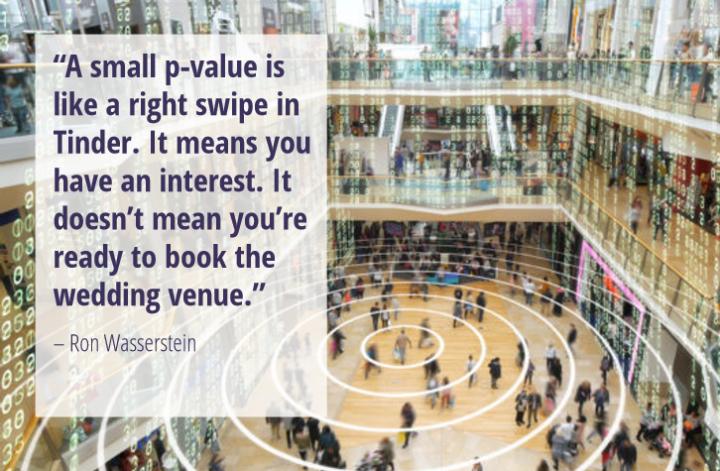
It's technically true, though in high-profile cases like with the International Agency for Research on Cancer in France, what they leave out is that to create their statistical hazard, they use studies with up up to 10,000 times the normal dose. To create hazard, they torture data but because they were able to get a p-value>.05 they declare it statistically significant.
Australia has changed in many ways over the past two decades. Rising house prices, country-wide improvements in education, an aging population, and a decline in religious affiliation, are just some of the ways it has changed. At the same time, political power has moved back and forth between the two major parties. How much can we attribute changes in political power to changes in who we are?
Quite a lot, as it turns out.
Finding the ‘average’ electorate
We analyzed election results from 2001 to 2016 and mapped them against data from the census to see how socio-demographic characteristics influence voting patterns, and how this has changed over time.
In the Chinese science fiction film The Wandering Earth, recently released on Netflix, humanity attempts to change the Earth’s orbit using enormous thrusters in order to escape the expanding sun – and prevent a collision with Jupiter.
The scenario may one day come true. In five billion years, the sun will run out of fuel and expand, most likely engulfing the Earth. A more immediate threat is a global warming apocalypse. Moving the Earth to a wider orbit could be a solution – and it is possible in theory.
Beinecke MS 408, commonly called
the Voynich manuscript (after Wilfrid Voynich, a book dealer who bought it in Italy), has long been dismissed as gibberish by most, but beginning in 1915, and certainly since the 1960s, it has also been a source of fascination for people who believe it must be a code. Or a recipe book. Or something. It is actually a proto-Romance language,
according to a new paper. It just had never been written before because educated people used Latin, says Dr. Gerard Cheshire.
So uneducated people wrote in a language from 2000 years earlier?
Eating sensibly is an important part of a healthy lifestyle but for some people this preoccupation with healthy eating can become physically and socially impairing. The condition, called Orthorexia Nervosa, is a patholofical obsession with "clean eating" and a new study finds it's more common among those who have a history of an eating disorder, obsessive-compulsive traits, dieting, poor body image, and an irrational drive for thinness.
Advocates for getting rid of gasoline love to use images from the 19th century, asking why the public is not using modern alternatives. They try to allege it is a corporate effort to suppress competitors but the argument doesn't work very well when they also argue in other areas that companies are only inventing new products to have something to sell.
Cigarette smoking among kids has continued to fall and since, as we have long noted, "smoking is a pediatric disease". if people don't take it up as children they likely never will. That will pay public health dividends. But with a problem about to be eliminated so is hundreds of billions of dollars that have been given to anti-smoking advocates, and many of them are scrambling to justify why their funding should continue.