Fake Banner
A Great Year For Experiment Design

While 2025 will arguably not be remembered as a very positive year for humankind, for many reasons...

Living At The Polar Circle

Since 2022, when I got invited for a keynote talk at a Deep Learning school, I have been visiting...

Conferences Good And Bad, In A Profit-Driven Society

Nowadays researchers and scholars of all ages and specialization find themselves struggling with...
USERN: 10 Years Of Non-Profit Action Supporting Science Education And Research

The 10th congress of the USERN organization was held on November 8-10 in Campinas, Brazil. Some...

User picture.
picture for Hank Campbellpicture for Patrick Lockerbypicture for Heidi Hendersonpicture for Bente Lilja Byepicture for Sascha Vongehrpicture for Johannes Koelman
Tommaso DorigoRSS Feed of this column.

Tommaso Dorigo is an experimental particle physicist, who works for the INFN at the University of Padova, and collaborates with the CMS and the SWGO experiments. He is the president of the Read More »

Blogroll
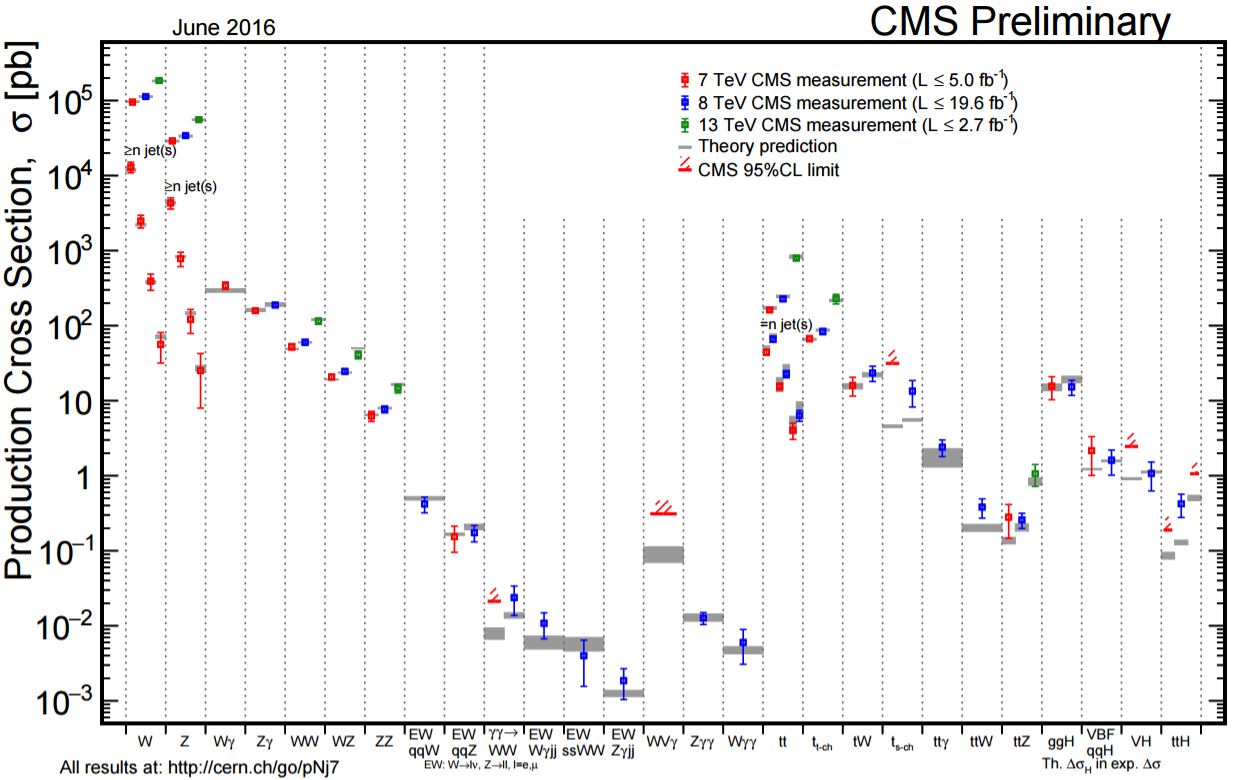
Today while I was having a shower I happened to think at how cool it is that we can actually measure the rate of production, in single hadron-hadron collisions, of multiple elementary particles. A graph like the one below, now routinely produced by ATLAS and CMS whenever they collect more data or switch to a higher center-of-mass energy, looks "natural" to produce, but it is actually surprising that we indeed can pull it off - it requred careful design choices in a number of ways. I wish to discuss one of these here.

In any physicists' new-year wish list there is a mandatory item: the finding of some unexpected, bolt-from-the-blue new physics result - possibly leading to highly-cited publications, press interviews and invitations, and ultimately career advancements or other similar ego boosts. Because we do it for the progress of mankind and the furthering of human knowledge, but we also do it for ourselves- we are human beings too.
As I am traveling around Europe this week, giving seminars in several places (Hamburg yesterday, Berlin today, and Clermont-Ferrand on Friday) my connectivity is erratic and my capability to follow the development of data analysis and new publications is strongly lowered. My connections to the world of LHC research continues through email exchanges, though.
The DZERO collaboration published earlier this year a search for resonances decaying to pairs in its Run-2 dataset of 2-TeV proton-antiproton collisions, produced by the now defunct Tevatron collider in the first 10 years of this century.
I am told that when a patient is diagnosed with a terminal illness, he or she will likely go through a well-defined sequence of stages. 
The first stage is Denial: the patient will convince him- or herself that there is a mistake in the diagnosis, that somehow the doctors are wrong, or something alike. It is a protective, visceral reaction, one preventing the shock of reckoning with a completely altered landscape. There follows a state of Anger: the "why me" sentiment is the cause of this state of mind. Then there is Fear, brought about by the lack of knowledge of what is coming. Then comes Grief - for oneself as well as for the loved ones. And finally, Acceptance, which brings peace to the soul.
The book "Anomaly! Collider physics and the quest for new phenomena at Fermilab" is about to be published, after a somewhat long and anti-climatic wait. And the first presentation events are being scheduled here and there.
If you are at CERN I hope I will see you at the CERN library (bldg 52) on November 29th, at 4PM. The book should already be available for retail by then. On that occasion I will just chat a little about the contents, answer questions, and maybe read one or two paragraphs to those of you who will come by.

The event is detailed in this indico page.