Fake Banner
A Great Year For Experiment Design

While 2025 will arguably not be remembered as a very positive year for humankind, for many reasons...

Living At The Polar Circle

Since 2022, when I got invited for a keynote talk at a Deep Learning school, I have been visiting...

Conferences Good And Bad, In A Profit-Driven Society

Nowadays researchers and scholars of all ages and specialization find themselves struggling with...
USERN: 10 Years Of Non-Profit Action Supporting Science Education And Research

The 10th congress of the USERN organization was held on November 8-10 in Campinas, Brazil. Some...

User picture.
picture for Hank Campbellpicture for Patrick Lockerbypicture for Heidi Hendersonpicture for Bente Lilja Byepicture for Sascha Vongehrpicture for Johannes Koelman
Tommaso DorigoRSS Feed of this column.

Tommaso Dorigo is an experimental particle physicist, who works for the INFN at the University of Padova, and collaborates with the CMS and the SWGO experiments. He is the president of the Read More »

Blogroll
In 1992 I started working at my undergraduate thesis, the search for all-hadronic top quark pairs in CDF data. The CDF experiment was just starting to collect proton-antiproton collision data with the brand-new silicon vertex detector in what was called Run 1a, which ended in 1993 and produced the data on which the first evidence claim of top quarks was based. But I was still working on the Run 0 data: 4 inverse picobarns of collisions -the very first collisions at the unprecedented energy of 1.8 TeV. And I was not alone: many analyses of those data were still in full swing.
I apologize to you, dear reader, for not having written yet about the 2.5 standard deviation excess that the ATLAS collaboration has recently found in diboson final states at 2 TeV in the 2012 8-TeV data. I thought it was interesting, but for some reason the distributions published by the experiment did not stimulate my fantasy enough to trigger an article here. Or maybe, it was because they got published at a time when I had too much on my plate to deal with it...

Among the many things that CMS and ATLAS physicists are looking forward to checking up, using the data that the LHC is starting to deliver from 13 TeV proton-proton collisions, one is the WH resonance signal that CMS found in a recent analysis. Mind you, "signal" here is a misnomer: what was seen was most probably a insignificant fluctuation of the background; yet we must keep our mind open to interpretation changes.

The search I am talking about is one CMS did for boosted Higgs bosons recoiling against boosted W bosons, in a "back-to-back" topology (paper is here).
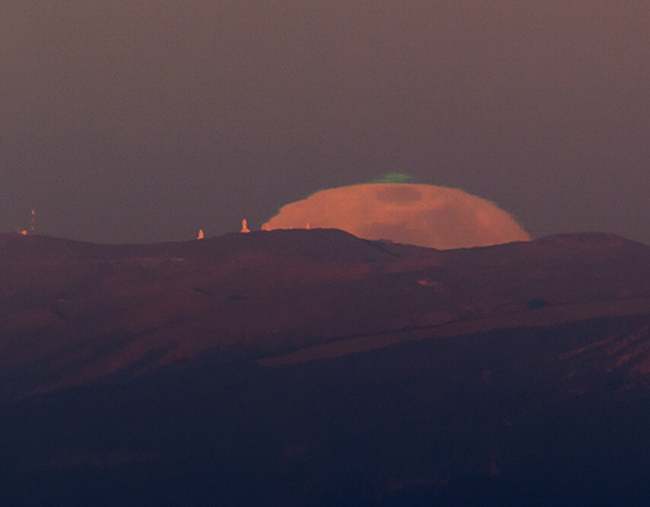
The light we receive from the sun is composed of all visible frequencies, among others, and it therefore appears white to our natural detection system - the human eye. Apparently, evolution caused us to develop a vision which works best at the center of the frequency spectrum emitted by the Sun. 

That notwithstanding, I am sure that if you ask the question "what colour is the Sun" to the average Joe, you will get an equal share of "white" and "yellow", and maybe some "red" answers. Besides, who among us has never painted a red Sun in a blue sky as a child ? 

The second infn school of statistics took place this week in the nice "green island" of Ischia, in the gulf of Naples, Italy. Organized by the INFN section of Naples, the school aims at training Ph.D. students and post-graduates in the foundations and the applications of the statistical methods most used nowadays in particle physics, nuclear physics, and astrophysics.

Yesterday I posed a question - Are the first collisions recorded by the LHC running at 13 TeV the highest-energy ever produced by mankind with subatomic particles ? It was a tricky one, as usual, meant to think about the matter.

I received several tentative answer in the comments thread, and thus answered there. I paste the text here as it is of some interest to some of you and I wish it does not go overlooked.

---

Dear all,