Fake Banner
A Great Year For Experiment Design

While 2025 will arguably not be remembered as a very positive year for humankind, for many reasons...

Living At The Polar Circle

Since 2022, when I got invited for a keynote talk at a Deep Learning school, I have been visiting...

Conferences Good And Bad, In A Profit-Driven Society

Nowadays researchers and scholars of all ages and specialization find themselves struggling with...
USERN: 10 Years Of Non-Profit Action Supporting Science Education And Research

The 10th congress of the USERN organization was held on November 8-10 in Campinas, Brazil. Some...

User picture.
picture for Hank Campbellpicture for Patrick Lockerbypicture for Heidi Hendersonpicture for Bente Lilja Byepicture for Sascha Vongehrpicture for Johannes Koelman
Tommaso DorigoRSS Feed of this column.

Tommaso Dorigo is an experimental particle physicist, who works for the INFN at the University of Padova, and collaborates with the CMS and the SWGO experiments. He is the president of the Read More »

Blogroll
Taking inspiration from Resonaances, who this year offers much more than an April's Fool in his blog (I am also flattered to see that I am featured there, and with a character of my liking), I am going to offer some predictions for the next run that the LHC is going to start, at the unprecedented energy of 13 TeV, in the next few weeks. The unconventional thing is that I will force the natural scepticism out of my brain, and try to be over-optimistic.
The prediction for 2015-2016
Plagiarism is the most sincere form of flattery, they say (or rather, this is said of imitation). In arts - literature, music, painting - it can at times be tolerated, as an artist might want to take inspiration from others, elaborate on an idea, or give it a different twist. In art it is the realization of the idea which matters.
Sometimes I think I am really lucky to have grown convinced that the Standard Model will not be broken by LHC results. It gives me peace of mind, detachment, and the opportunity to look at every new result found in disagreement with predictions with the right spirit - the "what's wrong with it ?" attitude that every physicist should have in his or her genes.
Spring is finally in, and with it the great expectations for a new run of the Large Hadron Collider, which will restart in a month or so with a 62.5% increase in center of mass energy of the proton-proton collisions it produces: 13 TeV. At 13 TeV, the production of a 2-TeV Z' boson, say, would not be so terribly rare, making a signal soon visible in the data that ATLAS and CMS are eager to collect.

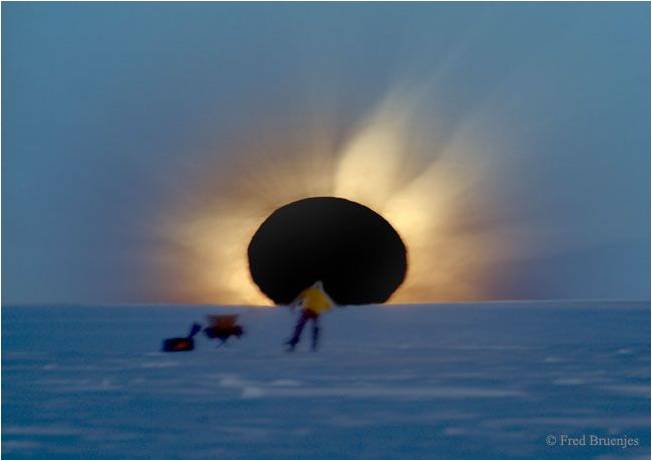
In the morning of March 20th Europeans will be treated with the amazing show of a total solar eclipse. The path of totality is unfortunately confined to the northern Atlantic ocean, and will miss Iceland and England, passing only over the Faroer islands - no wonder there's no hotel room available there since last September! Curiously, the totality will end on the north pole, which on March 20th has the sun exactly at the horizon. Hence the conditions for a great shot like the one below are perfect - I only hope somebody will be at the north pole with a camera...

(Image credit: Fred Bruenjes; apod.nasa.gov)

The top quark is the heaviest known elementary particle. It was discovered in 1995 by the CDF and DZERO experiments at the Fermilab Tevatron collider after a long hunt that had started almost two decades earlier: it took long because the top weighs as much as a whole silver atom, and producing this much matter in single particle-particle collisions is difficult: it requires collision energies that started to be available only in 1985, and the rarity of the production processes dictate collision rates that were delivered only in the early nineties.