Banner
Not So Elementary (the Cosmos, That Is)

Recently there are appeared a paper showing how Physics - Iron–Helium Compounds Form Under...

Carbon — to capture or not to capture

This came up on 2nd November 2024 (give or take a day), a broadcaster objecting to a carbon capture...

Betelgeuse, Gamow, and a Big Red Horse

There has been a lot of talk recently of Betelgeuse possibly going supernova this century or not...

User picture.
picture for Hank Campbellpicture for Patrick Lockerbypicture for Hontas Farmerpicture for Helen Barrattpicture for Sascha Vongehrpicture for Sean Gibbons
Robert H OlleyRSS Feed of this column.

Until recently, I worked in the Polymer Physics Group of the Physics Department at the University of Reading.

I would describe myself as a Polymer Morphologist. I am not an astronaut,

... Read More »

Blogroll

A multiplet is a simple thing to describe: it is a collection of several identical or nearly identical things. Here, however, a difficulty arises because a "multiplet" is a manifestation of symmetry groups, and symmetry groups are tough objects to discuss. So if in a scientific paper you write "the new hadron might belong to a SU(3) multiplet", you have the additional trouble that you need to avoid discussing group theory to an unwilling listener. What is SU(3) ? Do we actually care?
Thus wrote Tommaso Dorigo in The Language Barrier on 26th May this year.

I probably first heard of the McMahon Line in 1962, when there was a brief war between China and India for control of the Himalayan border between them.  


My chief memory of this is a Giles cartoon of the time, showing a policeman investigating a dispute between two neighbouring restaurants, one Chinese, one Indian.

Skegness is SO bracing


Recently Elizabeth Cunningham Perkins brought us a Weedy Rumination on the Creeping Bellflower, Campanula rapunculoides. I will now tell you about a wildflower growing in my own garden, which is full of memories.
I expect most of you have heard this song, with its sad words.  It’s full of letters sad and blue, a photograph or two, roses, tokens ….

Not for me!  But as I am clearing out our chemical store, with materials being sent off for disposal prior to the closure of the Reading University Physics Department, some of those bottles do hold memories for me.

There, in an outside brick shed, far enough away to store large quantities of flammable chemicals, sits a jar of sodium nitrite.  But the use to which it was put was somewhat unorthodox. 
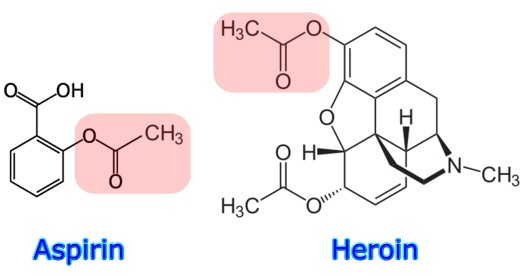
In February 1999, the giant German pharmaceutical company Bayer celebrated the centenary of the launch of ASPIRIN, the world’s most successful legal drug. One thing they did NOT celebrate is the launch of HEROIN one year earlier.

Both drugs are synthesized by adding acetyl groups to already existing natural compounds. Aspirin is produced by adding one group to salicylic acid, found in willow bark which had long been used as a traditional remedy for pains and fever, while heroin is produced by adding two acetyl groups to morphine, the active constituent of opium.  Here are the two formulae with the acetyl groups marked with pink rectanguloids.