




Astronomers have spied a faraway star system that is so unusual, it was one of a kind - and then its discovery helped them pinpoint a second one much closer to home.

They discovered the first star system 13 million light years away, tucked inside Holmberg IX, a small galaxy that is orbiting the larger galaxy M81. They studied it between January and October 2007 with the Large Binocular Telescope (LBT) on Mt. Graham in Arizona.

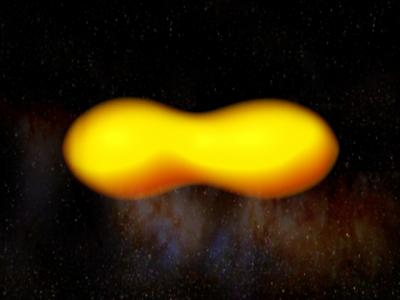
The star system is unusual, because it’s what the astronomers have called a “yellow supergiant eclipsing binary” -- it contains two very bright, massive yellow stars that are very closely orbiting each other. In fact, the stars are so close together that a large amount of stellar material is shared between them, so that the shape of the system resembles a peanut.

UC Irvine scientists have discovered a cluster of galaxies in a very early stage of formation that is 11.4 billion light years from Earth – the farthest of its kind ever to be detected. These galaxies are so distant that the universe was in its infancy when their light was emitted.

The galaxy proto-cluster, named LBG-2377, is giving scientists an unprecedented look at galaxy formation and how the universe has evolved. Before this discovery, the farthest known event like this was approximately 9 billion light years away.

“When you observe objects this far away, you are actually seeing the universe as it was a very long time ago,” said Jeff Cooke, a McCue Postdoctoral Fellow in physics and astronomy at UCI and lead author of this study. “It is as if a timeline is just sitting out there in front of you. These galaxies represent what the universe looked like well before the Earth existed.”

The Netherlands Organization for Scientific Research has a couple of interesting things in the works, the first being next generation media storage. Dutch researcher Alexander le Fèbre has demonstrated that a field-emission current signal can be used to arrange the position of thousands of nanometre-sharp needles. These probes can be applied to write and read in new storage media with an extremely high density, using bits on a nanometre scale.

The development of the hard disk is reaching its technical limits because the entire disk is served by just a single head so the capacity of the disk and the reading and writing speed cannot expand much more in the future. Research into a memory based on probes from the University of Twente’s MESA+ research institute means able to control the position of each separate probe - essential for realizing a system with extremely high densities.

NGC 2397, pictured in this image from Hubble, is a classic spiral galaxy with long prominent dust lanes along the edges of its arms, seen as dark patches and streaks silhouetted against the starlight. Hubble’s exquisite resolution allows the study of individual stars in nearby galaxies.

Located nearly 60 million light-years away from Earth, the galaxy NGC 2397 is typical of most spirals, with mostly older, yellow and red stars in its central portion, while star formation continues in the outer, bluer spiral arms. The brightest of these young, blue stars can be seen individually in this high resolution view from the Hubble’s Advanced Camera for Surveys (ACS).

LONDON, March 31 /PRNewswire/ -- Lowering the blood pressure of elderly patients could cut their total mortality by a fifth and their rate of cardiovascular events by a third, according to a new study presented today at the American College of Cardiology in Chicago and published simultaneously in the New England Journal of Medicine.

The 3,845 patient Hypertension in the Very Elderly Trial (HYVET), which is co-ordinated by scientists from Imperial College London, is the largest ever clinical trial to look at the effects of lowering blood pressure solely in those aged 80 and over. Patients were given either a placebo or the diuretic indapamide slow release (SR) 1.5mg, with the addition of the ACE inhibitor perindopril in tablet form once a day.

INGELHEIM, Germany, March 31 /PRNewswire/ --

- Results of 25,620 Patient Study ONTARGET(R) (ONgoing Telmisartan Alone and in Combination With Ramipril Global Endpoint Trial) Presented Today at the 57th Annual Scientific Session of the American College of Cardiology(1)

- For Non-US Healthcare Media

LONDON and PRAGUE, March 31 /PRNewswire/ --

- ALWIL Software a.s. is Pleased to Announce the Next Major Release of avast! antivirus, avast! 4.8.

avast! antivirus 4.8 is a major technology upgrade to the avast! product line, which includes the addition of anti-spyware detection, certified by West Coast Lab's Checkmark process, and the implementation of anti-rootkit capabilities, all directly from within avast! antivirus.

SAN DIEGO, March 31 /PRNewswire/ --

Amira Pharmaceuticals, a small molecule pharmaceutical company focused on the discovery and development of compounds to treat inflammatory disease, today announced the appointment of two additional members to its board of directors: Dennis M. Fenton, Ph.D. and Stephen W. Kaldor, Ph.D.

TORONTO, March 31 /PRNewswire/ -- The book, Lifeliner, by Shireen Jeejeebhoy has just scooped awards for Editors Choice and Publishers Choice, as well as winning first place in the Reader Views Reviewers Choice Award for biographies.

(Logo: http://www.newscom.com/cgi-bin/prnh/20080331/298826 )

The book, available from iUniverse, Barnesandnoble.com, Amazon and Chapters, tells the story of the first `lifeliner' Judy Taylor. She survived over 20 years living with a permanent catheter, in which she received total parenteral nutrition (TPN) thanks to a radical young doctor Dr Khursheed Jeejeebhoy.


