

Banner
    Exquisite Machines
    By Sean Gibbons | July 23rd 2011 11:30 AM | 24 comments | Print | E-mail | Track Comments
    The synthesis of non-equilibrium thermodynamics and biology, pursued in fits and starts over the years by an eccentric cast of thinkers, has produced a few scientific red herrings, but the overall idea has expanded our biophysical horizons.  I'll summarize what I've come to understand about the development of biological thermodynamics and its implications, while trying to skirt the rabbit holes.

    First, I suppose a brief explanation of thermodynamics is needed.  To put it concisely, thermodynamics is the branch of physics that deals with the conversion of energy into different forms.  We derive our physical conceptions of temperature (average kinetic energy of matter, i.e. how fast atoms and molecules bounce off of one another within a substance), heat (energy transferred between two bodies or systems in thermal contact), work (force multiplied by distance, i.e. joules), Gibbs free energy ('useful' energy, or energy available to do work) and entropy (disorder) from thermodynamics.  The first and second laws state that 1) energy can be neither created nor destroyed within an isolated system, only modified in form, and 2) entropy will never decrease within an isolated system.  Early work in classical thermodynamics involved designing engines that were able to perform mechanical work by transferring energy from a warm region to a cool region (like the sterling engine, diesel and gasoline engines, or nuclear power plants; see below).  Modern thermodynamics has evolved beyond heat engines to encompass chemical reactions and molecular/atomic theories of matter (chemical thermodynamics and statistical mechanics). 
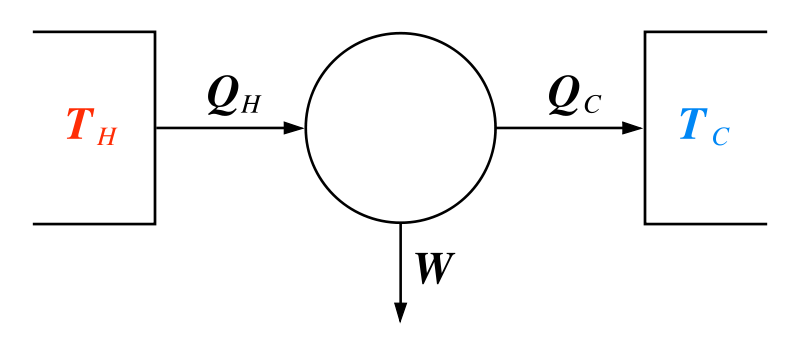
    The image above depicts a heat engine. T refers to temperature, Q to heat, and W to work. The subscripts H and C denote 'hot' or 'cool', respectively. As heat flows from a high temperature reservoir to a low temperature reservoir via an engine (circle), a certain amount of that heat energy is converted to work.
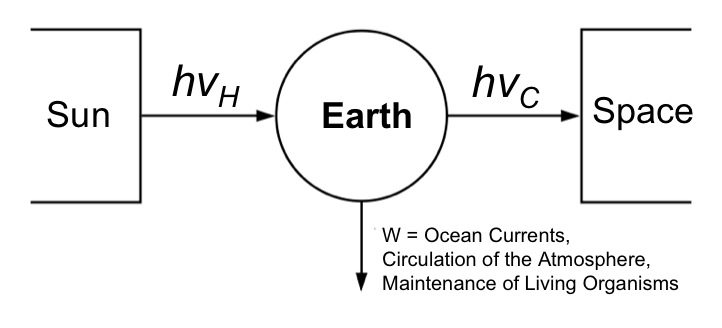
    The image above depicts a heat engine.  T refers to temperature, Q to heat, and W to work.  The subscripts H and C denote 'hot' or 'cool', respectively.  As heat flows from a high temperature reservoir to a low temperature reservoir via an engine (circle), a certain amount of that heat energy is converted to work.


     Parallels can be drawn between our planet and a heat engine.  The hot sun radiates high-energy light (hv) that is absorbed by our planet and re-emitted back to cold space as lower-energy infrared radiation.  A certain proportion of this flow is used to drive the circulation of our oceans, our atmosphere, and to sustain life (via photosynthesis).


    Erwin Schrödinger (a founding father of quantum physics), in his work entitled What is Life? (Schrödinger, 1944), attempted to reconcile biology with the observed laws of chemistry and physics.  He proposed two biological research programs: 'order from order' and 'order from disorder'.  The former was based on the fact that life involved self-replicating ordered structures that depended upon a strange 'crystalline molecule' called DNA that Watson, Crick, and Franklin would later demystify.  This 'order from order' hypothesis became the central dogma of molecular biology and led to an explosion of research and understanding.  The 'order from disorder' hypothesis (a misnomer) lay dormant for many years due to its assumed contradiction of the fundamental laws of thermodynamics.  In his work, Schrödinger observed that, at first glance, living systems seem to defy the second law of thermodynamics, which states that within isolated systems entropy should be maximized - chaos should reign.  Schrödinger, therefore, strayed from the traditional equilibrium-based thermodynamics that had been developed up to that point and began to investigate the thermodynamics of non-equilibrium systems. 

    A non-equilibrium system is defined in terms of external gradients maintaining a state at a certain distance away from equilibrium (Schneider&Kay, 1994).  These gradients (fluxes of energy and matter in and out of the system) somehow allowed non-equilibrium processes (convection cells, tornadoes, planetary rings, etc.) to maintain organized internal structures, vaguely reminiscent of living systems.  Schrödinger proposed that life itself is a non-equilibrium process by which localized order is maintained at the expense of larger global entropy production, suggesting that the study of living systems from a non-equilibrium perspective would reconcile biological self-organization and the inorganic world (Schrödinger, 1944).  When ordered processes (physical or biological) emerge from a non-equilibrium state, they develop and grow at the expense of increasing the disorder at higher levels in the system’s hierarchy.  Living organisms swim against an entropic stream, which tends to carry everything to an inert state of equilibrium, by catalyzing an accelerated increase in higher-level disorder proportional to the magnitude of biological organization.  Thus, metabolism allows the organism to export the internal entropy that it cannot help but produce by being alive (von Stockar&Liu, 1999).

    Perhaps the simplest illustration of biological thermodynamics is microbial metabolism (pictured below).  E. coli can consume organic compounds (glucose, for example) and “breath” oxygen to stay alive (aerobic respiration).  Energy-rich electrons are stripped away from glucose and made to flow through an electron transport chain, ending up in H2O.  This downhill flow of electrons is harnessed to pump ions across a membrane, much like a windmill pumps water from underground, creating an electrochemical gradient that can be used to do the work of building and maintaining the cell.  The Gibbs energy difference (∆G) between food and the metabolic waste product determines the driving force of metabolism (von Stockar et al., 2008), just as elevation gradients determine how quickly water rushes down a stream.  The exact metabolic rate is controlled by the balance of energy released through catabolism (breaking down molecules), consumed by anabolism (building up molecules) and the differences in chemical entropies between metabolic reactants (food) and products (waste).  The principal entropic byproduct of aerobic respiration is heat (von Stockar and Liu, 1999), which heightens disorder in the surrounding environment by increasing the temperature (atoms jostle against one another more vigorously) and 'pulls' metabolism in a forward direction (just as the expanding universe 'pulls' galaxies apart, or as a gas is 'pulled' into a vacuum). The bacterium siphons away some proportion of useable electronic energy to perform uphill work (building proteins, sugars, nucleic acids, and lipids), while the rest is relinquished to pay the thermodynamic piper.  In other words, life buys its lunch with chaos.
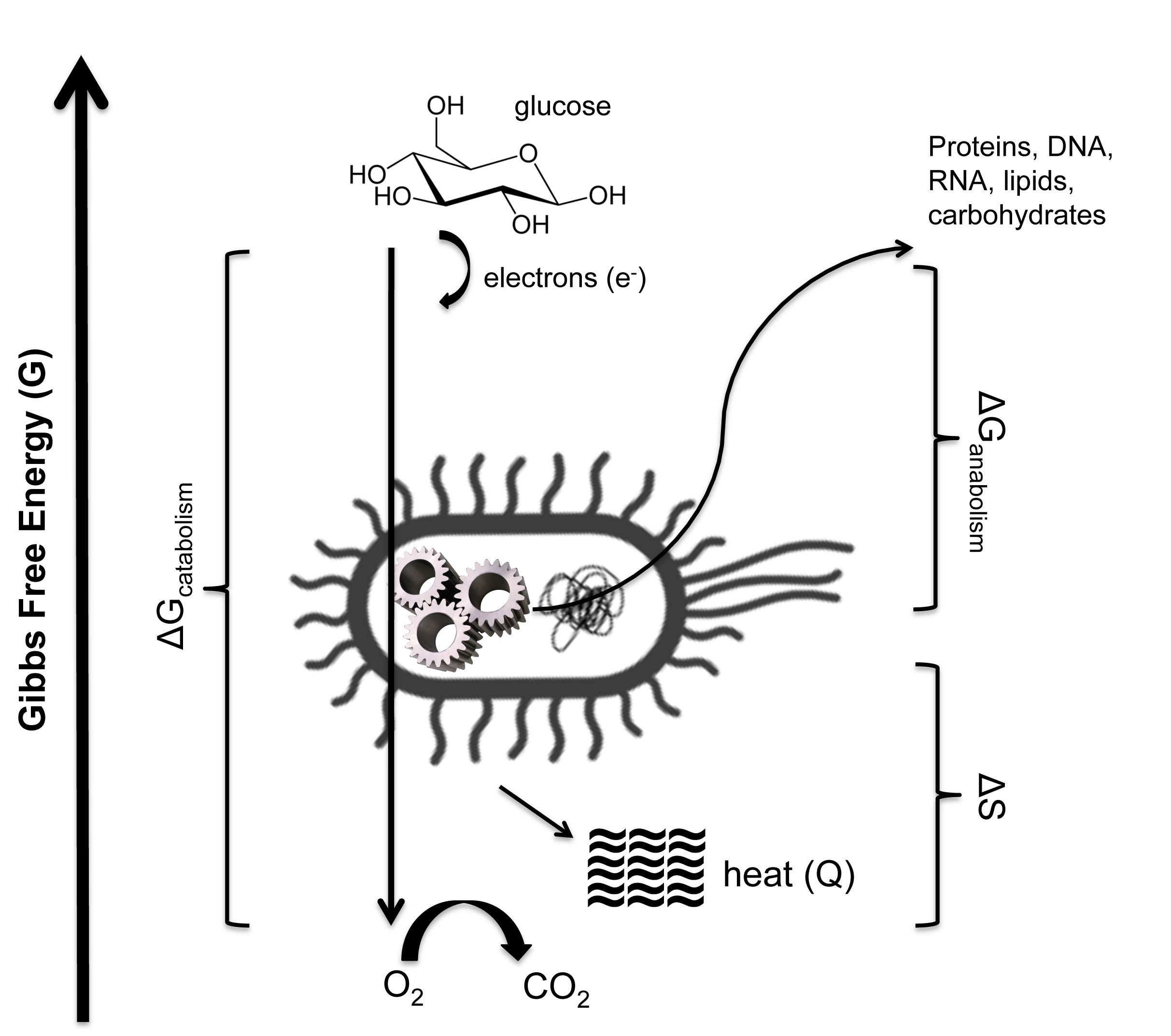

    The total entropy change (∆S) is a combination the chemical entropies of the products of metabolism and the heat lost during the breakdown of the substrate (glucose).

    It is necessary to point out that Schrödinger's 'order from disorder' hypothesis, while conceptually useful for its time, is fundamentally flawed.  What he should have said was 'biological order from non-biological order'.  In reality, the organization that we observe in the universe cannot be derived from chaos.  Contemporary order is descended from the Big Bang (and, yes, the occasional statistical fluctuation), when all the space, matter and energy in the cosmos were compressed into a single, infinitesimally small point.  At that moment, the universe was in its maximum state of order.  Since then, the echoes of that ancient uniformity are found in coherent structures like plants, suns, galaxies, and Tupperware.  It is from the energy differentials created by this diluted cosmological order that life arose and has persisted.
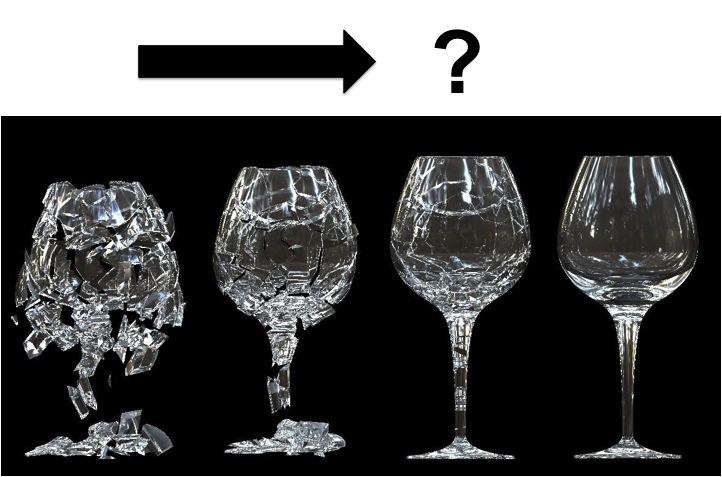

    Nope.

    Today, the idea that life is derived from the inorganic world seems relatively straightforward.  Most people accept that living things obey the laws of physics.  Understanding the dynamics of energy and matter within living systems allows us to predict biological phenomena from physical laws.  Because life is so vastly complex, these predictive powers have remained elusive.  After a century of extraordinary research in molecular biology and evolution (order from order – driven by genetics), and advances in large scale data collection and computation, biophysical science is positioned to answer Schrödinger’s call to address 'biological order from non-biological order'.  Brilliant trailblazers, like Ilya Prigogine, have illuminated foundational relationships between non-living processes and living organisms through non-equilibrium thermodynamics.  Sub-disciplines, like astrobiology and biogeochemistry, have flowered forth from these insights.  James Lovelock established the gaia hypothesis (Lovelock and Margulis, 1974), which integrated living organisms into the dynamic chemistry of our oceans and atmosphere.  Lovelock's predictions have lead to potential spectroscopic methods for detecting life-bearing planets outside of our solar system by looking, for example, for significant quantities of methane in oxidized atmospheres.  James Brown has proposed a metabolic theory of ecology (Brown et al., 2004), hypothesizing that patterns of species diversity vary predictably with temperature, suggesting a biophysical approach to ecology.  Brown’s theories could be employed to help predict ecological shifts due to changing climate conditions.  Perhaps most interestingly, these ideas may culminate in the discovery of how life arose (or could have arisen) on Earth, and how it might develop elsewhere in the universe.

    In conclusion, we cannot separate ourselves from the rest of the physical universe.  The distinction between life and non-life is arbitrary.  We are exquisite machines, sustained by electrochemical currents.  Life on Earth has achieved amazing longevity due to its evolutionary memory, which is recorded and passed down from cell to cell via the genetic code.  This living document has been characterized to such an extent that we can now read and even write our own biological prose.  3.8 billion odd years ago, the chance marriage of DNA/RNA software to physiological hardware became what we recognize as life.  Just as life began as a synthesis of memory and muscle, our nascent understanding of life should proceed through a coupling of evolutionary biology (the genetic history of life) and biophysics (the structural framework and physiochemical engines of life that have survived natural selection and earned a place in the genetic code).  Such a synthesis can be found in the emerging field of synthetic biology.  Christina Agapakis, a synthetic biology blogger and practitioner, defines her field as “three independent but interrelated research programs aimed at engineering life… - building genetic circuits and devices based on interchangeable biological parts, chemically synthesizing genetic pathways or whole genomes, and trying to recreate the earliest life forms with protocells.”  Synthetic biologists fabricate DNA in vitro, allowing them to disassemble and reassemble living things from the ground up, and to combine novel forms of hardware and software that don't currently exist on Earth.  This field draws us into a future where the manipulation and manufacture of living things is as natural to us as fixing a bike or baking a pie.  It will grant us incredible powers to alter and control our environment, for better or for worse, and lead us to unimaginable discoveries that will change the way we think of the universe and ourselves.


    Echoes of ancient uniformity, the inorganic precursors to life - A clip from the new film "Tree of Life".

    References
    Brown, J.H., Gillooly, J.F., Allen, A.P., Savage, V.M., West, G.B. (2004) Toward a metabolic theory of ecology. Ecology 85:7 1771-1821.

    Hatsopoulos, G.N., Keenan, J.H. (1965) Principals of General Thermodynamics. New York: John Wiley&Sons Co.

    Lovelock, J.E., Margulis, L. (1974) Atmospheric homeostasis by and for the biosphere: the gaia hypothesis. Tellus 26:2 2-10.

    Schrödinger, E. (1944) What is Life? Cambridge: Cambridge University Press.

    Toussaint, O., Schneider, E.D. (1998) The thermydynamics and evolution of complexity in biological systems. Comparative Biochemistry and Physiology 120:1 3-9.

    Schneider, E.D., Kay, J.J. (1994) Complexity and thermodynamics: towards a new ecology. Futures 26:6 626-647.

    von Stockar, U., Liu, J.S. (1999) Does microbial life always feed on negative entropy? Thermodynamic analysis of microbial growth.  BBA-Bioenergetics 1412:3 191-211.

    von Stockar, U., Vojinovic, V., Maskow, T., Liu, J. (2008) Can microbial growth yield be estimated using simple thermodynamic analogies to technical processes? Chemical Engineering and Processing. 47: 980-990.


    Comments

    Sean, Thanks for an excellent article! I have a single question, is consciousness entropic in that it requires glucose metabolism to create the illusion? Or, did I miss something in the article?

    sgibbons
    Any sustained biological process will require the consumption of energy, which will necessarily augment the of entropy of its surroundings (the brain puts off a fair amount of heat, for example).
    Sean M. Gibbons
    vongehr
    just as the expanding universe 'pulls' galaxies apart
    ...
    Contemporary order is descended from the Big Bang ..., when all the space, matter and energy in the cosmos were compressed into a single, infinitesimally small point.
    Most of what you write is OK, so it may be better to not discredit your knowledge by adding stuff from other disciplines that is terribly wrong. With entropic gravity, somehow cosmic entropy "pulls" galaxies, but since you afterwards talk about the BB model the way you do (i.e. classical, time reversible GR), that does not fly either, so it is plainly wrong. Without cosmic inflation (which happens before (!) the BB), there is also no reason to suspect the BB to have low entropy (say by some sort of ad hoc Weyl curvature hypothesis). Moreover, the BB is not a singularity (except in bad popular science accounts and in classical GR where we long since know it leaves its domain of applicability).
    sgibbons

    Dear Sascha,

    Thanks for your feedback.  I am, admittedly, no physicist (at least not yet).  I am currently writing from a biologist’s perspective, so I cannot give an eloquent response to your arguments about entropic gravity, time reversible general relativity, the big bang, and Weyl curvature.  My point in the article was simply to state that order does not, on average, arise from disorder, but that there is a primordial source of order in the universe (manifested in structures like our sun, for example) that provides residual low entropy inputs for living (and non-living) non-equilibrium processes.


    Regards,

    Sean

    Sean M. Gibbons
    It is my understanding that their is no such thing as an "Isolated system" . I think that is stated in most physic's text books. Sorry I can't supply the link right now. But a youtube search for Nassim Haramein and his 45 part Rogue River talk on mini blackholes should straighten the matter out. Good read though. Well done overall. Peace and thank you for your efforts.

    sgibbons
    Dear Ron,

    I agree that an "isolated system" is a theoretical construct devised by physicists, and that no such system exists in the known universe.  However, what about the universe itself?  Are we aware of any transfer of energy or matter in or out of the boundaries of the universe?  Thanks for your feedback!

    regards,
    Sean
    Sean M. Gibbons
    Sorry Sean. I am not aware of any transfer of energy in or out of the universe. Unfortunately. I am not aware of any boundry's either. All the brainiac's say boundry's don't exist. Kinda makes one wonder what the universes is expanding into.Thanks for your feedback as well.

    Gerhard Adam
    Good article, but I think you're taking quite a few liberties with some concepts.
    The distinction between life and non-life is arbitrary.
    I think that this is a bit of an overstatement, since life is characteristically different from non-life. 
    3.8 billion odd years ago, the chance marriage of DNA/RNA software to physiological hardware became what we recognize as life.
    I think this description is backwards, but that's my own point of view.  However, I'm not fond of using the term "chance" in this situation since that seems implausible.
    We are exquisite machines, ...
    Actually we aren't and this analogy leads to more misunderstandings than anything else.
    sgibbons

    Thanks for the input!  I do, however, think that the distinction between life and non-life is rather arbitrary.  That's not to say we don't have established definitions of life (homeostatic interior environment maintained by metabolism, nucleic acid-based information storage, reproduction, etc.).  I wanted to point out the absurdity of drawing aline in the sand.  For example, the argument of whether viruses should be considered ‘alive’.  I’ve just extended it one more step, to include non-equilibrium processes in general.  My argument was, primarily, against those who would refute the material origins of life (i.e. transcendentalists, metaphysicists, or spiritualists) and say that life possesses a secret sauce that sets it apart from the rest of the universe. 

    There are incredibly complex chemistries that play out wherever we observe energy differentials.  On Earth, these chemistries grew into carbon-based life forms.  I'm not saying that the origin of life was due to chance, since it would probably have been statistically favored over million-year timescales (as long as there were geothermal and solar energy gradients to maintain dissipative non-equilibrium processes).  Once biochemical reactions occurring in a non-living context found themselves somehow encapsulated in a membrane of amphipathic molecules and acquired a reproductive "memory" (likely RNA), then there was no stopping them.  The evolutionary ratchet allowed life to tenaciously persist and explode in diversity.

    I have to disagree on the last point.  What are living beings if not delicate, intricate, self-assembling, self-optimizing, biomolecular machines? 

    Sean M. Gibbons
    Gerhard Adam
    That's not to say we don't have established definitions of life (homeostatic interior environment maintained by metabolism, nucleic acid-based information storage, reproduction, etc.).
    Well, that's actually part of my point, since those are merely some attributes that life may (or may not) possess, but they don't actually provide the final definition.  Without taking the time to expand on it (although I'm working on a blog post), it seems that the over-arching characteristic that no one mentions is "intent".  Not intent in any intellectual or psychological sense, but a kind of "intentionality" that describes a purpose, whereas inanimate processes are "purposeless".

    Using your example about viruses, illustrates that they must be considered alive because they demonstrate a "purpose" in hijacking a cell's reproductive machinery in order to reproduce.  They "know" specifically how to achieve this objective, and they have evolved specifically in ways to achieve it.  These are not processes that are subject to probability or randomness.
    What are living beings if not delicate, intricate, self-assembling, self-optimizing, biomolecular machines?
    To answer this, consider this question.  Can you describe a single machine that actually has a trait which is characteristic of life?  The problem here, is that the use of the term machine is simply a self-referential (almost "pat on the back") to human achievement and defines nothing.  There is no machine now or ever built that comes close to replicating a biological system, in kind or in complexity.  There is no machine capable of performing in any way even approximating most single-celled organisms, and yet people somehow insist that this is a fair comparison.  Would you have considered that description appropriate 100 years ago?  200 years ago?  When did mankind's machines become sufficiently complex to be used in this comparison?  Should we compare pyramids to mountains? 

    Part of the reason I'm somewhat adamant about this description is that it is precisely the type of argument that engages creationists to require biology to have intelligent design.  After all, if organisms are simply machines, then (they argue) it is reasonable to expect to have a designer.  This is why there are always arguments about random assemblies producing 747's or a watch. 

    This has become a viewpoint that has its roots in scientific reductionism, where it was imagined that somehow by breaking everything down into the smallest constituent parts, we'd miraculously be able to understand what was taking place.  This is still a myth that is being promoted by those that think that technology is our "savior" and that somehow every problem we have as biological creatures and as a society are simply engineering problems.   Such a perspective completely misses the point, in my view.


    Bonny Bonobo alias Brat
    ...those are merely some attributes that life may (or may not) possess, but they don't actually provide the final definition.  Without taking the time to expand on it (although I'm working on a blog post), it seems that the over-arching characteristic that no one mentions is "intent".
    This sounds like an interesting blog to look forward to.

    Make love not war
    sgibbons
    I would be very careful when injecting "intent" into any scientific argument.  In fact, I personally reject any teleological argument regarding life.  You could just as easily assign intent to a convection cell (its "purpose" is to dissipate heat more quickly than thermal conduction).  Life is an emergent property of the physical universe (as is sentience, for that matter).
    I too am humbled by biological complexity, and I agree that human technology is bland and simplistic in comparison.  However, I reject the metaphysical argument that biology cannot be explained because it is somehow separate from the rest of the universe.  I firmly believe that living processes can be broken down into their constituent parts and understood.  This is the basis of all the biological sciences!  To believe otherwise is to reject all the scientific knowledge accumulated over the past several centuries.
    We will see the day, in the near future, when living organisms will be manufactured from chemical components in a laboratory.  This has already been done with a genome (although they pirated a cell membrane from another organism - search Craig Venter, 2010).  We are machines, just like a star is a nuclear fusion machine, and we require no grand designer.  We emerge from the universe, just as a tornado emerges from the clashing of two weather fronts.  This is not a 'random' process per se, but a statistical one.  We live in a statistical universe.  There is no 'intent'.  Rather, things are drawn towards statistically likely outcomes.
    Sean M. Gibbons
    Gerhard Adam
    There is no 'intent'.  Rather, things are drawn towards statistically likely outcomes.
    But that's not really true.  One can hardly argue that the purpose of sperm fertilizing eggs is to "intentionally" reproduce.  They may succeed or fail, but they will never do anything else.  Every aspects of the division of labor of cells is for a specific purpose.  When a virus penetrates a cell to hijack its reproductive machinery, it evolved this capable for a purpose, for the "intent" of reproducing.  The argument here is not teleological, since no external design is required.  All the necessary "intelligence" exists within the organism, where it must, to direct the processes for its own survival.

    It simply can't be avoided.  The difference between the oxidation in a cell and the uncontrolled oxidation which produces a fire is for the express purpose or "intention" of producing a controlled flow of energy to the cell.  These aren't statistical processes (at least not in the macro world where they are observed). 

    Like it or not, we are stuck in a world that operates in a fundamentally deterministic way and the success of these processes is specifically focused on having a "purpose" for the jobs they perform.  This doesn't mean an intellectual "purpose", but rather that a function has evolved to assist in the organism's fundamental "intent" which is to survive. 

    How else would you describe it?

    I'm certainly sure that you wouldn't describe your own life and actions as being without "intent".  If not, then where did this capability suddenly emerge?

    BTW, I still disagree with you on the machine definition, and while I can appreciate your optimism, I don't believe we've even come close to appreciating the complexity of biology.  This isn't to say that reductionism hasn't produced some useful data, but it is ultimately a dead-end, since it is incapable of explaining what is actually observed.  Using a comparable type of machine analogy.  You can't deduce a jet engine by examining the nuts and bolts.
    ...just like a star is a nuclear fusion machine
    I would also argue that this is stretching the language too far.  If I build a fire in a fireplace, that can hardly be called a heat/light generation machine.  It's a chemical process; nothing more, nothing less.  The star is a nuclear fusion process that will operate until it runs out of fuel.  There is nothing more there.  In short, my objection is that the word "machine" is a useless definition since it is strictly anthropomorphic and carries far too much human-associated baggage to be of any value.
    sgibbons
    Perhaps we're being drawn into a debate on semantics.  Still, I cannot agree with your points on "purpose" and "intent".  For me, purpose implies teleology.  A virus has no purpose, it simply does that which it is best at doing, because it has been selected by its environment.  Specialized cells do not have any "purpose", they simply perform a function that results in their persistence.  If you want to anthropomorphize cells, then you might talk about purpose in abstract terms, I suppose, but not generally.  Saying that cells have intent or purpose is gibberish.
    I think it is also false to claim that humans, or sentient beings, have any objective intent or purpose.  We are physical systems that respond to our environment in predictable ways (although the system is so complex that we may never be capable of developing a fully predictive model for human behavior).  Free will is an illusion that we are granted by living in a complex system with a high degree of stochasticity.  I believe that our intelligence is just another emergent property from a physical system. 
    I agree that oxidation is more tightly controlled within a cell than in a fire.  However, there are gradients of control (order) in any number of processes.  For example, a hurricane is highly ordered, with winds moving in a coherent manner around the center of the storm.  Does this mean that hurricanes have some ethereal, incomprehensible property that make them different from a normal breeze?  No, they are organized processes that are maintained by an energy gradient. 
    I agree that the sun is not a machine in an anthropomorphic sense (no cogs or circuits), but it is an organized physical structure that consumes hydrogen, produces helium and a large amount of electromagnetic radiation.  I concede that "machine" carries too much baggage, so it may be getting in the way of our discussion - let's call it a non-equilibrium process.  Life is also a non-equilibrium process, which consumes energy (high-energy electrons) to maintain an ordered state.  It pays for that order by an accelerated increase in entropy in its environment.  This is true of all non-equilibrium processes, living and non-living.
    I agree that you couldn't reassemble a jet engine via deduction.  That is a job for inductive reasoning, or the scientific method.  In fact, there are many instances where U.S. scientists have reversed engineered jet engines built by enemy states (predominantly the Soviet Union).  They had a pile of nuts and bolts that they turned into a functioning engine.  In addition to this pile of material, they also had contextual information (i.e., they knew that they were building an aircraft engine of some kind).  Molecular biologists can build artificial ribosomes (the cellular protein factory), which was reverse-engineered from our understanding of molecular and evolutionary biology.  This is the biological jet-engine equivalent.
    I completely agree that the universe is deterministic, but this quality arises from the statistical nature of the cosmos, and not from any "intent" or "purpose".
    Sean M. Gibbons
    Gerhard Adam
    Well, you have an interesting set of definitions, because invariably you're claiming that all of biology is without "purpose" and that you're claiming that cells and organisms do everything because it is "doing what it can do best" because it has been "selected" by the environment.  ... and yet in the midst of all this, you still claim no "purpose".

    Are you claiming that the heart has no purpose?  Or that your elaborate sexual system, digestive system, etc. all operate without purpose?  Of course not.

    You're simply trying to avoid some teleological argument that hasn't been made.  Purpose is clear, because THAT is the point of natural selection.  It isn't external and it isn't consciously directed.  It is intrinsic in a refining process that allows randomness and arbitrariness to replaced with increasingly ordered systems that are repeatable and capable of focusing on particular objectives.

    It is "purpose" that is the basis of natural selection.  Can you truly argue that the evolution of the eye is not with the express "purpose" of enabling visual sensory input into the brain?  Can you argue that the mechanisms of hearing aren't for the express "purpose" of enabling vibrating air to provide input into the brain?  For that matter, can you truly argue that the existence of a brain, itself, isn't for the express purpose of coordinating these inputs and providing a more sophisticated means of allowing an organism to improve it's likelihood of survival?
    If you want to anthropomorphize cells, then you might talk about purpose in abstract terms, I suppose, but not generally.  Saying that cells have intent or purpose is gibberish.
    It's on ly anthropomorphizing if you insist on a human perspective for "purpose".  Would you deny that bacteria are capable of "communicating" within their own species (quorum sensing)?  Would you deny that it is this capability that allows bacteria to change their behavior when a sufficient number exist?  Is this not a purpose?  What else would you call it?

    Every organism (down to each individual cell) must have a purpose, or the entire system fails.  Multi-cellular organisms operate precisely because they represent a cooperative group of cells that are each operating according to their "purpose" to maintain the viability of the larger organism.  Any that don't, invariably give rise to cancers and death.  Give me an alternative word to use? 

    It simply seems that you're not arguing semantics but are responding out of the concern that the use of the word "intent" gives rise to external design arguments or mysticism.  Nothing could be further from the truth.  By ensuring that each biological process operates with "intent" or a "purpose" we squarely place the behavior where it belongs, in an organism subject to natural selection.  It isn't some arbitrary machine put in place by an external designer, nor is it a process that is being consciously controlled by some "brain power" within the organism.  It is a refining process that ensures "orderliness" by selecting only those processes that have the greatest accuracy in being repeatable.  It is this concept that makes reproduction viable in the first place.  Without this, there is simply chaos or magic.


    sgibbons
    Gerhard, thank you for the stimulating philosophical conversation.  I think we're essentially on the same page.  It all depends on how you define "purpose" and "intent".  I think you're looking at biology from a top-down perspective when assigning "purpose" to structures like the heart and the eye.  Evolution is a random-walk algorithm that explores multidimensional space provided by the environment.  Biological structures arise randomly, but if they allow living things to displace one another, or move further and deeper into this multidimensional space, they are retained.  For example, an eye does not evolve for the purpose of sight.  It is derived from pre-existing biological structures that perform different functions, but that are mutated and deformed randomly across evolutionary timescales.  Most of these deformations are detrimental, but one in a million might help capture a new sensory input (i.e. light), which endows the organism with an adaptive advantage.  Once the eye has evolved, it does have a "purpose", but this "purpose" was not derived from any sort of intent.  I'm arguing that there is no overall objective purpose to living processes.  I can say that my eye currently performs a specific function, but its "purpose" is not fixed (it's precursor did not have the same function, and who knows what this organ may one day morph/evolve into in some distant lineage?).  The living world functions just fine without delusions of purpose or intent.  It is our own insecurities that give rise to these ideas.  
    There is no objective (or fixed) meaning or purpose to our existence.  One day all transitory physical processes (life, suns, black holes) will fade away, leaving no trace.  It is up to us, therefore, to provide our small living pocket of the universe with a subjective sense of purpose.  I think this is the point that you are making as well, and I agree that this is necessary.  We assign purpose to ourselves and the things around us to maintain our own sanity.  We see functions performed by biological structures as carrying out their purpose, and we provide ourselves with the illusory comfort of free will.
    You're right that "machine" was an imperfect metaphor.  We'll have to agree to disagree on whether objective intent or purpose invokes a top-down (transcendental) perspective.

    Sean M. Gibbons
    Gerhard Adam
    I understand the difficulty with the term "intent" and I currently am pursuing the idea in another blog post that will try to refine that concept.  In general, the point is to illustrate that "intent" is a consequence of natural selection, because in order for an organism to be successful it must be repeatable.  It is insufficient to simply "work", it must "work" into future generations, which is precisely what eliminates the random or arbitrary.  As a result, natural selection creates the impression of a direction, and the life processes display an "intent" because all other variations have been eliminated.

    However, it is that sense of intentionality that allows us to determine behavior that is associated with something being alive.  That's why in a circuitous way, we can conclude that viruses must be alive precisely because they display such an "intent".  As a result, we can conclude that they are subject to natural selection, and from there conclude that they must be alive.  They are not a random or arbitrary process.
    sgibbons
    I agree completely that life is not random.  Biological variation, however, is random (i.e. mutation), but the filter acting upon that variation selects for a particular outcome.  Thus, out of random (and infinite) potential arises non-random function, which fits the environment.  Since living things replicate themselves via the genetic code, they are able to pass along what works to the next iteration, and over time they shed what no longer works.  Like I said before, life is a random-walk algorithm that explores multidementional space.  For every million non-adaptive changes there is one adaptive change that persists. 

    I want to make a previous point again, which is that non-living processes also display this behavior (random variation is filtered by the environment, i.e. the environment also selects for particular inorganic processes).
    Sean M. Gibbons
    Gerhard Adam
    I'm not sure what example you're thinking of regarding non-living processes, because that shouldn't happen (by definition).  Since natural selection isn't simply change, but it is heritable change that is required, I can think of no instance of a non-living system that would fit that criteria.

    I won't quibble over your use of "random", although that only has a specific application and wouldn't hold if we consider epigenetics, behavioral, and/or cultural systems which can also have effects on the genome.  In addition, we have to be careful in attributing what is unpredictable with what is random (although I agree, that randomness certainly plays a role). 

    In any case, it's an interesting, stimulating discussion.
    sgibbons
    I agree, non-living systems are not influenced by natural selection, because that implies heritable change.  I was careful to say that the "environment selects" or "filters".  For example, in an early "RNA world" when the precursors for life were competing for dominance, those biochemical reactions that were best able to monopolize the the energy resources in the primordial soup would be better at persisting.  In addition, if these reactions were efficient at perpetuating or replicating themselves, they would gain further advantage. 

    In another example, take any organic chemistry lab class.  The assignment is to produce a particular precipitate via a particular reaction.  You'll almost never get 100% yield of your desired product, but if you create conditions that favor this product, then you would expect the majority of the reaction to result in this precipitate.  The environmental conditions that are imposed on the reagents determine which reaction mechanism will win out.  There are many competing reactions across an energy landscape, but those reactions that are statistically more likely to occur will win.
    Sean M. Gibbons
    Gerhard Adam
    For example, in an early "RNA world" when the precursors for life were competing for dominance, those biochemical reactions that were best able to monopolize the the energy resources in the primordial soup would be better at persisting.  In addition, if these reactions were efficient at perpetuating or replicating themselves, they would gain further advantage.
    I'm starting to come around to thinking that the RNA world defines a circumstance in which natural selection was already well under way.  RNA and reproduction don't really make sense (in my view) as precursors, since they are themselves selected.  Of course, I'm going off on a tangent here.
    Gerhard Adam
    It is also ironic that you would deny "intent" or "purpose" to cells and yet ascribe to the idea that biological systems are "machines" and capable of being engineered.

    You can't have both.  There is no question that my car has a purpose.  It isn't a purpose that was initiated by the car itself, but you can't argue that the engine, wheels, frame, etc. all exist without a specific purpose.  In this case, since it is inanimate, the purpose is externally established.
    Gerhard Adam
    In fact, I personally reject any teleological argument regarding life.
    ... and yet I suspect that biologists will be looking for the ability to display an "intent" to verify life on other planets.  After all, no matter what is observed, until it can be demonstrated that the "organism" is capable of directing processes for its own survival, it is just chemistry.
    Gerhard Adam
    ...acquired a reproductive "memory" (likely RNA), then there was no stopping them.
    Exactly my point.  Life had to occur before RNA/DNA.
