




Last week it was asteroid mining, as Peter Diamandis and his partners showed us their bold new venture, Planetary Resources, aiming eventually to start harvesting trillions of dollars worth of materials that would then no longer have to be ripped out of Mother Earth.
This glimpse of a vigorously bold and can-do future provoked The Daily Show's Jon Stewart to comment, "Do you know how rarely the news in 2012 looks and sounds how you thought news would look and sound like in 2012?" to fervent approval from his audience. Having worked in this area 30 years ago, I was thrilled to see this forward-looking initiative finally get rolling in my lifetime. Oh, but also... to see it completed...
Now, for something else that's speculative/inspiring: another bit of space news announced only a few days later.
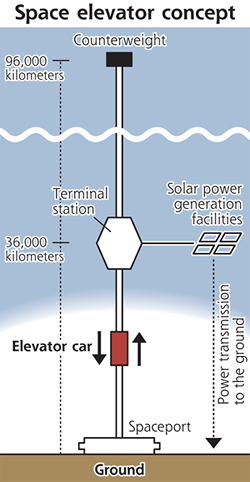
According to the The Daily Yomiuri (via Gizmodo), construction company Obayashi Corp has announced it will construct a space elevator capable of shuttling passengers 36,000 kilometers above the Earth by 2050.
 Obayashi
plans to manufacture cables for the elevator from carbon nanontubes,
which are twenty times stronger than steel. Those will extend toward a
counterweight placed 96,000 kilometers above earth's surface
(approximately one-fourth of the distance to the moon.) Passengers will
be able to reach the elevator's terminal station at geostationary height
(GEO), 36,000 kilometers above Earth's surface, traveling in cars at
200 kilometers per hour, powered by solar energy.
Obayashi
plans to manufacture cables for the elevator from carbon nanontubes,
which are twenty times stronger than steel. Those will extend toward a
counterweight placed 96,000 kilometers above earth's surface
(approximately one-fourth of the distance to the moon.) Passengers will
be able to reach the elevator's terminal station at geostationary height
(GEO), 36,000 kilometers above Earth's surface, traveling in cars at
200 kilometers per hour, powered by solar energy.
Cool enough for you? Could it happen in real life?
== An uplifting idea ==
Although there had been scribbled concepts for "towers to space" going back to Tsiolkovsky in the 1890s, it wasn't until 1959 that Russian scientist, Yuri N. Artsutanov published the counter-weighted space elevator concept known today, with a midway station conveniently located at GEO, and everything held suspended by tension, rather than compression. Subsequently, amid all the excitement over rockets, most in the west remained ignorant of the concept...
... till it burst upon us in the 1980s, with the simultaneous publication of great space-elevator novels by Charles Sheffield (T he Web Between the Worlds) and Arthur C. Clarke (The Fountains of Paradise). Since then, it has been portrayed in many other tales, like Red Mars and Foundation's Triumph.
In fact, in Red Mars, Kim Stanley Robinson vividly showed that the ideal site for a space elevator system is not Earth, where you need materials right near the edge of what's possible with the carbon bond, with a safety multiplier in single digits... but Mars, where such a device is much simpler to build, due to lighter gravity. Almost a no-brainer.
 That is, till someone sabotages it! At which point (snap!)
the part that's beyond geostationary orbit goes hurtling away while the
lower third proceeds to impact the surface at hypersonic speeds, laying
a visible equator mark, as if for a manufactured toy globe!
That is, till someone sabotages it! At which point (snap!)
the part that's beyond geostationary orbit goes hurtling away while the
lower third proceeds to impact the surface at hypersonic speeds, laying
a visible equator mark, as if for a manufactured toy globe!
Ah, sci fi. It does warn us to exercise extra care, and get it right. And watch out for crazies.
== So.... BS? or not-BS? ==
In fact, this is not the first time we've heard such an announcement and I give it less cred than the initiative from Planetary Resources, by some distance. Still, the coincidence in timing... plus a number of fascinating technologies that I saw while attending (as an advisor) the recent NASA Innovative and Advanced Concepts workshop ... lead me to wonder. Is our time of disappointment in space coming to an end?
Consider how different things used to seem. Until the launch of Voyager 2, every advance in the speed that human beings could travel fit neatly on a logarithmic curve that increased very slowly for centuries, through foot and steed to sailing and then steamship. Then overland train, automobile, airplane... an acceleration that breached escape velocity from the solar system! Projecting this curve beyond Voyager, it seemed the stars might be in our grasp within a lifetime.
Only then, the seeming irresistible force of a mathematically modeled curve met the immovable object of something called reality. The much-feared "S-curve" that crushes the fantasies of the naive... those whose simple-eager projections fuel doomed asset bubbles!
After Voyager, nothing man-made ever moved that fast again... that is, till the New Horizons mission to Pluto, just a few years ago.
Shall we forgive some dreamers for growing grouchy, during the long wasteland of the Space Shuttle era?
(Indeed, I once started writing a story with a stark premise to explain such an unlikely shift from hopeful progress to stagnation. In it, some nasty aliens negotiate a pact with President Elect Ronald Reagan - similar to the one he worked out with the Iranian Ayatollahs. The aliens would stop supporting the USSR, propping up that incompetent, thuggish state, allowing it to crumble...
...and in return, America would divert all "space" efforts, veering away from accomplishment and toward wheel-spinning. Spending lots of money but getting nothing done at all. The timing works, by the way. Certainly George W. Bush's nonsensical notion of wasting our time by going back to the sterile moon fit that lurid but snarky scenario.)
== A Resumption? ==
So is that it? Were those early dreams just fantasies? Were the Apollo landings flukes? Or evidence that an earlier generation was better, or more daring, than us?
Well now, here's the thing about sudden tech spurts and long, frustrating plateaus. You may be deluded by the spurts, but you can also get too accustomed to plateaus! In fact, as models of reality they are just as unrealistic.
 What's more accurate is to realize that Apollo was way, way premature.
Given the technology of the 1960s -- your phone has more computational
power than all of NASA had, back then -- it's amazing they didn't blow
themselves up every time. It was a perfect example of human
determination and ingenuity overcoming all obstacles of technology or
common sense.
What's more accurate is to realize that Apollo was way, way premature.
Given the technology of the 1960s -- your phone has more computational
power than all of NASA had, back then -- it's amazing they didn't blow
themselves up every time. It was a perfect example of human
determination and ingenuity overcoming all obstacles of technology or
common sense.
I have long called Apollo an example of the same phenomenon as Las Vegas -- proof that there is nothing human beings cannot achieve with enough fervid concentration of money, water... and desire.
Ironically, during the long dry period, background technology and abilities have been maturing, till now....
Why did the Planetary Resources consortium of billionaires suddenly announce plans to move ahead in steady steps toward fulfilling the dream of reaping lavish rewards from asteroid mining? Because space optics and microelectronics and communications and computers and ion drive engines have all matured to a point where dozens of their planned "Arkyd" spacecraft might be built and deployed for mere tens of millions of dollars. Crowd-sourcing some of the computation to distributed networks of millions of home computers will both reduce costs and get countless citizens involved. (I hope each participant will get a stock share!)
== Can it really happen? ==
 So are the the folks at Obayashi Corp just blowing smoke? Well... almost certainly at some level. Still, that doesn't matter, so long as we are generally moving forward, with confidence and an eager, can-do spirit.
Could it be that Clarke and Sheffield and Artsutanov had a prescient dream that might come true o n my 100th birthday, perhaps soon enough for me to take a comfy orbital elevator car ride, gentle enough for brittle centenarian bones? You gotta hope and believe that a confluence of technologies may arrive, as part of a "good singularity" wave.
Is humanity ready? I mean mentally? Well, not judging from the level of puerile responses in the comments section, under the Gizmodo report...
My optimistic solution to that obstacle? Brain boosts. Smart pills. For everybody. (oh, please!) If we can get those, without major side effects, then maybe... just maybe... those stars.
It's an amazing time. A time for us to resume being amazing. In fact, if you heed the wise advice of Zaphod Beeblebrox, you'll be getting ready to be amazingly amazing.






Comments