Banner
    Inorganic Life?
    By ... ... | September 17th 2011 09:23 AM | 7 comments | Print | E-mail | Track Comments
    About ...

    ... Now at a new blog, called The Beast, the Bard and the Bot....

    View ...'s Profile

    What is life? As tough questions come, this is a good one. It seems simple at first, but even after great advances in biology and a sizeable increase in understanding how life works, there appears to be no real consensus on life. To quote Carl Sagan:

    Yet despite the enormous fund of information that each of these biological specialties has provided, it is a remarkable fact that no general agreement exists on what it is that is being studied. There is no generally accepted definition of life. In fact, there is a certain clearly discernible tendency for each biological specialty to define life in  its own terms. The average person also tends to think of life in his own terms.

    Be sure to check this short overview of definitions of life by Carl Sagan to get acquainted with the most common ones.

    And now, Professor Lee Cronin from Glasgow University, and his team, are making matters even more complicated through demonstrating a way to make inorganic-chemical-cells, or iCHELLs (see figures 1 and 2). The idea is to create inorganic cells that replicate and evolve. These cells are built with metal-containing molecules, and through the creation of selective internal membranes, they are also compartmentalized (see video 1).


    Figure 1: Scheme showing the formation of a membranous sack upon injection of polyoxometalase (POM) solution (blue) into a solution of DIP captions (green). Insets (left) show the POM and DIP structures, and (right) an image of a sack and an interpretation of how the two components are aggregating at the interface.

    (Source: Cooper et al., 2011)


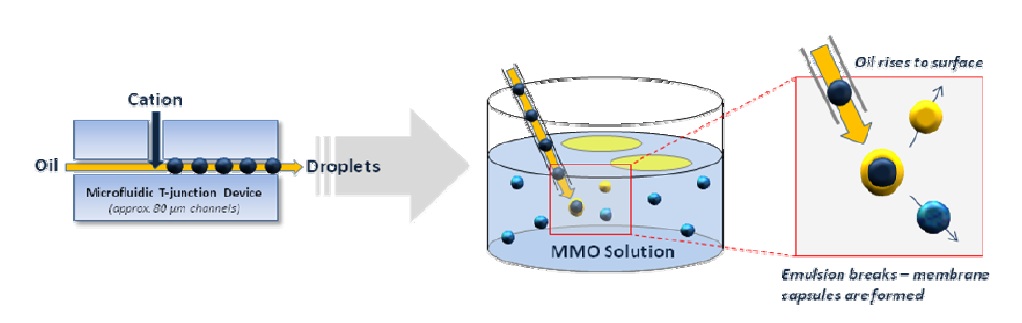
    Figure 3: Mass-production of membrane sacks ranging from 100-400 μm using a microfluidic
    device to make a water-in-oil emulsion.
    (Source: Cooper et al., 2011)


    Video 1: Creating life-like cells from metal.

    (Source: New Scientist)


    As the project continues, the team plans to show that these iCHELLs are capable of self-replication and evolution (possibly with the help of polyoxometalates, of which Professor Cronin has shown, last year in Science, that they can use each other as templates to self-replicate). Because after all, in the words of Professor Cronin:

    Bacteria are essentially single-cell micro-organisms made from organic chemicals, so why can't we make micro-organisms from inorganic chemicals and allow them to evolve?

    And here is a video of Professor Cronin explaining the project:


    Obviously, there are still hurdles to overcome. And if the team is successful, there is still the question: is this life?

    You be the judge…


    Reference

    Cooper, G.T.J.; Kitson, P.J.; Winter, R.; Zagnoni, M.; Long, D.-L. and Cronin, L. (2011). Modular Redox-Active Inorganic Chemical Cells: iCHELLs. Angewandte Chemie International Edition. Published online 8 September 2011. doi:10.1002/anie.201105068. 

    Comments

    Gerhard Adam
    The idea is to create inorganic cells that replicate and evolve.
    ... and what point would that prove?  Just like the point made about biology defining life within various specialties, it seems that people pursuing the inorganic route constantly seem to "under-define" life so that their pet "creation" qualifies (or may be considered to qualify).

    It's simply an absurd distraction and does nothing to bring about a better understanding of life or anything else.

    ... and for all those people that insist that life can be so readily created (especially in computers), I would raise this challenge.  Define not just what you mean by life, but also what you mean by death.  If the latter doesn't exist for your "creation", then neither does the former.
    Gerhard:

    "Life" is quite easy to define: "ability to self-replicate and evolve in a natural environment". So prions and viruses are alive (at least some of the time) but computer viruses are not (computer is not a natural environment). By this definition inorganic life would be alive.

    "Death" is also quite easy to define: "permanent cessation of metabolism and ability to self-replicate". And again, no problems for inorganic life here.

    Gerhard Adam
    Sorry, but your definition fails in a simple encounter with crystals, which certainly replicate and evolve in a natural environment.

    In addition, your definition of death is a bit wanting because it fails to address the issue of organization.  After all, when a large organism dies, you can't claim that metabolism has ceased for the individual cells.  However it is the larger organization that has been disrupted, so the system collapses.

    All in all, there are too many loopholes in your proposed definitions.
    "Sorry, but your definition fails in a simple encounter with crystals, which certainly replicate and evolve in a natural environment."

    They can? Then they are alive. But please, provide references for _evolution_ of crystals.

    "In addition, your definition of death is a bit wanting because it fails to address the issue of organization. After all, when a large organism dies, you can't claim that metabolism has ceased for the individual cells."

    And the problem is?...

    Individual cells might be alive (metabolizing stuff), even if the larger organism has died. HeLa cell line is a great example of this.

    Again, my definition works just fine.

    Gerhard Adam
    Evolution is simply change, and crystals change.  If you mean natural selection, then that is a different definition and illustrates the necessity of precision in terms.
    Ok, make it "ability to evolve in response to the natural selection" instead of simple "ability to evolve".

    Dude,

    I saw your presentation at TED. You're a smart guy with a bold vision and tremendous ambition...but without any computer programming at some rudimentary level, your creations will never seem lifelike.

    For example, you can push a snowball so that it rolls down a hill, growing larger and larger as it rolls and picks up more snow, and you can aim the snowball so that it (hopefully) collides with a thin tree halfway down the hill, so that it splits into 2 snowballs, each of which continues to roll down the hill and grow as it does. And you can call that "inorganic life". But it won't seem lifelike to many people.

    All living things obey some sort of internal computer programming. As a career computer programmer (and the son of a career computer programmer), I can tell you that there cannot be even the simplest computer program without some sort of programming behind it. Even the simplest computer programs consist of some form of information storage and retrieval, input/output, and conditional processing.

    Your chemicals can react to other chemicals in their environment. But unless some sort of abstract representation of that environment is stored in some sort of "memory", processed along some sort of "circuits", there will be no semblance of autonomous decisions, therefore no semblance of "life".