
Banner
    Sperm Competition
    By ... ... | June 24th 2011 06:39 AM | 9 comments | Print | E-mail | Track Comments
    About ...

    ... Now at a new blog, called The Beast, the Bard and the Bot....

    View ...'s Profile

    The term sperm competition can be used in two ways.

    In the broad sense, it involves a large range of morphological, behavioural and physiological attributes, including courtship and copulation behavior (for example, a male that guards females to ensure that he’s the father).  

    In the narrow sense, which is the focus of this article, sperm competition is used to denote the physiological processes occurring inside the female’s genital organs after multiple matings.

    (For a brief review on the complexity of sperm selection, see Wigby and Chapman, 2004).

    When it comes to sperm competition in the narrow sense, the question becomes whether it involves scramble competition (no interaction between sperm of different males, basically ‘getting there first’) or interference competition (with interaction), or a mixture of both.

    One observation that strongly supports scramble competition, is that males of polyandrous species possess much larger testis (and produce a lot more sperm) than males of monogamous ones (for example, compare chimpanzees with gorillas, see Harcourt et al., 1981). Another (really cool) observation is that sperm might even cooperate to improve the odds of fertilization, as in the spermatozoa of the wood mouse, that form ‘trains’ to improve motility (see Moore et al., 2002) (see figure 1).
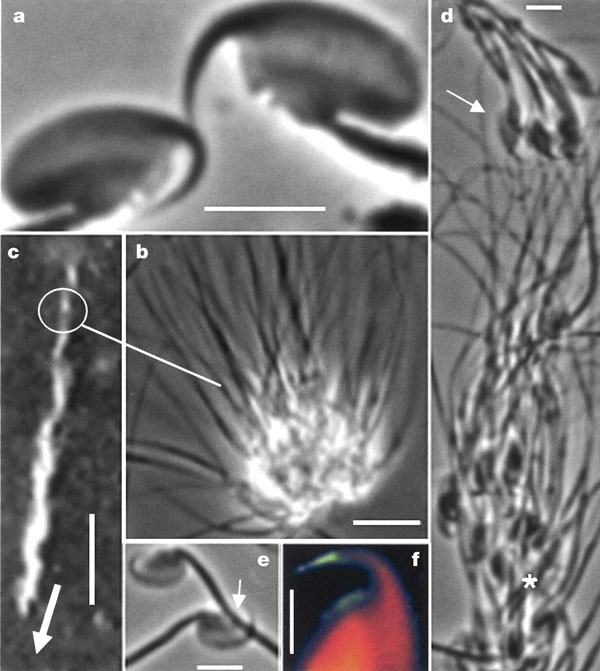
    Figure 1: 'Barbed' sperm of the wood mouse, forming 'sperm trains' (Source: Moore et al., 2002)  

    But there are indications that interference competition also occurs. Sperm polymorphism is one observation that strongly points in this direction. For example, parasperm (non-fertile sperm produced through a constant developmental process) occurs in several invertebrates (see Hayakawa, 2007). Certain snails, for example, produce parasperm that contains lysozomes, possibly used against rival sperm (see Buckland-Nicks et al., 1999) (see figure 2).
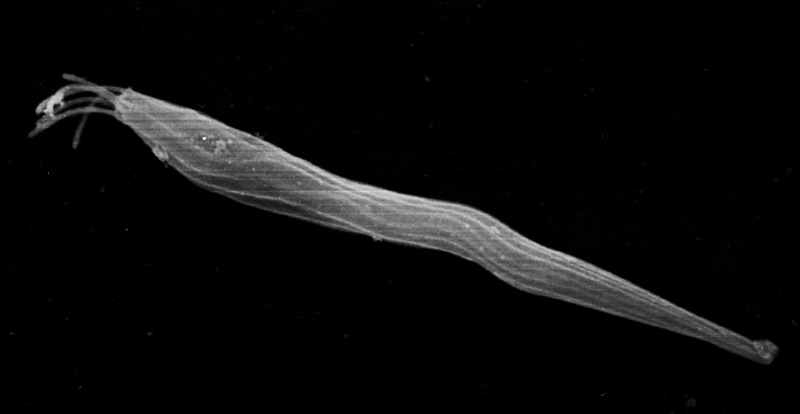
    Figure 2: Infertile parasperm of the snail species Fusitriton oregonensis. (Source: Wikimedia Commons, author: John Buckland-Nicks)

    Recently, Manier et al., 2010, have been able to catch sperm competition red-handed in Drosophila, by creating transgenic males with red and green sperm (see video).

    Competition between red and green sperm in Drosophila. (Source: Scott Pitnick, Syracuse University)

    In vertebrates, this notion is more controversial (in some fish, there seems to be sperm polymorphism, see Hayakawa et al., 2007) . Baker and Bellis (1988) proposed the ‘kamikaze sperm hypothesis’, which basically states that mammals, even humans, produce a type of sperm the acts as ‘blockers’ for potential rival sperm. This, however, is not widely accepted (see, for example, Harcourt 1991). Although vertebrates, including mammals, may produce deformed sperm, this is no evidence for parasperm as it could have arisen due to developmental anomalies. Some sperm cells might just be ‘flawed’.  So, interference competition among vertebrate sperm is still in need of empirical support. There is still a lot to learn, but further research will hopefully continue to elucidate the mechanisms of sperm competition.

    References

    Baker, R.R. and Bellis M.A. (1988). ‘Kamikaze’ Sperm in Mammals? Animal Behavior. 36, pp. 936 – 939.

    Buckland-Nicks, J.; Bryson, I.; Hart, L. and Partridge, V. (1999). Sex and a snail’s sperm: on the transport, storage and fate of dimorphic sperm in Littorinidae. Invertebrate Reproduction and Development. 36, pp. 145 – 152.

    Harcourt, A.H.; Harvey, P.H.; Larson, S.G. and Short, R.V. (1981). Testis weight, bodyweight and breeding system in primates. Nature. 293, pp. 55 – 57.

    Harcourt, A.H. (1991). Sperm competition and the evolution of nonfertilizing sperm in mammals. Evolution. 45(2), pp. 314 – 328.

    Hayakawa,Y. (2007). Parasperm: morphological and functional studies on nonfertile sperm. Ichthyological Research. 54(2), pp. 111 – 130.

    Hayakawa,Y.; Takayama-Watanabe, E.; Watanabe, A.; Kobayashi, M.; Munehara, H. and Onitake, K. (2007). Partial formation of sperm dimorphism from spermatocytes of the cottoid fish, Hemilepidotus gilberti in cell culture. Zygote. 15, pp. 285 – 293.

    Manier, M.K.; Belote, J.M.; Berben, K.S.; Novikov, D.; Stuart, W.T. and Pitnick, S. (2010). Resolving Mechanisms of Competitive Fertilization Succes in Drosophila melanogaster. Science. 328(5976), pp. 354 – 357.

    Moore, H.; Dvoráková, K.; Jenkins, N. and Breed, W. (2002). Exceptional sperm cooperation in the wood mouse. Nature. 418, pp. 174 – 177.

    Wigby, S. and Chapman, T. (2004). Sperm Selection. Current Biology. 14(3), pp. R100 – R103.(Click here)


    Comments

    Steve Davis
    A fascinating article Gunnar, thanks for taking so much trouble.
    Now I just have to digest it, as the term worries me a little.
    Steve Davis
    One problem with the term “sperm competition” is that the “broad sense” of its meaning that you explained in the intro should not come under what has become an umbrella term. These broad sense tactics would perhaps be more accurately called “mating competition”.
    Another problem is that the word “competition” is emotive; it tends to reduce the capacity for logical thought. As a result, we find in other articles on the subject, conclusions that are just not logical. For example, it’s been stated that the shape of a human male penis, and the thrusting that occurs during intercourse, have evolved to remove the sperm of rival males from an advantageous position inside the female. Utter nonsense, of the kind we see in evolutionary psychology.
    Another problem is that once a label like this is applied it seems to suggest, or rather the meaning slowly extends to suggest that sperm competition is universal, that sperm even from one male compete to fertilise the egg.
    Yet clearly, even from your brief article, sperm competition is not universal. So something else is going on.
    Then when we consider that females can have strategies in the fertilisation process, we have to look at the big picture and the primary objective here for sexually reproducing organisms must be that fertilisation occurs, and that viable offspring result.
    In the case of bonobos, the male does not care if he is ultimately the father; his only concern is to ejaculate. But for the good of the species (how my keyboard trembled at that!) it does matter that the fittest offspring are produced. The fact that males with the largest testes produce the most offspring is surely not the end of the story. It’s likely that this trait is linked to other traits that confer greater fitness.
    So a general criticism of the term “sperm competition” is that it is reductionist. It tends to reduce the processes so that we can’t see the forest for the trees. If, as I’ve argued elsewhere, the purpose of life is to produce or nurture life, then all of these varied activities must be viewed with that in mind, so that what we are seeing is life at work in all its messy glory. Therefore, to view it only as the attaining of individual wants is to obscure reality.
    Bonny Bonobo alias Brat
    In the case of bonobos, the male does not care if he is ultimately the father; his only concern is to ejaculate.
    Aren't all males like this? Why pick on the bonobos?
    Make love not war
    Gerhard Adam
    It's not "picking on them" if it's true.... and no, all males are not like this, since clearly the same criteria doesn't apply to humans (as a simple example where paternity does matter).
    Bonny Bonobo alias Brat
    OK, so a few species like humans, lions and chimps exhibit some behaviors that imply that they are also concerned about paternity of the offspring, but it seems to me that the majority of males of most species including many humans, seem to be primarily concerned about achieving their next ejaculation.

    According to this article it is only recently with DNA testing that up to 30% of men who have arranged DNA tests have discovered the paternal discrepancy' that they were not the father of their partner's children, prior to that all they could do was have suspicions and maybe divorce the partner, this wouldn't necessarily stop them from being primarily concerned about their next ejaculation though :-
    a stark increase in paternity testing in the United States has spurred a phenomenon known as paternal discrepancy. “In the United States, rates [of paternity testing] more than doubled to 310,490 between 1991 and 2001" (Reinberg, 2005, qtd. Bellis, 2002, p. 1). That this statistic has been increasing significantly indicates that paternal discrepancy, or “...when a child is believed to have been fathered by the husband [or partner] but is actually the progeny of another man,” (Bellis, Hughes, Hughes,&Ashton, 2005, p. 749) is becoming a pervasive familial conflict that may very well be hard to diagnose. In the Journal of Epidemiology and Community Health, Mark A. Bellis et al. (2005) report that “…rates vary between studies from 0.8% to 30%...” (p. 749). That fathers have this need to believe the child to whom they are devoting their resources is their own biological progeny is a facet of human nature that has fascinated evolutionary psychologists for decades.
    Make love not war
    Gerhard Adam
    That statement is just foolishness and is based simply on your own personal beliefs about men and has nothing to do with biology.  You're confusing sex with paternity.  Most men are very much concerned about paternity which is precisely why paternity testing exists in the first place.  Among many animals species, it is even more critical.  Your statistic demonstrates nothing except that despite the protestations of many females, as a group, they don't demonstrate any great commitment to fidelity.  In short, the only point you've made is that 30% of females aren't to be trusted.

    In addition, the quote from the article that says "fathers have this need to believe" is condescending rubbish. 
    Bonny Bonobo alias Brat
    Gerhard, I don't what world you are living in but most animals aren't even capable of thinking about the concept of whether they are the fathers of some offspring and most men here in Byron Bay couldn't give a damn about producing offspring either, they want to ejaculate! Just because its something that you personally are very concerned about doesn't mean that it applies to the majority of males in this world. Look at any male of any species in any courtship activity and you will see a male that is primarily trying to ejaculate into a female orifice, unless he's gay of course.
    Make love not war
    Gerhard Adam
    I don't what world you are living in but most animals aren't even capable of thinking about the concept of whether they are the fathers of some offspring
    OK, let me spell it out for you simply.  Any animal that is involved in rearing young, where the mates stay together is definitely interested in paternity.  That's the biological basis for the rituals and habits they have "evolved".  No, that doesn't mean that such animals are agonizing over whether their mate is faithful or cheating.  However, the fact that you seem to think that conscious awareness and abstraction are requirements before paternity is relevant in animals, simply illustrates that you don't understand biology any better than you understand quantum mechanics.  The rest of your statement is sexist and stupid.
    Steve Davis
    Helen, Gerhard is correct, but the only reason I mentioned  bonobos was that they get mentioned often in articles on this subject and I "misremembered" Gunnar's reference to chimps and gorillas. Sorry about the confusion.
