

Banner
    Are Environmental Issues Piling Up or Slowing Down?
    By David LePoire | December 3rd 2011 07:02 PM | 4 comments | Print | E-mail | Track Comments
    About David

    Dave explores the connections between energy, the environment, and technology. He currently works at a U.S. national laboratory on a variety of environmental...

    View David's Profile
    Energy use and environmental sustainability are deeply entwined. The impact of environmental degradation has been an important factor in the development and decline of civilizations. It has been suggested that many agricultural societies collapsed by overextending their reach for resources, including energy. Most of the case studies focused on agricultural societies because of their simplicity relative to industrialized societies. It is important to take a look at recent connections between energy and the environment to see if we are following the paths of these simpler societies.

    In the 20th century, three key environmental issues arose at different times and different political scopes: (1) the sanitary phase of rapidly growing urban centers in the early 20th century; (2) national concern with clean air and water with action peaking in the early 1970’s; and (3) international concern over trans-boundary issues (e.g., wildlife) and atmospheric release (e.g., chlorofluorocarbons, sulfur dioxide, and carbon dioxide) with treaties peaking in the mid 1990’s. (see figure below). These phases of environmental activities seem to indicate a pattern of periodic interest as technologies are developed, environmental problems arise, and social responses are formulated. However, throughout the 20th century the time between these phases decreased while the time to resolve each phase increased. Continuing this pattern would be unsustainable as the environmental problems would continue to pile up without satisfactory resolution (Scenario 1 in the figure below).
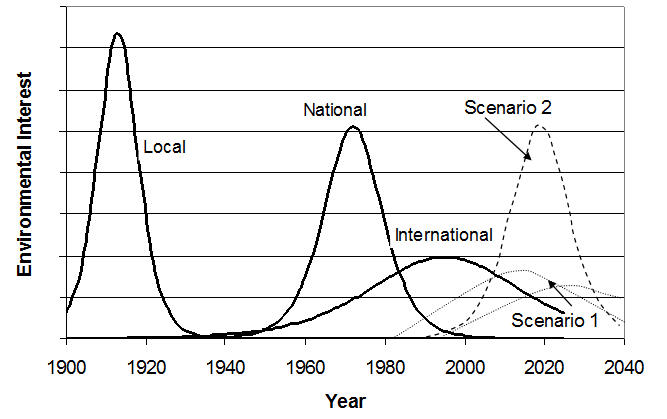
    This leads to questions concerning ways of understanding waves, their connections, and their directions. Specifically, what is the next environmental phase and how will it’s resolution be organized? A prediction based on an “S”-curve learning trend is that new issues, such as global climate change, trade, inequality, and environmental degradation, need to be addressed at a quicker pace as the world population and energy demand increases. This would lead to the next environmental phase peaking in just over another decade (Scenario 2 in the figure).

    What might be next? There are many dimensions to be considered, including new technologies, better understanding, new governance models, and new levels of environmental complexity. For example, new technologies, include combinations of genomics, robotics, artificial intelligence, and nanotechnology, which offer both potential environmental benefits and risks. Better understanding can be gained by making measurements, constructing models, and viewing the issues as part of a larger ecological and economic system. Better governance models might include longer-term robust strategies that include considerations of uncertainties but are periodically reviewed as new information becomes available. New levels of environmental complexity can be identified as limits of energy and food production are approached and integrated into a sustainable system.

    A critical factor for determining which scenario is realized is the relative rate of technology development compared to the social response. Possible leading indicators of the next period of environmental interest include new social mechanisms such as the incorporation of environmental impacts in economic accounting and the responsible development of new technologies.


    Comments

    Hank
    You make fine points, though the social mechanisms tend to kill business when they outrun the technology - increased accounting is another punitive measure for current technology without anything meaningful happening to alternatives.  There aren't really any instances where that worked. It was something of a victory for janitors at car companies to get $50 an hour, for example, a great social mechanism win, but now most of them have no jobs, so it was a loss in the real world.

    The opposite - subsidies of alternatives - haven't worked either.  People clearly can't be forced or bought off into embracing bad alternatives. Anyone who has bought a crappy Energy Star dryer probably knew they were being lied to and their electricity bill would not go down, but they had little choice and now it takes longer to dry their clothes but it hasn't helped the environment.
    Want more no-nonsense, independent science? Buy Science Left Behind
    dlepoire
    Good comments. Although I think that sometimes incentives, positive or negative can be helpful. Yes many do not work, but an incentive designed correctly should lead to reduced externalities (e.g., pollution) or to encourage the progress along a learning curve, e.g., a learning curve for solar energy production. In this sense the research is being done by the private industries to figure out how to drive costs down to be a viable business when the subsidy is removed. As you point out htere is trouble if the business never matures or the subsidy is not removed. Your comment about clothes dryers might apply to brands advertised as energy efficient or matched with an energy star washer, but the current decision has been to not place Energy Star ratings on dryers.
    DaveL
    Gerhard Adam
    In my view the problem is more fundamental than that.  We already have too many unintended incentives in place.  Every time we grant a tax break or subsidize an existing industry, we undercut the ability of new innovative competitors to enter the market.  When we depend on existing businesses to develop the models that will take THEM into the future, we are undercutting innovation.

    We don't need incentives, we need to remove the protections that shield existing corporations from the new upstarts and entrepreneurs that will provide future solutions.  The status quo cannot provide answers.  They are too entrenched in existing business models and are simply looking to replicate the same profit models they've come to rely on.  We need to begin exacting the true costs of energy production and removing the obstacles for new businesses to get started so that the opportunity for new ideas has the potential to be realized.

    Corporations do not produce new solutions nor jobs.  They are the albatross around our necks and as long as we keep protecting them, they will eventually drag us all down.  We need to support the entrepreneurs, by removing obstacles to their success (especially those that are thrown there by large corporate competitors that don't want to see them succeed).
    UvaE
    Anyone who has bought a crappy Energy Star dryer probably knew they were being lied to and their electricity bill would not go down, but they had little choice and now it takes longer to dry their clothes but it hasn't helped the environment.

    We gave our 1989 dryer to my mom who keeps wondering how an old dryer can work so well...Easy it's not an Energy Star!
