Photo Shoots that Should Never Be Done
I'm sure I'm not the first to blog about this, but while I was out of the loop for a few days, someone made another hopeless attempt to make nerds look cool: Rock Stars of Science.
Here's what it's about:
The Rock S.O.S campaign idea was generated in part by a recent Research!America public opinion poll finding: 74% of Americans can’t name a living scientist. ROCK S.O.S aims to bridge that recognition gap.
I'm a G-protein coupled receptor (GPCR) fan, and all of you should be too. Most drugs, from pot to tylenol, act on G-protein Coupled Receptors. The pharmaceutical industry would be helpless without them.
For a quick primer on GPCRs, you can try to decipher this picture:
Twitter, the newest social networking sensation, can generate sales leads for your business faster than other social network, even with a slashed budget, says David White, Founder and Chief Executive of Weboptimiser and he says he can tell you how your company can benefit from it when he presents his webinars in July. He says Twitter is generating up to half the hits on his company’s website.
After a big kerfuffle in March over whether a researcher violated a confidentiality agreement with JAMA, the journal has eased off a bit with an editorial laying out the new policy for reporting conflict of interest.
As I noted in a post in March, Dr. Jonathan Leo alerted JAMA editors to a conflict of interest in an article published last year, which JAMA addressed several months later in a correction and apology published this spring.
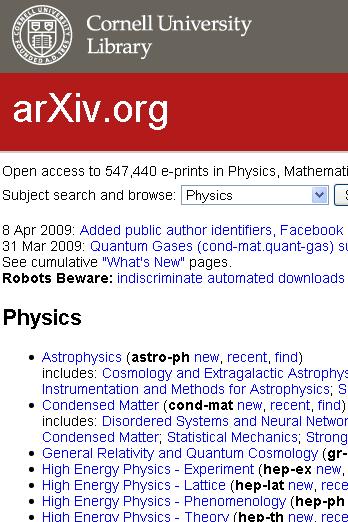
The Arxiv is an online repository of scientific papers in physics, astronomy, maths, cosmology, computer science, and a few other topics, where papers due to be published on scientific journals are submitted by the authors, and become quickly accessible for free to anybody before the peer-review process ran by the journals is over and they get printed there.
This is my course assignment of Evolutionary Ecology of Stockholm University,Sweden in the year of 2009.
Abstract
Specialization character of phytophagous insects is one of the key examples of insect-plant relationship. Host specificity of insect is required for their larval development. Several factors like trade-off, characteristics of host plant, insect’s neural system are responsible to an insect for becoming a specialist. Though specialization character of phytophagy increase the vulnerability towards extinction, still insect tense to be specialist for protecting themselves from natural enemies, getting the microclimate facility and boost up the survival rate of their offspring.
Scientists have discovered the gene behind Recessive Omodysplasia, a rare skeletal disease characterised by short-limbed dwarfism and craniofacial anomalies. The work, just published in the American Journal of Human Genetics, reports the identification on chromosome 13 of a gene - GPC6 – that is shown to be crucial for normal bone development.
The research will allow a better comprehension, as well as prevention, of the disease by permitting the screening of potential mutation carriers in pregnancy but most importantly will also help to understand better bone development and its molecular bases.
Nothing makes biologists happier than psychologists declaring things a product of evolution. Now it turns out even social constructs like 'taking turns' have gotten some benefit from evolutions' 'invisible hand'.
How so? It spans across species so it must be evolution, say University of Leicester psychologists professor Andrew Colman and Dr Lindsay Browning, who carried out the simulations due to appear in the September issue of Evolutionary Ecology Research which they say helps explain the evolution of cooperative turn-taking.
If you've read your history and wondered about when the next Ice Age is coming, you can thank global warming it hasn't happened. But it could be worse. Earth's 4.5 billion years have seen several instances where temperatures changed dramatically, like in life ending ways, along with asteroids bombarding the planet and any number of species going extinct without a single activist to hunger strike for them.
But one of the biggest moments in Earth's lifetime is a positive one - the Cambrian explosion roughly 540 million years ago when complex, multi-cellular life burst out all over the planet. Scientists can pinpoint this pivotal period as leading to life as we know it today but no one is sure what caused the Cambrian explosion of life.
The news that Newcastle University researchers have used embryonic stem cells to create human sperm under laboratory conditions has led to a lot of questions; like, who will television commercials make fun of if all men are gone?
In the technique developed at Newcastle, stem cells with XY chromosomes (male) were developed into germline stem cells which were then prompted to complete meiosis - cell division with halving of the chromosome set. These were shown to produce fully mature sperm called In Vitro Derived sperm (IVD sperm).
Rising levels of smokestack emissions from oceangoing ships will cause an estimated 87,000 deaths worldwide each year by 2012 — so more than heat wave deaths in French elderly people in 2003 while French young people protested much fewer deaths in the American invasion of Iraq but far less than the nearly 15,000,000 who die annually from cancer.
And it's almost one-third higher than the previously claimed 60,000 deaths but, like many things in pollution-related deaths, accurate numbers are hard to pin down. You take some sample data and you extrapolate.
If nanotechnology has a dream future, it is self-assembling and self-organizing systems - something nature has been producing for millions of years.
A team of scientists has examined how thousands of bacterial membrane proteins are able to assemble into clusters that direct cell movement to select chemicals in their environment and they say their results provide valuable insight into how complex periodic patterns in biological systems can be generated and repaired.
The Swan Nebula, also called the Omega Nebula because when seen through a small telescope the nebula has a shape that reminds some observers of the final letter of the Greek alphabet, omega, while others see a swan with its distinctive long, curved neck, is a dazzling stellar nursery located about 5500 light-years away towards the constellation of Sagittarius (the Archer).
Don't feel left out, lawn games and crustaceans, it is also called the Horseshoe and the Lobster Nebula.
No matter its name, it is an active star-forming region of gas and dust about 15 light-years across and has recently spawned a cluster of massive, hot stars. The intense light and strong winds from these hulking infants have carved remarkable filigree structures in the gas and dust.
The Young People's Development Programme (YPDP) in England, a government-backed youth development pilot program aimed at reducing teenage pregnancies, drunkenness and cannabis use not only didn't reduce teenage pregnancies or drunkenness or marijuana use, it might actually have increased pregnancies, according to research led by Meg Wiggins of the Institute of Education, University of London and Chris Bonell at the London School of Hygiene and Tropical Medicine.
They were commissioned by the Department of Health to carry out an independent evaluation of the YPDP, which was initiated in 2004.
This priceless little pearl of wisdom comes from a graph called the Laffer Curve. It is based on the premise that there is a critical point of government taxation where taxes become counter-productive and therefore reduce the flow of revenue into federal coffers. This has become a favorite pronouncement of politicians since they can lay claim to wanting to lower taxes and still raise federal revenues.
Before we start I want to be clear that I am not making predictions, nor advocating any particular solution, since that would only be speculative on my part. Instead I am simply reviewing what is supposed to be a part of modern economic theory to see what it tells us.
Who hasn't thought about starting a food fight at a formal dinner function? Telling your interviewer about some embarrassing personal story? The worst thing to do at the wrong time? And then the internal fight starts: "The impulse increases to a wish, the wish to a desire, the desire to an uncontrollable longing," says Poe, as quoted in the NY Times Science Tuesday article on why the imp in your brain gets out.
I have pondered writing about the transhumanism movement for a while, and the opportunity has finally landed on my desktop when I read a brief article by Kyle Munkittrick of the Institute for Emerging Ethics&Technologies. The article is in the form of a FAQ expressly addressing the question of whether aging is a moral good, and in it Munkittrick briefly explains and (thinks that he) refutes some of the standard arguments against transhumanism. Let’s take a look.
Based on a number of queries on basic structure design, settlement protection, and settlement operations.
Firstly, the entire colony does not need to be entirely of domes. Domes can be used for the living habitat for settlers, the forest, and for agriculture, where there needs to be an element of 'openness' and efficient supply of sun light. For industrial and storage units, simple match-box like structures with slanting sides can be used to save on material and simplify structure assembly -- any automatic, non-labor intensive units don't even need to covered with glass at all! You can give it a continuous case like form. Glass is gonna be expensive.