




That was the fastest pitch ever recorded.
Yet last season over 50 pitchers in Major League Baseball threw 100 MPH and 140 more hit that velocity in the minor leagues. In September of 2010, Aroldis Chapman threw 105.1 MPH. Clearly, pitchers have gotten a lot faster, due to superior training and better scouting identifying athletes who will excel at pitching and getting them to play baseball rather than basketball or something else.
Unless they haven't. Across eras, pitches have been clocked three different ways; when Ryan set his record, a radar gun measured the ball velocity at or near home plate. The Speedgun measured closer to the plate than the JUGS so pitchers measured by JUGS had faster velocities, and the Stalker in the 1990s measured even closer to the pitcher rather than the plate so it read pitchers as faster than both of its predecessors. In 2006, those made way for the PITCHf/x camera-based tracking system, which measured velocity 50 feet from the plate, and in 2017 Statcast began measuring velocity as it leaves the pitcher's hand.
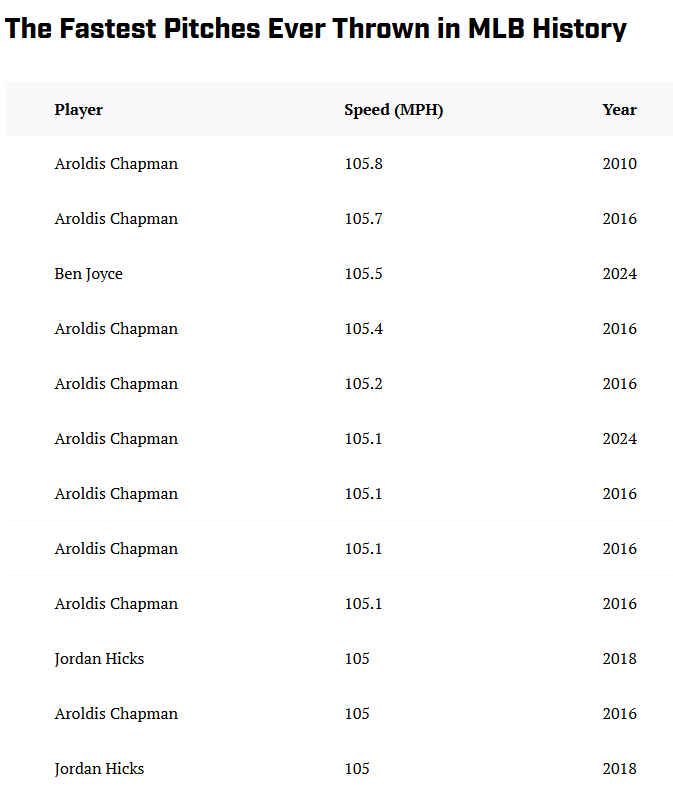
This Sports Illustrated 'fastest pitches' graphic all show one important thing in common; the closest they measured to the plate was 50 feet away. Which means we are not getting the real story of pitchers than and now.
At the pitcher's hand, 50 feet from the plate, and at the plate are three different velocities because of the laws of physics. When Nolan set his record, his velocity was just under 148 feet per second when it arrived at the batter. Since the mound is only 60 feet and 6 inches from the plate, you can imagine how fast it arrived to someone who has to decide if it is a strike or a ball, if it is inside or outside or that belt-high middle-in location we all love to jump on. Ryan was not getting the modern measurement benefit of less air resistance, gravity and deceleration of one mile per hour every seven feet. But hitters feel better. A pitch recorded at 100 today could 'only' be moving at 133 feet per second when it reaches the batter. A lot more manageable than when Ryan threw, where I would've just taken my three swings and been grateful he didn't put on in my brain pan.
Due to physics, a ball could lose up to 10 percent of its velocity by the time it crosses home plate. A 100 MPH fastball recorded when Ryan pitched would be clocked at around 91 today. Which means Ryan's pitch measured from the hand by modern systems would be a whopping 108 MPH.
Players recognize that, as Tim Salmon states here:
"When you're seeing velocities at 95 [MPH] today, those aren't velocities at 95 we saw."
— HaloTerritory (@HaloTerritory) April 16, 2026
Tim Salmon talks about the difference in how velocity is tracked, and how it may be misleading when comparing eras. pic.twitter.com/4PFttxvGi4
The three pitchers who averaged 100 MPH last year are obviously great, but at their fastest are not Nolan Ryan fast. The real question is how 'country strong' Ryan had to be to do it. In experiments, Glenn Fleisig, a biomechanical engineer, subjected cadaver elbows to increasing rotational force and found that the average ulnar collateral ligament (it connects the the humerus and ulna in the elbow) snaps at about 80 Newton-meters.
Which is also the torque on a pitcher's elbow when they throw at a velocity in the upper 90s. An pitcher in the major leagues is already doing what would destroy a normal person's arm. Which means we should start a petition to get Nolan Ryan to donate his elbow to science.
Are pitchers faster today overall? Certainly, and that is due to far better conditioning and copious amount of money that make it worthwhile not to sell beer in the offseason. But it is hard to imagine anyone has beat Ryan, or perhaps ever will.




Comments