

Banner
    Are Artists Born Or Taught?
    By News Staff | August 19th 2007 11:00 PM | 13 comments | Print | E-mail | Track Comments
    In 17th century Rome, the Baroque painter Orazio Gentileschi gave all his children the finest art education available. But only one of them—his daughter Artemisia—developed into an artist. In fact, Artemisia matched and surpassed her father's skills, and became the first female member of the Academy of Design in Florence and the only woman to follow and innovate upon the tradition of painting established by Caravaggio.

    What creates a great artist like Gentileschi, Van Gogh or Manet? Talent or training?

    Artists are both born and taught, says Nancy Locke, associate professor of art history at Penn State. "There is no question in my mind that artists are born," says Locke. Many artists arrive in the world brimming with passion and natural creativity and become artists after trying other vocations. Before he had devoted himself to art, Van Gogh tried to be a minister among poor miners in Belgium. "He just frightened and overwhelmed people," says Locke. "He was too intense to act effectively in that capacity."
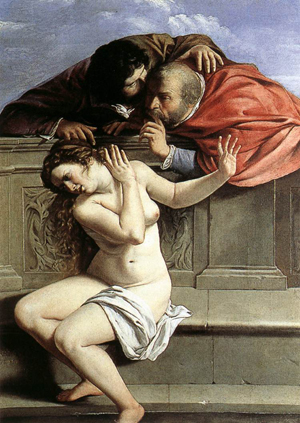

    Susanna and the Elders by Artemisia Gentileschi Web Gallery of Art/

    Artists are also made, she says. They require training, education and a culture of other artists, often an urban culture, says Locke. "Put an artist in isolation and nobody can learn anything from the work." A craftsman masters a skill, but an artist ventures beyond to innovate. "Artists have to be in touch with other artists, building on what other artists have done," says Locke. 

    Artists must learn a tradition to challenge it, so artists are products of their times and context, both artistic and social, she adds. Like natural talent, the vision is innate. Yet the way that vision comes to fruition depends upon the artist's time and place, the surrounding artistic tradition, training and life experience.

    "You can take an artist who doesn't have the visionary quality of a Manet," Locke notes, "someone who really wants to be an artist and is less talented and that person can be a follower, can be a technician, can learn a craft and can turn out something that looks like an Impressionist painting. But that person will never have the vision of a Seurat, Van Gogh or someone who's a real innovator."

    Yet, says Locke, Manet's art, which challenged the Renaissance works and sowed the seeds of Impressionism, owes as much to his environment—his particular time and place—as it does to his inborn talent. "If you take Manet away from Paris in the late 19th century, if you stick him out in the woods somewhere and nobody sees his art, it wouldn't be very important. It's important because other artists and critics made it important."

    The necessity of both natural-born talent and societal influences in shaping an artist rings true in the life of Artemisia Gentileschi, she adds. In the early 17th century, women were not allowed to attend all-male art academies and could only become artists if they learned fundamental skills privately, usually from a relative or through lessons.

    At age 18, Artemisia Gentileschi, a promising young painter, was initially denied entry into all-male professional art academies. As a result, her father hired the Tuscan painter Agostino Tassi to privately tutor her, but after Tassi raped her, Artemisia endured a painfully humiliating public trial—including being tortured to test if she was lying—that resulted in Tassi's one-year prison sentence.

    Gentileschi's talent, Caravaggio's technique and her life experience is all apparent in her work. Susanna and the Elders, for example, illustrates the Biblical story of a virtuous woman who is sexually harassed by village elders. "If you're a woman and you've been taken advantage of the way Artemisia was, you have a sense of the vulnerability of Susanna. That's a very different approach that comes out of life experience."

    Gentileschi's painting, Giuditta che decapita Oloferne (Judith beheading Holofernes) (1612-1613), depicts the Biblical heroine Judith and her handmaiden gruesomely beheading the Assyrian general Holofernes. The painting is widely interpreted as Artemisia's revenge for the violence she suffered.

    Perhaps her success was her greatest revenge. She moved to Florence and became the first female painter to enter the city's Accademia del Disegno. She became known for her paintings of biblical heroines and for mastering the contrast of light and dark.

    Yet, despite Gentileschi's artistic success, she could not pass on her gift. Although she taught her two daughters to paint, there is no evidence that either of them became an artist.

    —Lisa Duchene

    Reprinted with permission from Penn State University: http://www.rps.psu.edu/probing/artist.html

    Comments

    Torchwood
    This is a double entendre or double-edged question. An artist is clearly born, he is an animal that grows into his skin - but the question is are his skills innate in his genes ... or is the artist born into a pair of genes (like when one puts on a pair of jeans) and uses the body he is born into the skin he grows in - to reveal his art. Some artists are clearly taught, any art or science is taught or learnt at schools (even today) ... even Masters learnt their Art day by day But where the inspiration or the innateness of original thought comes from - well it would be ilogical to claim original thought was genetically inherited, would it not. Anything new whether genetic mutation or thought is added to the (or innate) information held by previous genes. Are the children of vegetarians 'born' vegetarian?
    Hank
    It was a discussion article more so than anything that could lead to closure, that's why we asked to reprint it from the Penn State author.

    I had artistic ability before I ever knew my father did. He never painted or drew anything when I was young but he turned out to have been a pretty good artist and took it up again after I did as a boy. Go figure.

    Bonny Bonobo alias Brat
    I might not agree on some things with you Hank, but one thing is for sure, you do have great artistic ability. Your sketches that I have seen so far are excellent. Are you still sketching and do you exhibit anywhere?
    Hank
    Thanks.   At Christmas I do custom Christmas cards for the kids in my family (Spider-Man, characters on TV cartoons, etc.) but otherwise I never do anything.  I learned early on my style of 'art' was incredibly unpopular in the larger art world, where abstract and performance and modern were the rage.  Other than things I did with a #2 pencil on a piece of paper and later scanned in, I don't have any art.
    Torchwood
    Hi Hank, that's why I thought I'd comment. Increasingly we are attributing more and more to the genes, and not withstanding whether we all evolved from the same gene pool, or whether gene pools spontaneously sprouted hither and dither ... it is clear we all inherit certain attributes - 'mortality' a predisposition to shortsightedness, baldness or whatever other genetic facyors we can and do inherit. However despite our best attempts to nurture political or pseudo-religious thought, these are clearly not always inherited or adhered to. One could of course say well someone in the family was a painter or a musician, or a mathematician or a magician - in fact it would be odd for a family where no member had ever displayed some skill and ability or craft ... though of course there is only so much room in the world for revered Old Masters or idolysed baseball heroes and rock stars. However, I was touching on a more subtle area - when the child is born and starts to grow into his skin, distinguish colour and light, start to focus and reach within his grasp - of course all within the 'physical' limits of his physical & mental (brain) capacity. I'm always drawn to the story of the 'ugly duckling' finally realising it is a swan. To all intents and purposes the mind seems to need to realise what it is born into, whether it's a cat or a dog, whether it's a cow or a horse, and then even among humans whether it is male or female ... A carpenter's son does not always a good carpenter make. And a doctor's or surgeon's son does not always a good brain surgeon make, though no doubt he/she will have access to that path, and if he/she chooses that path many doors will open. But then again a carpenter's son may become the next brain surgeon or nobel laureate, and the surgeon's son may become the next builder of eco-homes, or design crafted kitchen cabinets. All in a day's work. All Art in it's own way.
    Gerhard Adam
    I think we need to be careful in what we mean when we use the term "artist".  It is clear that we can't inherit someone's thoughts, although we can obviously be influenced by them as we grow up.  However, there is more to art, music, science, etc. than merely a raw skill.  No matter how coordinated one becomes, there is no assurance that a musician will be produced that could be considered an "artist".  In effect, the artistic quality we're describing is a way of viewing the world and having the ability to translate that view into a particular representation.

    This could involve painting, where it seems that an artist "sees" differently than others, just as a musician "hears" differently than other people.  Certainly training would be required to refine the raw skills, as well as providing challenges that could lead to improvements.

    However, in the end it seems that we simply gravitate to what we enjoy and then if we possess the skills to express that viewpoint, we will have found an "artistic" calling.  I would agree that it presumes much to expect genetics be sufficiently repeatable so that artistic abilities were directly heritable.  It would seem that the one universal trait that all artists share (regardless of how their artistry is expressed) is a sense of passion for what they like.  That cannot be taught.
    Hank
    That's a good point.  I have played guitar for 30 years yet I can't consider myself a musician - I am technically competent enough but thousands of kids in Korea put videos on YouTube far better than I have ever been so raw skill is not the end of it.

    But doesn't your description invalidate YoYo Ma and every musical virtuoso, since they are merely repeating the work of composers and not really creating anything new, just like if I were to become great at making copies of Rembrandt works?
    Gerhard Adam
    Isn't that why we distinguish them by terms such as "virtuoso" rather than "artist"?
    Gerhard Adam
    Of course, there are virtuosos that are so phenomenal that they may be considered artistic just because of their physical skills.
    Aitch
    Passion

    Abso-blooming-lutely!

    That can't be taught either....maybe alluded to, but like true art, it comes from within

    There maybe passion in a lot of people, but few seem to hold onto and truly express it in a way which inspires others in vast numbers, and it is that which is often mistakenly described as art

    The inspirational passion is true beauty, whether as art on canvas, as music, as a carving, a sculpting, or in language, as poetry, novel, or spiritual tome

    I love passion, passionately ;-)

    Aitch
    This is an important question, and in part by the formation of the question itself. It appears to refer to "great artists". On the other hand, and this is the thing that is really pregnant, and wanting in our star-dominated culture, everyone is, after a fashion, an artist of their own living and in their areas of skill and developed expertise, no matter how small. (Interesting that the great pianist Claudio Arrau said that every talent has something to offer, no matter how small). In this sense, everyone is born an artist. This conception of artistry is way at the other end of the spectrum, I realize.

    The question bout "born or taught" leaves out all sorts of dimensions, in any case. The matter of the formulation of the hypothesis is important. I think it is highly possible that there are quite simply rare configurations of potentially quite normal cognitive/procedural operations that we may barely be able to formulate that can lead to exponential productive ability of the kind that could lend to dialogue with "great artists". Furthermore, even the attainment of the status of "mere technician" is no small accomplishment, and to be able to transmit, transfer, engender or produce in the average learner something of the ability which, in this frame of reference, would amount to the "merely good" would be a spectacular attainment, as in the transferring of a greater ability to read or learn mathematics, communicate, attain emotional competence, etc.

    It is worthwhile to work at the ways of hypothesizing here and not presume that we have begun to ask this important question nearly as well as it can be asked.

    Amateur Astronomer
    Exceptional parents tend to produce average children. That’s why the Eugenics movement failed. Extreme measures couldn’t rescue it. Now the name of Eugenics is an icon for cruelty and incompetence. The corollary is that average parents can produce exceptional children. Then the artistic results depend on how the potential is developed. Potential can be born, but very few babies create great art. Abilities are developed one way or another from the potential.
    Bonny Bonobo alias Brat
    Can someone explain to me why this has been the no. 1 article for so long?

    Add a comment

    The content of this field is kept private and will not be shown publicly.
    • Allowed HTML tags: <sup> <sub> <a> <em> <strong> <center> <cite><TH><ul> <ol> <li> <dl> <dt> <dd> <img> <br> <p> <blockquote> <strike> <object> <param> <embed> <del> <pre> <b> <i> <table> <tbody> <div> <tr> <td> <h1> <h2> <h3> <h4> <h5> <h6> <hr> <iframe><u><font>
    • Web page addresses and e-mail addresses turn into links automatically.
    CAPTCHA
    If you register, you will never be bothered to prove you are human again. And you get a real editor toolbar to use instead of this HTML thing that wards off spam bots.


