

Banner
    Does Open Access Lead To More Quality Citations? The Data Says ...
    By News Staff | October 18th 2010 12:30 AM | 4 comments | Print | E-mail | Track Comments
    If you like to read science studies you are most likely to get them through one of two avenues; the long-standing business model has been that a print journal gets the study and does the work formatting it and lends their 'goodwill' to it with marketing - in return, they hold copyright and subscribers pay to read it.   A more recent approach has been companies that instead charge the scientists to publish the study but reading it is free - open access versus toll access, proponents claim, though in a practical sense someone is either paying to read or someone is paying to publish.

    The recent trend toward even greater government funding of science studies has led to calls for more open access, since it seems unfair that taxpayers should have to pay private corporations to read taxpayer-funded studies(1) and Pres. Bush signed a law making steps in that direction, though not without a Democrat trying to squash the movement but, outside a core group of advocates, the big question has been whether or not the pay-to-publish model has as much credibility where it counts as traditional journals - citations and impact.  Open access as a cultural mantra is fine but at the end of the day, researcher performance is valued, measured and rewarded by how much their work contributes to further research by other scientists and scholars.

    Do open access studies get more quality citations, and if it were to follow that studies that are free-to-read get more citations and have an advantage, why not make them all open access?

    A new study published in an open access publication, PLoS One, set out to determine whether or not open access articles were cited more just because anyone could access them or because articles more likely to be popular were made open access; self-selection rather than a causal benefit.  

    According to the 'self-selection bias' hypothesis, open access articles that seem to have greater impact may be an artifact of bias on the part of authors toward making their better, and thus more usable and citeable articles, open access to boost that result. If the open access advantage is self-selection bias, then making all research open access is a non-issue and pay-to-publish and toll access journals can co-exist in a capitalist world without issue.

    A team from the University of Southampton's School of Electronics and Computer Science (ECS) in the UK and l'Université du Québec à Montréal in Canada set out to find some answers.   

    They analyzed all articles that were made open access at the four first institutions in the world to make self-archiving mandated, the University of Southampton School of Electronics and Computer Science,  CERN, the University of Minho and Queensland University of Technology, and compared their citation impact with control articles, in the very same journals and years, from un-mandated institutions, that were made open access by author self-selection or not made open access at all. The open access impact turned out to be basically the same whether open access was self-selected or required by institutions.

    The results also showed that the percentage of an institution's yearly research output that is made open access self-selectively varied between 5% and 25%, whereas the percentage when open access is mandated jumped to 60% and climbed toward 100% within a few years of mandate adoption. 

    The conclusion of the study was that the open access impact advantage is real, and caused by the greater accessibility of open access articles, but that open access mandates are also the way to make all research benefit from the greater likelihood of being used and cited that open access provides.    The good news for legacy publishers is that 
    higher-impact journals had a substantially greater open access benefit than lower impact open access journals - so reputation still counts, especially with 25,000 peer-reviewed journals competing for attention.
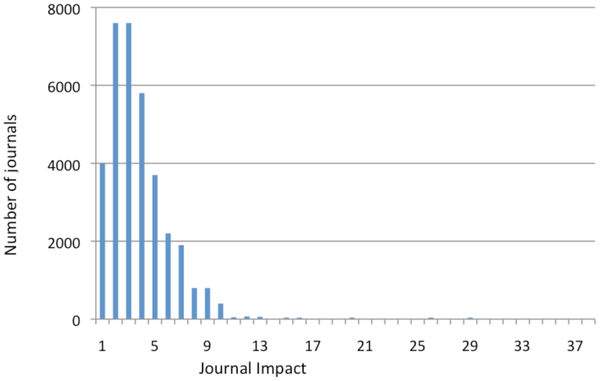
    Distribution of Journal Impact Factors by Journal
    Distribution of Journal Impact Factors(JIF) by Journal.  As with the distribution of individual article citation counts (Figure 3), the distribution of journal impact factors (average citation counts) is highly skewed. Most journal JIFs fall between 0 and 5, with the peak between 2 and 3, followed by a long rapidly shrinking tail, tail with very few journals having a JIF greater than 10.

    Citation: Gargouri Y, Hajjem C, Larivière V, Gingras Y, Carr L, et al., 'Self-Selected or Mandated, Open Access Increases Citation Impact for Higher Quality Research', PLoS ONE 5(10): e13636. doi:10.1371/journal.pone.0013636

    (1) Should taxpayers have to pay to publish studies funded by taxpayers is the flip side of that, but not a topic for this article.


    Comments

    PEACEFUL CO-EXISTENCE IS POSSIBLE BETWEEN OA AND TA

    Good summary! But even though the OA impact advantage is real, and causal, hence OA needs to be mandated in order to give research and researchers the benefit of the maximized impact, it does not follow that "pay-to-publish and toll access journals [cannot] co-exist." What universities and research funders need to mandate is that their researchers self-archive the final, peer-reviewed draft of their papers in their institutional repositories immediately upon acceptance for publication, for all those potential users whose institutions cannot afford to subscribe to the journal in which they happen to be published. It does not necessarily follow that institutions will cancel their subscriptions because an OA version is available online. 

    (But if and when universal OA self-archiving mandates do turn eventually out to lead to institutional subscription cancellations, making subscriptions unsustainable as the means of covering the costs of publishing, then journals can and will convert to OA publishing, with [much reduced] article publication charges to the author-institution covering the costs out of a fraction of the institutional windfall savings from the subscription cancellations.)

    For an interesting breakdown of the graph you have reproduced above, see the graph at the bottom of:

    http://www.openaccessweek.org/events/the-mandated-open-access
    Hank
    I certainly agree that open access is better than subscription access but I would go beyond that and not charge scientists either - the true open publishing peer-reviewed model.  Some quality publishers have the cost down to $150 and I am pretty sure a completely free model could work quite easily.

    I am just busy overturning 2,000 years of how scientists communicate so I can't make a peer-reviewed journal also.  :)

    Good luck with open access week!
    Want more no-nonsense, independent science? Buy Science Left Behind
    It's generous of you not to charge, but since it is someone else who is offering the actual product/service, it is that someone else who has to decide whether they want to give it for free!

    The authors of peer-reviewed journal articles (unlike the authors of most books, textbooks, newspaper articles, software, audio, video) give away their works for free because what they seek is research impact, not sales royalty revenue. That's what their careers and research progress depend on. Referees (much the same people, wearing other hats) peer-review for free. But an honest broker needs to manage the refereeing process: pick the right referees, evaluate their referee reports, decide what needs to be done to meet the quality standards for acceptance, etc. I'm not sure that that work (which I did for a quarter century) can be expected to be done for free by editors (not to mention the ones who handle and track the paperwork and software). So some (small) amount per paper -- somewhere between $200 and $500 per manuscript submitted (not all papers are accepted!) will continue to have to be paid.

    The good news is that institutions are right now pay far more -- an order of magnitude more -- for their journal subscriptions than they will have to pay for the implementation of peer review if and when universal OA self-archiving mandates make subscriptions unsustainable. Institutions will pay out of a fraction of their annual windfall subscription cancellation savings.

    (And before you suggest that we can replace pre-publication peer review with post-publication peer commentar, please see this and this.)

    Harnad, S. (2007) The Green Road to Open Access: A Leveraged Transition. In: Anna Gacs. The Culture of Periodicals from the Perspective of the Electronic Age. L'Harmattan. 99-106. http://eprints.ecs.soton.ac.uk/13309/

    Harnad, S. (2009) The PostGutenberg Open Access Journal. In: Cope, B. & Phillips, A (Eds.) The Future of the Academic Journal. Chandos. http://eprints.ecs.soton.ac.uk/15617/

    Hank
    It's generous of you not to charge, but since it is someone else who is offering the actual product/service, it is that someone else who has to decide whether they want to give it for free!
    It's certainly a viable business model.    You didn't pay to read this website and don't pay to read open access journals.   In the US, TV is free.   I just don't see an inherent ethical or societal benefit to pay-to-publish over pay-to-subscribe that wouldn't be made better by truly open publication.

    I am not saying I can start one today - let's not be naive and pretend open access publications do not care about revenue the same way subscription ones do.  So if I start one I would have both of those groups trying to kill me.   But someone will do it and it will work.
    Want more no-nonsense, independent science? Buy Science Left Behind
