




Nodosaurs have been found in diverse locations worldwide, but they've rarely been found in the United States. The area had originally been a flood plain, where the dinosaur originally drowned and it was tiny - only 13 cm long, just shorter than the length of a dollar bill. Adult nodosaurs are estimated to have been 20 to 30 feet long.
Stanford called up David Weishampel, Ph.D., a professor of anatomy at the Johns Hopkins University School of Medicine who works as a paleontologist and expert in dinosaur systematics. Weishampel confirmed it was a nodosaur and research since then reveals it is the youngest nodosaur ever discovered, and a new genus and species, Propanoplosaurus marylandicus, that lived approximately 110 million years ago during the Early Cretaceous Era.
Weishampel and colleagues were able to confirm the fossil's identity as a nodosaur by identifying a distinctive pattern of bumps and grooves on the skull. They then did a computer analysis of the skull shape, comparing its proportions to those of ten skulls from different species of ankylosaurs, the group that contains nodosaurs. They found that this dinosaur was closely related to some of the nodosaur species, although it had a shorter snout overall than the others. Comparative measurements enabled them to designate the new species as Propanoplosaurus marylandicus. In addition to being the youngest nodosaur ever found, it is the first hatchling of any dinosaur species ever recovered in the eastern United States, says Weishampel.
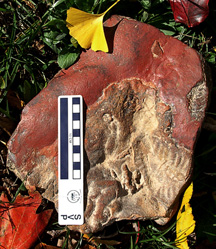
Propanoplosaurus marylandicus fossil. Credit: Ray Stanford
Cleaning the fossil revealed a hatchling nodosaur on its back, much of its body imprinted along with the top of its skull. Weishampel determined the dinosaur's age at time of death by analyzing the degree of development and articulation capability of the ends of the bones, as well as deducing whether the bones themselves were porous, as young bones would not be fully solid.
Weishampel used the position and quality of Propanoplosaurus marylandicus to deduce the dinosaur's method of death and preservation: drowning, and getting buried by sediment in the stream. Egg shells have never been found preserved in the vicinity, and by the layout of the bones and the size of some very small nodosaur footprints found nearby, led them to believe that the dinosaur was a hatchling, rather than an embryo, because it was able to walk independently.
"We didn't know much about hatchling nodosaurs at all prior to this discovery," says Weishampel. "And this is certainly enough to motivate more searches for dinosaurs in Maryland, along with more analysis of Maryland dinosaurs."
Stanford has donated Propanoplosaurus marylandicus to the Smithsonian's National Museum of Natural History, where it is now on display to the public and also available for research. The findings are published in the Journal of Paleontology.



Comments