




Exploratory concepts like functional Magnetic Resonance Imaging (fMRI), which visually display changes in blood flow and oxygen levels, show that some experiencing the condition have differences in how their brains process pain signals. That led to recent work using Adding transcutaneous electrical nerve stimulation (TENS) as an adjunct to physical therapy reduced movement-based pain and fatigue in patients with fibromyalgia.
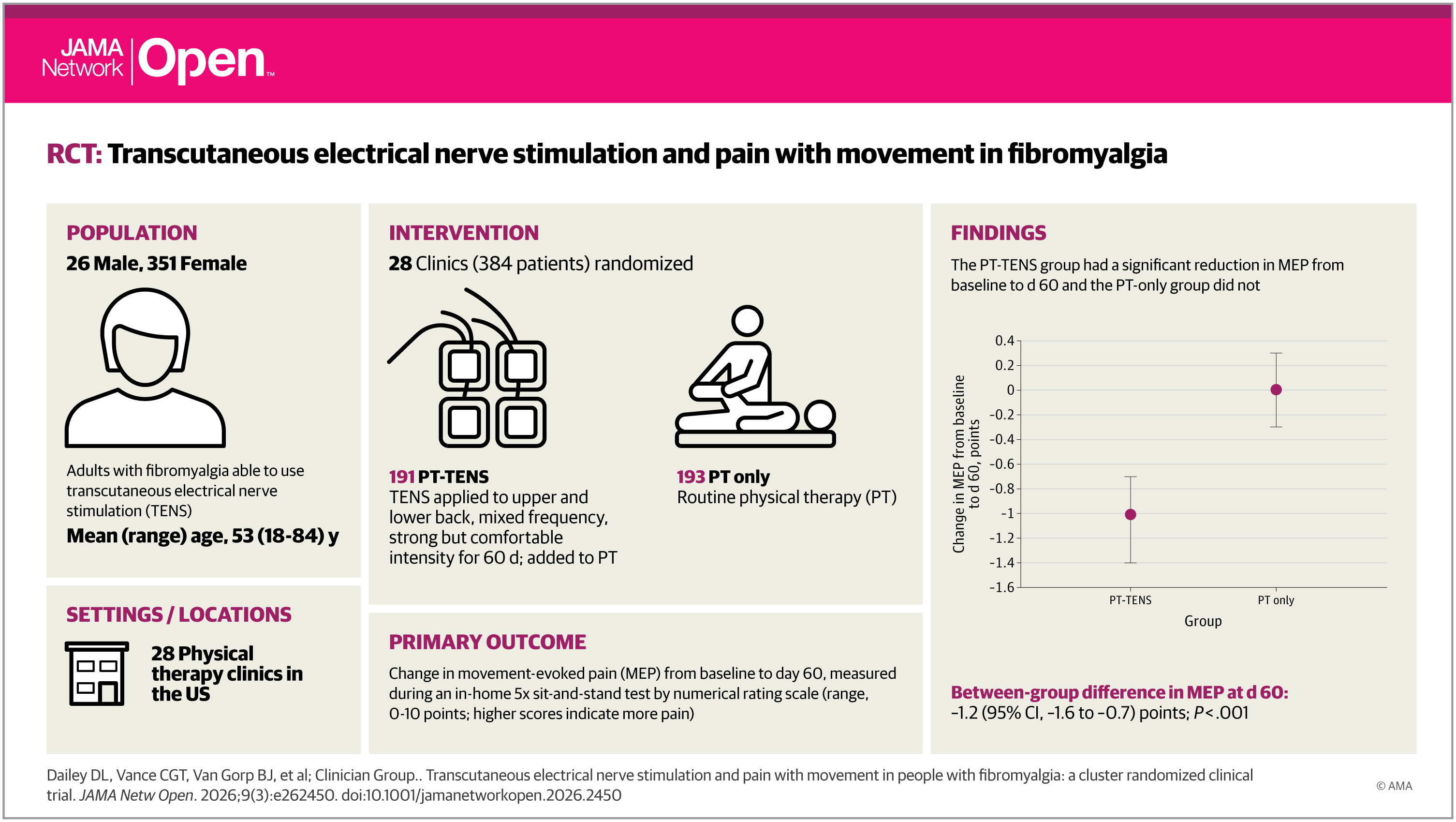
TENS uses adhesive electrodes that send mild electrical pulses through the skin to help block or reduce pain. The new work had 384 people enrolled and they reported reduction in pain similar or better than FDA-approved Serotonin-Norepinephrine Reuptake Inhibitor (SNRI) pain medications like Cymbalta. The study was 28 locations randomized to provide either physical therapy (PT) with TENS or physical therapy alone. In the PT-TENS group, participants were asked to use electrodes placed on the upper and lower back delivering a mixed-frequency signal at an intensity as strong as the participant could tolerate for two hours a day over six months.
After 60 days, patients with the TENS treatment reported less movement-evoked pain while participants who received only physical therapy had no change in their movement-evoked pain. The response was dose-dependent, with people who used TENS daily for 60 days having the best outcomes. After the primary endpoint of 60 days, the PT-only group was also given TENS, and all the participants continued in the study for another four months, and that group reported the same improvements.
Overall, 80 percent of patients found TENS helpful. At six months, 80 percent were still using TENS once a week, and over 70 percent reported they felt better after using it.
Citation: Dailey DL, Vance CGT, Van Gorp BJ, et al. Transcutaneous Electrical Nerve Stimulation and Pain With Movement in People With Fibromyalgia: A Cluster Randomized Clinical Trial. JAMA Netw Open. 2026;9(3):e262450. https://jamanetwork.com/journals/jamanetworkopen/fullarticle/2847027



Comments