




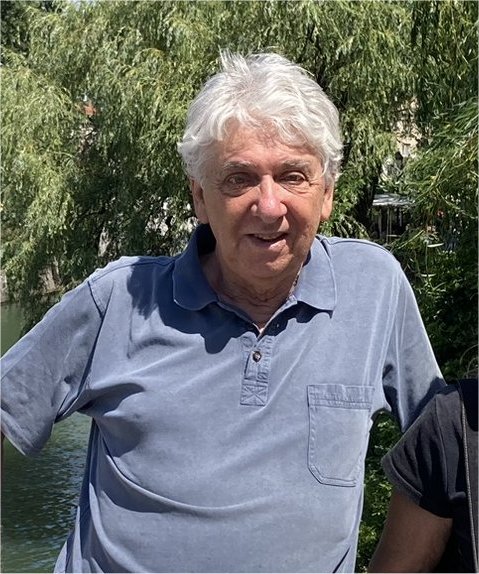
[Above, a recent picture of Enrico]
The Associazione Astrofili Veneziani
I met him when I was 10 years old, and he was already a young architect with a moustache. In 1976 a family friend who knew my passion for stars and planets mentioned to my father that a new association of amateur astronomers in the Venice area was being founded - fortnightly meetings would take place in the Franciscan convent in S. Nicolo' di Lido, at the northern tip of the Lido of Venice. I was there since the first meeting, and somewhere I still have my membership card, as member #15 IIRC. Enrico must have beaten me on time shortly as far as membership cardinality is concerned, as he was among the founders. In his late twenties or early thirties, he was already a knowledgeable meteor observer, and soon a member of the UAI, the Italian Astronomers Union, where he then held for a long time the charge of the union's meteors working group.
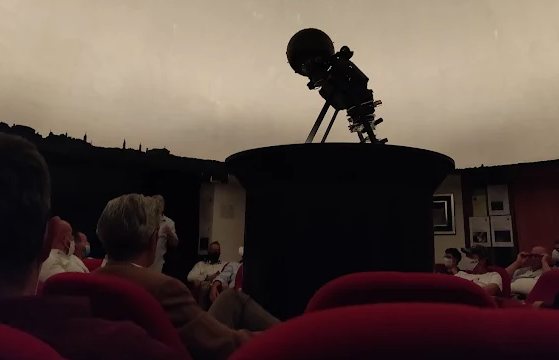
[By the way, the AAV is still active and operates a Planetarium in Venice Lido, with public events and lectures every two weeks. Notably, the planetarium was built from scratch by members of the association! The picture above shows the planetarium during a lecture.]
In Italy those were the years when amateur astronomers did not yet have easy access to powerful instruments, leave alone digital gizmos. A 20cm diameter Newtonian scope was the dream of all of us, and the few who had laboriously built one for themselves were admired and envied. And yet, their "citizen science" work provided invaluable data to researchers.
To give you an idea, Jupiter and Saturn surface drawings were carefully made by those lucky Newtonian owners on pre-prepared template sheets of paper showing coordinates and cardinal points, along with tables to be filled with the time at which the few observed features were seen to pass through the central meridian. That way, one could determine the relative speed of rotation of surface gases at different latitudes, a quite insightful piece of information on the planet dynamics.
That was not an idle occupation, as even the largest scopes on Earth (Mt Palomar, the 5-meter mirror, was king those days) could only get rather lousy photographs of Jupiter and Saturn's surface too, due to the turbulence of Earth's atmosphere, a factor that had yet to be overcome with adaptive optics. Telescope time being a scarce resource, the few giants in operation were more often directed to dark-sky targets.
But amateur astronomers in the seventies did much more than taking apparently silly drawings. Asteroidal occultations of stars were timed with high precision by amateurs scattered around whole countries, producing data useful for improved trajectories of those bodies as well as amazingly cool shadow drawings of the asteroid shape and dimensions once projected on a map.
Another amateur occupation that produced invaluable data to real astronomers was the one of visually observing meteor showers. The dynamics of dust filaments in the solar system was still rather ill-understood, and data were scarce. Big observatories could not collect useful data - in the business of meteor showers, quantity overpowered quality; astronomers researching comets and solar system debris had to rely on observations by amateurs. Radio detection of meteors was also not yet well developed to match the information that patient observers could collect.
Enrico was on top of that data-gathering occupation for AAV and UAI. He taught me and other enthusiasts how to draw meteor trajectories on star maps, and what data to record (speed, colour, flares, precise timing, visual magnitude). An important side occupation was also that of precisely recording the limiting magnitude of visible stars during the observation, the percentage of cloud cover, and the conditions of the atmosphere: all those data were used to process the raw rate counts and produce precise estimates of the incident meteor shower flux as a function of time. The latter constituted a "slice measurement" of the dust filament's density.
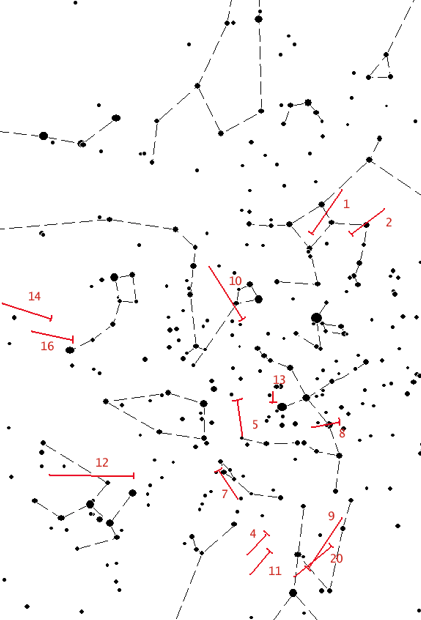
[Above: a random observation of meteors I took in 2014. Each meteor is labeled with a number with corresponding data in a table (not shown).]
I was particularly impressed by Enrico's insistence on obtaining as much information as possible about fireballs from extemporaneous observations, even ones by witnesses who had no clue on the phenomenon. If I reported to him that a friend had observed a bright meteor, he would insist that I should ask my friend about his precise location, the exact time, and an estimate of the starting and end point in the sky of the light streak. Had there been any sound? Any special light flashes? Was the streak white? Was there an afterstreak remaining in the sky? And so on. All those data would then join others collected by other observers, and a model of the meteoroid's trajectory in the atmosphere would ensue, with an attribution to the most likely dust filament it belonged to, as well as an estimate of the composition, weight, etcetera. The data would eventually get published in bulletins and made available to the scientific community.
800 km chasing meteors
Enrico never got tired of observing meteors, during the fifty years since our first acquaintance. Over time he of course specialized his techniques and at some point went digital, as the technology offered that chance. I warmly remember one crazy night we spent together, along with a couple of other meteor enthusiasts. It was November 17 2002, and the Leonid meteors were foreseen to be peaking at 3AM over Italy. The Leonids produce very high rates of meteors every 33 years, when the dust filament originated from comet Tempel-Tuttle crosses the Earth's path.
We were both based near Venice, but the sky was predicted to be overcast there, so we jumped in Enrico's car and drove to the reachable place that was offering the best chances of clear skies: the Argentario - a 400-km drive. We were not disappointed, as we could see a fantastic display of meteor streak for a couple of lucky hours just before the peak, until the sky got completely overcast.
That night, while Enrico deployed a wide-field camera based on a large parabolic mirror, and our colleagues were armed with fancy photographic equipment and fast optics, to collect integrated impressions of several meteor streak on the same background of stars, I brought with me a digital sony video camera I had just bought in the US. It wasn't an especially expensive camera, but it had a very nice feature allowing for high sensitivity to dark scenery. Initially Enrico questioned the likelihood that I could get anything out of it, but later in the night I was able to show that the camera could record meteors down to 3rd or 4th magnitude!
As we drove back toward Venice I remember that Enrico pointed out to me that he was surprised by the extremely high value for meteor observation of the Sony camera I had brought with me. That was indeed a transition time for the whole field, when dynamical data could be acquired inexpensively. Some time later I made some processing of the collected meteor streaks, and with Enrico's help obtained a dust profile graph, see below.
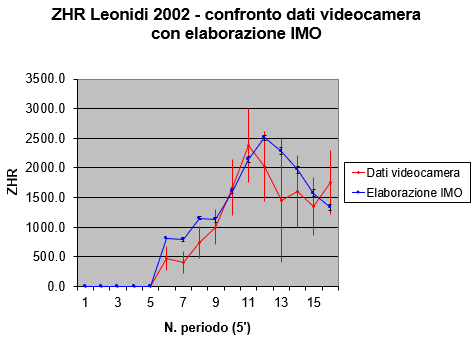
[Above, the official IMO results on the Zenith Hourly Rate (ZHR) of the Leonid meteor storm (in blue) is overimposed to the results of my processing of about 200 meteors recorded on camera.]
While my activities as an amateur astronomer have progressively decreased over the years, I know Enrico has kept them steady, and he continued to contribute valuably to the field of meteor studies for his whole life, with bulletins of the international meteor association, reports on fireballs, and public lectures. I lost touch of him, and I believe our last meeting was in S.Marco square, in Venice, when amateurs organized a public display with telescopes and a stargazing session. The picture below (courtesy AAV) may have been taken then.
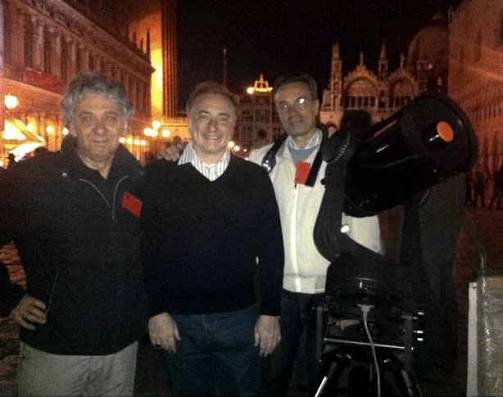
[Above, Enrico Stomeo (left) with friends during a public event in Venice]
Goodbye Enrico, you were a source of inspiration for me since my youth. I think you had some impact in showing me the importance of experimental data collection about Nature around us. You will be missed!




Comments