




"It is probably the site of "Galgala" from the historical Madaba Map," Prof. Zertal says.
The enormous and striking cave covers an area of approximately 1 acre: it is some 100 meters long and about 40 meters wide. The cave is located 4 km north of Jericho. The cave, which is the largest excavated by man to be discovered in Israel, was exposed in the course of an archaeological survey that the University of Haifa has been carrying out since 1978.
Credit: University of Haifa
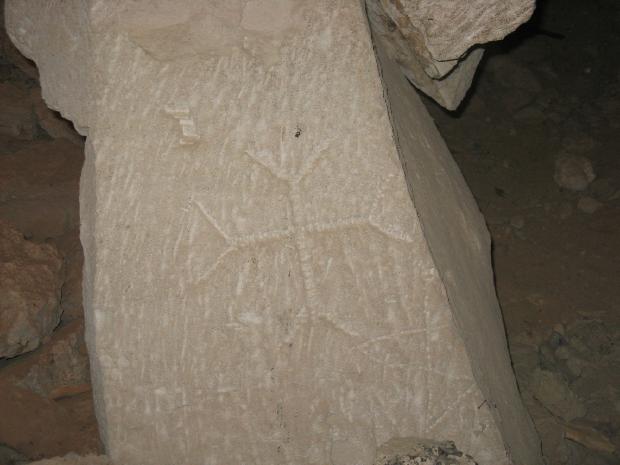
As with other discoveries in the past, this exposure is shrouded in mystery. "When we arrived at the opening of the cave, two Bedouins approached and told us not to go in as the cave is bewitched and inhabited by wolves and hyenas," Prof. Zertal relates. Upon entering, accompanied by his colleagues, he was surprised to find an impressive architectonic underground structure supported by 22 giant pillars. They discovered 31 cross markings on the pillars, an engraving resembling the zodiac symbol, Roman letters and an etching that looks like the Roman Legion's pennant. The team also discovered recesses in the pillars, which would have been used for oil lamps, and holes to which animals that were hauling quarried stones out of the cave could have been tied.
The cave's ceiling is some 3 meters high, but was originally probably about 4 meters high. According to Prof. Zertal, ceramics that were found and the engravings on the pillars date the cave to around 1-600 AD. "The cave's primary use had been as a quarry, which functioned for about 400-500 years. But other findings definitely indicate that the place was also used for other purposes, such as a monastery and possibly as a hiding place," Prof. Zertal explains.
The main question that arose upon discovering the cave was why a quarry was dug underground in the first place.
"All of the quarries that we know are above ground. Digging down under the surface requires extreme efforts in hauling the heavy rocks up to the surface, and in this case the quarrying was immense. The question is, why?"
For a possible answer to this mystery, Prof. Zertal points to the famous Madaba map. This is a Byzantine mosaic map that was found in Jordan and is the most ancient map of the Land of Israel. Jerusalem and the Jordan Valley are depicted with precision on the map, and a site called Galgala is depicted next to a Greek inscription that reads "Dodekaliton", which translates as "Twelve Stones."
This place is marked at a distance from Jericho that matches this cave's distance from the city. According to the map, there is a church next to Dodekaliton; there are two ancient churches located nearby the newly discovered cave. According to Prof. Zertal, until now it has been hypothesized that the meaning of "Twelve Stones" related to the biblical verses that describe the twelve stones that the Children of Israel place in Gilgal. However, it could be that the reference is a description of the quarry that was dug where the Byzantines identified the Gilgal.
"During the Roman era, it was customary to construct temples of stones that were brought from holy places, and which were therefore also more valuable stones. If our assumption is correct, then the Byzantine identification of the place as the biblical Gilgal afforded the site its necessary reverence and that is also why they would have dug an underground quarry there," Prof. Zertal concludes. "But" he adds, "much more research is needed."





Comments