Banner
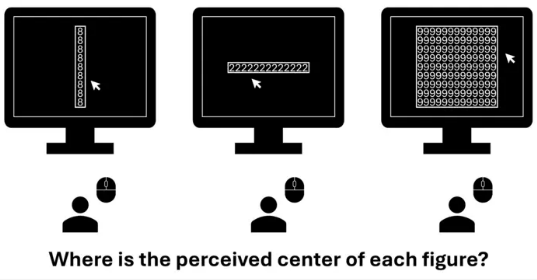
Object-Based Processing: Numbers Confuse How We Perceive Spaces

Researchers recently studied the relationship between numerical information in our vision, and...
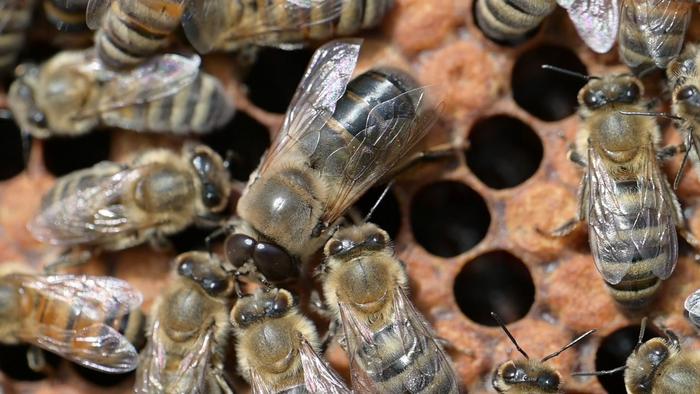
Males Are Genetically Wired To Beg Females For Food

Bees have the reputation of being incredibly organized and spending their days making sure our...

The Scorched Cherry Twig And Other Christmas Miracles Get A Science Look

Bleeding hosts and stigmatizations are the best-known medieval miracles but less known ones, like ...

$0.50 Pantoprazole For Stomach Bleeding In ICU Patients Could Save Families Thousands Of Dollars

The inexpensive medication pantoprazole prevents potentially serious stomach bleeding in critically...

User picture.
News StaffRSS Feed of this column.

News Releases From All Over The World, Right To You... Read More »

Blogroll

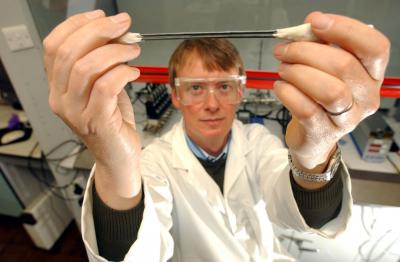
Greenhouse gas emissions from power stations could be cut to almost zero by controlling the combustion process with tiny tubes made from an advanced ceramic material, claim British engineers.

The material, known as LSCF, has the remarkable property of being able to filter oxygen out of the air.

Molly Brown of NASA’s Goddard Space Flight Center in Greenbelt, Md., and her colleagues have created a model using data from satellite remote sensing of crop growth and food prices.

Brown conceived the idea while working with organizations in Niger, West Africa, that provide information regarding failed crops and help address local farmers' worries about feeding their families. Brown's new approach could improve the ability for government and humanitarian aid officials to plan and respond to drought-induced food price increases in Niger and elsewhere.

On July 3, a NASA aircraft equipped with a state-of-the-art sensor provided emergency response officials with critical soil moisture data for several regions across Texas that were threatened by flooding. NASA responded to the heavy rains and flooding in Texas by redirecting a NASA research aircraft, the P-3B, to Texas after it completed an interagency project in Oklahoma.

The aircraft had been flying a sensor developed by the University of Colorado at Boulder, NOAA and U.S. Department of Agriculture that could provide detailed maps of ground surface water.

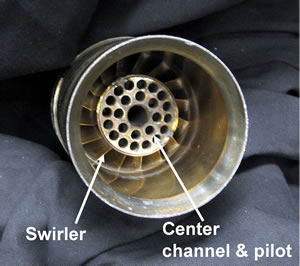
LSI (low-swirl injector) technology, developed by Robert Cheng of Lawrence Berkeley National Laboratory, recently won a 2007 R&D 100 award from R&D magazine as one of the top 100 new technologies of the year for successfully using pure hydrogen as a fuel – a milestone that indicates a potential to help eliminate millions of tons of carbon dioxide and thousands of tons of NOx from power plants each year.

The LSI holds great promise for its near-zero emissions of nitrogen oxides, gases that are emitted during the combustion of fuels such as natural gas during the production of electricity.

If you take a strip of paper, twist one end by 180° and then stick the two ends together to form a ring, the result is called a Möbius strip, a geometric shape with only one surface and one edge. You can prove this by making a line along the strip with a pencil: Without lifting the pencil you get back to your starting point in the end—with the whole strip marked: at each point, both sides of the strip are marked by the line.

Ring-shaped aromatic molecules can also have a topology like that of the Möbius strip, with only one side. Polish researchers have now made a porphyrin-like ring that can do something its paper analogue can’t.

In 2004, Korean investigators announced the creation of the world's first human embryonic stem cells through somatic cell nuclear transfer, entailing transfer of genetic material from a cell in the body into an egg.

Research led by Kitai Kim, PhD, and George Q. Daley, MD, PhD, of the Children's Hospital Boston Stem Cell Program demonstrates that the Koreans created something entirely different – the world's first human embryonic stem cell to be derived by parthenogenesis, a process that creates an embryo containing genetic material only from the donor egg.

The report sheds new light on a now-discredited Korean embryonic stem cell line, setting the historical record straight and also establishing a much-needed set of standards for characterizing human embryonic stem cells.