Banner
Pilot Study: Fibromyalgia Fatigue Improved By TENS Therapy

Fibromyalgia is the term for a poorly-understood condition where people experience pain and fatigue...

High Meat Consumption Linked To Lower Dementia Risk

Older people who eat large amounts of meat have a lower risk of dementia and cognitive decline...

Long Before The Inca Colonized Peru, Natives Had A Thriving Trade Network

A new DNA analysis reveals that long before the Incan Empire took over Peru, animals were...

Mesolithic People Had Meals With More Tradition Than You Thought

The common imagery of prehistoric people is either rooting through dirt for grubs and picking berries...

User picture.
News StaffRSS Feed of this column.

News Releases From All Over The World, Right To You... Read More »

Blogroll

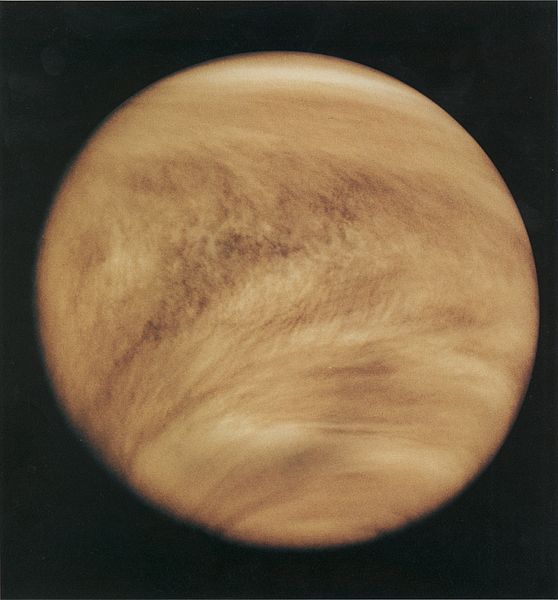
The surface of Venus can't be seen from orbit in visible light due to its hot, dense and cloudy atmosphere. Instead, radar has been used by spacecraft to penetrate the clouds and map out the surface – both by reflecting radar off the surface to measure elevation and by looking at the radio emissions of the hot surface. The last spacecraft to map Venus that way was Magellan, two decades ago. 

One of the Venusian surprises discovered at that time is that radio waves are reflected differently at different elevations on Venus. Also observed were a handful of radio dark spots at the highest elevations. Both enigmas have defied explanation.

Human parainfluenza virus (hPIV) is highly infectious and the leading cause of upper and lower respiratory tract disease in young children, including Croup, which is responsible for thousands of hospitalizations in the developed world, and hundreds of thousands of deaths each year in developing countries.

Griffith University's Institute for Glycomics
Director Professor Mark von Itzstein said his Group's research findings published in Nature Communications today provide a new direction towards the discovery of anti-viral drugs against hPIV.

It is often believed that masculine men and more feminine women were prized in ancient societies and that modern culture is beyond gender simplifications, but a
team of psychologists, anthropologists and biologists that surveyed 12 populations around the world, from the primitive to the highly developed, find that isn't so.

How did life originate? And can scientists create life? These questions have always occupied philosophers and scientists interested in the origin of life, and they impact technology of the future also.

If we can create artificial living systems, we may not only understand the origin of life - we can also revolutionize the future of technology.

Protocells are the simplest, most primitive living systems, you can think of. The oldest ancestor of life on Earth was a protocell, and when we see, what it eventually managed to evolve into, we understand why science is so fascinated with protocells. If science can create an artificial protocell, we get a very basic ingredient for creating more advanced artificial life.

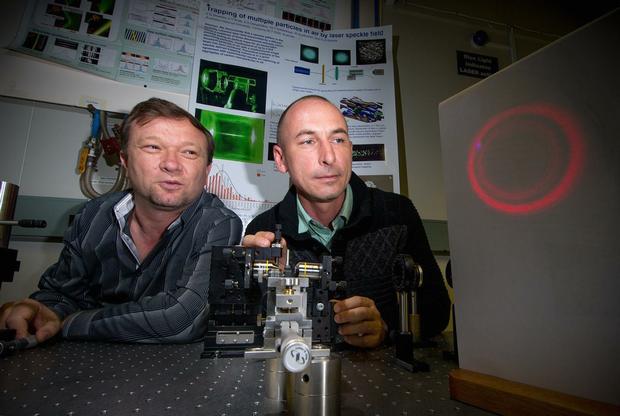
A long-distance optical tractor beam can move tiny particles - one fifth of a millimeter in diameter - a distance of up to 20 centimeters, which is almost 100 times further than previous experiments.

The hollow laser beam is bright around the edges and dark in its center and it can be used to attract or repel objects.

Get ready to control the weather or capture an X-Wing fighter in space - if it's really close, that is.

Dr. Vladlen Shvedov (L) and Dr. Cyril Hnatovsky adjust the hollow laser beam in their lab at the Australian National University. Credit: Stuart Hay, ANU

Is fairness built into the brain? According to a new Norwegian brain paper, people appreciate fairness - but fairness is not that everybody gets the same income, which is sure to concern those who believe all money should be distributed equally.

Economists from the Norwegian School of Economics and brain researchers from the University of Bergen decided to try and assess the relationship between fairness, equality, work and money: how brains react to how income is distributed.

The team looked at the striatum - the "reward center" of the brain. By measuring reaction to questions related to fairness, equality, work and money, they believe they can find answers about how we perceive distribution of income.