Banner
Pilot Study: Fibromyalgia Fatigue Improved By TENS Therapy

Fibromyalgia is the term for a poorly-understood condition where people experience pain and fatigue...

High Meat Consumption Linked To Lower Dementia Risk

Older people who eat large amounts of meat have a lower risk of dementia and cognitive decline...

Long Before The Inca Colonized Peru, Natives Had A Thriving Trade Network

A new DNA analysis reveals that long before the Incan Empire took over Peru, animals were...

Mesolithic People Had Meals With More Tradition Than You Thought

The common imagery of prehistoric people is either rooting through dirt for grubs and picking berries...

User picture.
News StaffRSS Feed of this column.

News Releases From All Over The World, Right To You... Read More »

Blogroll
Two decades ago, the inclusion of women in biomedical research was mandated by law but sex-specific research is still not the norm.

As a result, many women receive recommendations from their doctors for prevention strategies, diagnostic tests and medical treatments that may not have included women adequately. There is no evidence treatment has been worse due to that - and no one can force women to participate in studies - but diseases such as lung cancer, heart disease, Alzheimer’s and depression disproportionately affect women, which raises questions about the impact of research on women’s health.   

Mindfulness. Zen. Meditation drumming. Chakra. Buddhist and transcendental meditation. It evokes eastern mystics and hip elites in California pretending to to leave their corporeal forms behind and achieve some higher state of being.

But what about poor stressed-out wretches that can't afford to fly in big-name Yogis? What does the research say? Not much. 

We're all going to die, that is nature's way of telling us to get the hint. But it is the purpose of science and medicine to defy nature. Death is going to be standing at the door and doctors have taken an oath to block the way.

But what about when it's unavoidable and quality of death becomes more important than quality of life? That's a psychology issue.

A paper in Journal of Pain and Symptom Management analyzes the overall 'quality of death' of cancer patients who die in an urban Canadian setting with ready access to palliative care was found to be good to excellent in the large majority of cases. Is suffering at the end of life inevitable?

The weather is big news. No matter what is happening, too little or too much, someone is talking about that and then linking it to long-term climate disruption. The UN IPCC says not do to that, but if people will anyway, the big question is; how much accuracy is possible?

Rainfall is important and therefore a topic of intense debate. While we historically haven't been able predict it, we can use modern weather satellites to monitor it, and so that has become a widely-practiced technique.  That is not without pitfalls. Yet how accurate are claims about past rainfall? And can satellites do better? Establishing a reliable context for rainfall observations to current and historical ground-based rainfall data has been difficult.

Since October 2013,  the rate of earthquakes in Oklahoma has been up by about 50 percent, which has geologists thinking about the chance for a damaging quake in central Oklahoma.

A joint statement by the U.S. Geological Survey and Oklahoma Geological Survey says that 183 earthquakes of magnitude 3.0 or greater occurred in Oklahoma from October 2013 through April 14, 2014. The long-term average from 1978 to 2008 showed only two magnitude 3.0 or larger earthquakes per year. The increased number of small and moderate shocks has led them to predict a higher likelihood of future, damaging earthquakes for central and north-central Oklahoma.
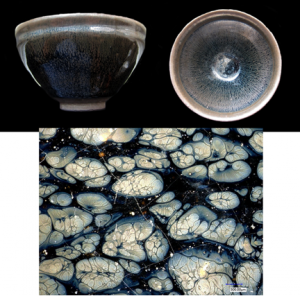
A new analysis of ancient Jian wares reveals that the distinctive pottery contains an unexpected and highly unusual form of iron oxide - a rare compound called epsilon-phase iron oxide which was only recently discovered and characterized by scientists and so far has been extremely difficult to create with modern techniques.

Understanding 1,000 year old synthesis conditions used by Chinese potters could lead to an easier, more reliable synthesis of epsilon-phase iron oxide, enabling better, cheaper magnetic materials - including those used for data storage.