




Bees are not dying, there are more than at any point in recorded history, up 85 percent since the 1960s. There was never a Colony Collapse Disorder, mass bee die-offs have been recorded for literally as long as beekeeping has been recorded. And "pesticides" have nothing to do with it. The top three killers of honeybees are varroa mites, varroa mites, and varroa mites. They are, as University of Maryland Entomology Professor and project director for the Bee Informed Partnership Dennis vanEngelsdorp called them, dirty hypodermic needles that are a vector for viruses. No "organic" pesticide can kill those parasites so instead of killing bees, science saves them.
Unless your diet consists of almonds, almost none of your food relies on honeybees. And none of your food at all relies on wild ones. In reality, only a few species of bees get counted at all because only a few have hives we can find - out of 27,000 known species of bees. We know very little about bees and a new paper shows just how little. The paper details that just one cemetery near their lab has 5,500,000 wild, ground-nesting regular mining bees (Andrena regularis) in just 1.5 acres. To get their estimate they placed 10 traps starting March of 2023, for six weeks. Of the 3,251 critters they got, A. regularis was the most prevalent of 16 species total.
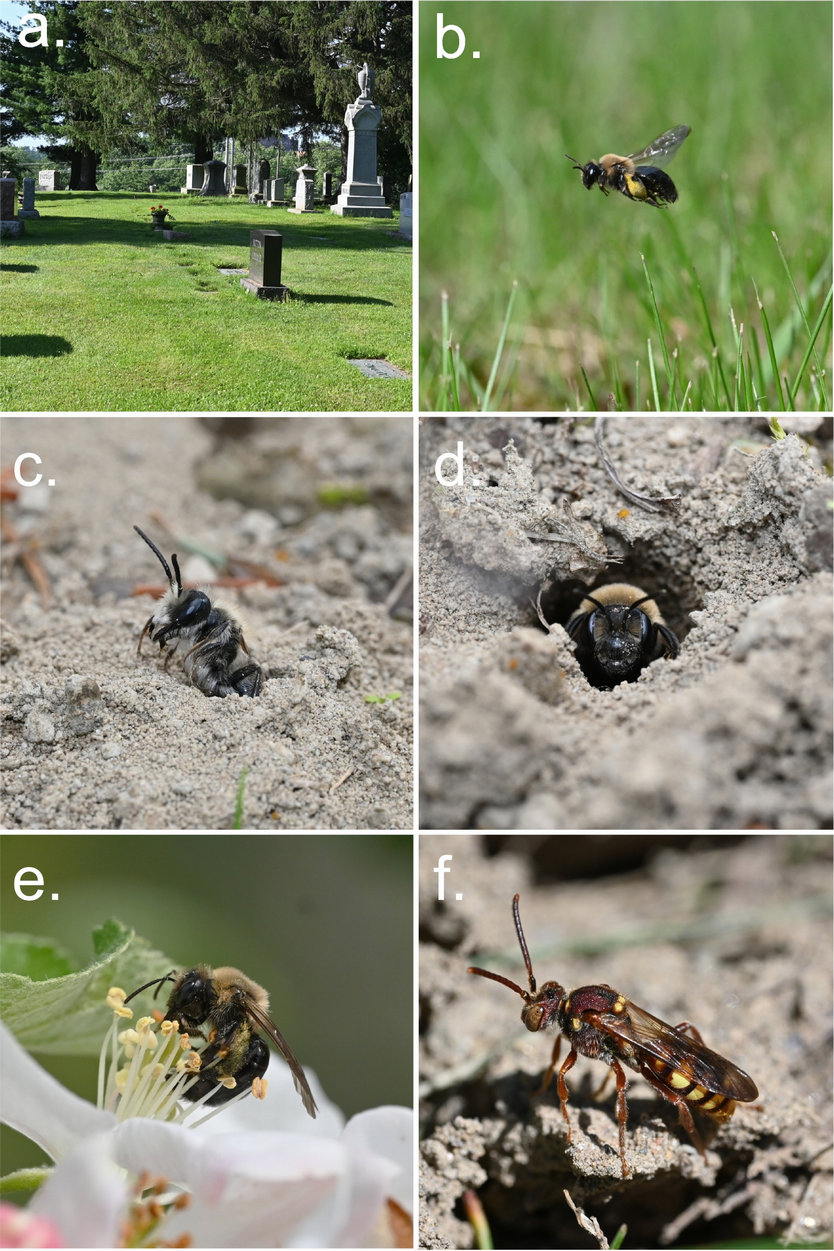
They don't get counted (and therefore exaggerated) by amateurs for surveys because they are outside the 7 species that can be easily counted. Yet there are so many they could fill 200 hiveswith just that one species on one small plot of land. Ground-nesting bees like A. regulari don't get all the publicity of honeybees thanks to environmental lawyers but they help with other crops. Since their nests are in the ground and, unlike the honeybees people imagine, overwinter as adults, when spring hits they are full grown and ready to go.
The bees at this cemetery been there since at least the early 1900s, which isn't a surprise given the apple orchard nearby.
To help broaden the discussion beyond over-politicized honeybees, the authors have created a citizen science project to help people participate.
So if honeybees disappeared, well, nothing would happen. Some other bee would do their pollination, and if all 27,000 species of bees disappeared other flying critters would do their pollination. But the good news is they aren't going anywhere either. Anyone claiming they are is selling you an Organic™ apple.
Citation: Hoge, S.T., Kueneman, J.G., Fordyce, R., Dobler C., Odanaka K., Danforth B., Emergence dynamics and host-parasite associations in a large aggregation of Andrena regularis (Hymenoptera: Apoidea: Andrenidae). Apidologie 57, 29 (2026). https://link.springer.com/article/10.1007/s13592-026-01256-6
NOTE:
(1) Like when Whole Foods claimed Organic™ food has no pesticides, it's a lie scientifically but to marketing it is just stretching a technicality. We forced them to clarify that their produce only used pesticides certified Organic™. Still more toxic to the environment than modern products, but exempted from scrutiny by the panel of lobbyists and marketing heads on the National Organic Standards Board that gives certain chemicals - including entirely synthetic ones - a free pass.



Comments