Banner
Pilot Study: Fibromyalgia Fatigue Improved By TENS Therapy

Fibromyalgia is the term for a poorly-understood condition where people experience pain and fatigue...

High Meat Consumption Linked To Lower Dementia Risk

Older people who eat large amounts of meat have a lower risk of dementia and cognitive decline...

Long Before The Inca Colonized Peru, Natives Had A Thriving Trade Network

A new DNA analysis reveals that long before the Incan Empire took over Peru, animals were...

Mesolithic People Had Meals With More Tradition Than You Thought

The common imagery of prehistoric people is either rooting through dirt for grubs and picking berries...

User picture.
News StaffRSS Feed of this column.

News Releases From All Over The World, Right To You... Read More »

Blogroll

GAINESVILLE, Fla. — Breathing the air outside their homes may be just as toxic to pregnant women — if not more so — as breathing in cigarette smoke, increasing a mom-to-be's risk of developing deadly complications such as preeclampsia, according to findings from a new University of Florida study.

UF researchers compared birth data with Environmental Protection Agency estimates of air pollution, finding that heavy exposure to four air pollutants led to a significantly increased risk for developing a high blood pressure disorder during pregnancy. The research was published in the January issue of the Journal of Epidemiology & Community Health.

New research quantifying the risk of admission to hospital for self-harm has identified a raised risk of self-harm among groups of patients with certain physical illnesses. While it is known that psychiatric illnesses are associated with a greatly elevated risk of self-harm, a moderately elevated risk was seen with common physical illnesses such as diabetes, epilepsy and asthma. The research, published today by the Journal of the Royal Society of Medicine, investigated the risk of self-harm comparing people with different psychiatric and physical disorders in England.

A business scholar says that there are fewer product placements in scary movies, and therefore companies are missing a prime marketing moment.

Coca-Cola doesn't want a half-naked sorority girl to be drinking their soda just before she gets stabbed in the eye, that is a much different association than cute polar bears or, in the case of Budweiser, giant affectionate horses. Humor product placements, good, adventure, of course, but not horror.

Yet University of British Columbia PhD student Lea Dunn writes in an upcoming article in the 

The Nazis studied everything to gain an advantage. Those stories about mysticism and artifacts aren't wrong, and the advanced weapons projects are well known, that is why US President Harry Truman authorized "Operation Paperclip" to recruit their scientists and engineers, rather than just kidnapping them the way Communist leaders in the USSR did.

But they weren't just interested in big weapons, they studied small ones, like bugs, though not to use them for biowarfare or weird experiments. Hitler had a ban on that.

Peregrine falcons are one of the world's fastest birds, reaching up to 200 miles per hour when diving.

Scientists are studying the body shape and wing contour of the bird to better understand how they reach these high diving speeds while maintaining maneuverability - in human planes, flaps slow you down to make the aircraft more maneuverable. 

Researchers trained peregrine falcons to dive in front of a 200 foot dam and captured 35 dives with a stereo high-speed camera system and hi-res camera. The images allowed researchers to reconstruct the flight path and body shape of the falcon during certain flight phases, and to build a life size model of the falcons. They then analyzed the aerodynamics of the model bird in a wind tunnel. 

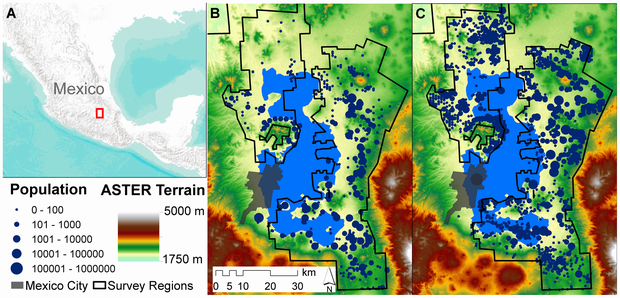
Anthropologists have developed mathematical models that they say describe development patterns in both modern urban areas and ancient cities settled thousands of years ago.