Banner
Pilot Study: Fibromyalgia Fatigue Improved By TENS Therapy

Fibromyalgia is the term for a poorly-understood condition where people experience pain and fatigue...

High Meat Consumption Linked To Lower Dementia Risk

Older people who eat large amounts of meat have a lower risk of dementia and cognitive decline...

Long Before The Inca Colonized Peru, Natives Had A Thriving Trade Network

A new DNA analysis reveals that long before the Incan Empire took over Peru, animals were...

Mesolithic People Had Meals With More Tradition Than You Thought

The common imagery of prehistoric people is either rooting through dirt for grubs and picking berries...

User picture.
News StaffRSS Feed of this column.

News Releases From All Over The World, Right To You... Read More »

Blogroll
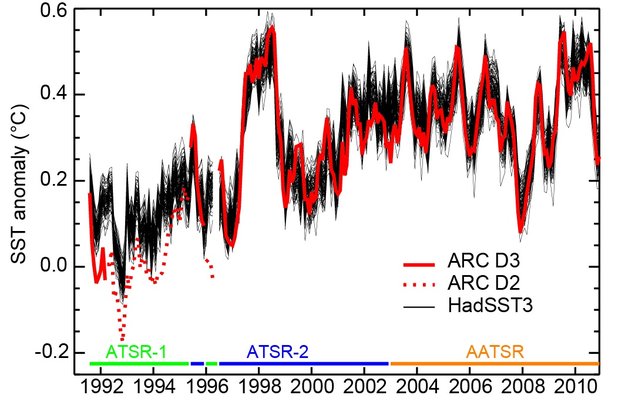
Satellite observations of global sea-surface temperature have shown that a 30-year upward trend slowed in the last 15 years.  It can't be due to successful mitigation, since outside the United States and a few countries in Europe, CO2 emissions have not dropped back to those levels.

Some satellites carry instruments that provide a global view of the surface temperature of oceans and seas. Satellite and local readings show that sea-surface temperature rose rapidly during the 1970s and '80s but then significantly slowed in the last 15 years.

 Mesopelagic fishes like lantern fishes (Myctophidae) and cyclothonids (Gonostomatidae) live in the twilight zone of the ocean, between 200 and 1,000 meters deep.

 With a stock estimated at 1,000 million tons so far, mesopelagic fish dominate the total biomass of fish in the ocean and are the most numerous vertebrates of the biosphere. Now it turns out they have been severely underestimated. Researchers writing in Nature Communications have estimated their numbers are 10 times higher than previous estimated, based on acoustic observations conducted during the circumnavigation of the Malaspina Expedition.

Policy makers know to hit biology where it counts; in the wallet. Rural farmers in Mexico have seen honey shipments to Germany rejected because of genetically modified organism (GMO) soybean pollen in honey samples

Is it harmful? No, but that is not how European science policy is written. Instead, because GMO soybean pollen in honey has not been approved for human consumption in honey, it as returned as unsafe and farmers have to take the hit - unless they stop using GMOs and use more pesticides and herbicides.

The world's oceans contain algae that produce certain chemicals
that can accumulate in seafood and are known to cause brain damage.

This natural neurotoxin, domoic acid, is a very stable and heat resistant and is also toxic to the kidneys, but at much lower concentrations than guidance has suggested, according to an upcoming study in the Journal of the American Society of Nephrology (JASN).

It's cold and snowy just about everywhere except where you expect it. Ice in northern Alaska’s lakes during winter months is on the decline, as shown by twenty years of satellite radar imagery demonstrating how changes in our climate are affecting high-latitude environments - at least in the last few decades. 

Changes in air temperature and winter precipitation over the last five decades have affected the timing, duration and thickness of the ice cover on lakes in the Arctic. In this region, warmer climate conditions result in thinner ice cover on shallow lakes and, consequently, a smaller fraction of lakes freezing all the way through during winter months. 

We have a biological clock related to sleep cycles and a new paper says we have weight loss cycles related to behavior; people are going to gain weight on the weekend so if they lose more during the week, that weight loss cycle will result in better health.

Dr. Brian Wansink of the marketing department at Cornell University, in collaboration with researchers from the VTT Technical Research Centre of Finland and Tampere University of Technology, looked into the impact that the seven-days-a-week human cycle has on weight.