Banner
Thousands Of Unpublished Studies Show Why Conservation Efforts Miss The Mark

Europe alone has so much unpublished, un-catalogued biological data that it is challenging to take...

Why Antarctic Sea Ice Stopped Growing In 2015

Though numerical models and popular films like An Inconvenient Truth projected Arctic ice...

Wealth Correlated To Loneliness

You may have read that Asian cultures respect the elderly more than Europe but Asian senior citizens...

Ousiometrics Analysis Says All Human Language Is Biased

A new tool drawing on billions of uses of more than 20,000 words and diverse real-world texts claims...

User picture.
News StaffRSS Feed of this column.

News Releases From All Over The World, Right To You... Read More »

Blogroll
Males and females process pain using different cells, a new study with mice suggests.
The findings could help researchers develop the next generation of medications for chronic pain—the most prevalent health condition humans face.

“Research has demonstrated that men and women have different sensitivity to pain and that more women suffer from chronic pain than men, but the assumption has always been that the wiring of how pain is processed is the same in both sexes,” says co-senior author Jeffrey Mogil, professor of pain studies at McGill University and director of the Alan Edwards Centre for Research on Pain.
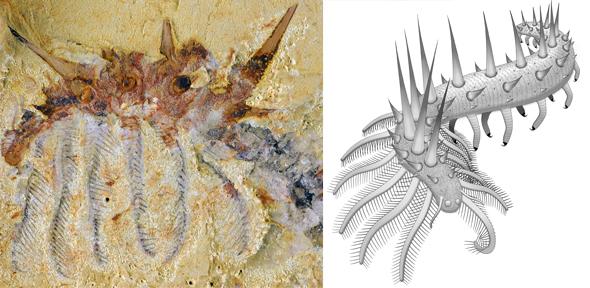
A new species of ‘super-armored’ worm, named Collinsium ciliosum, or Hairy Collins’ Monster after the palaeontologist Desmond Collins, who discovered and first illustrated a similar Canadian fossil in the 1980s, was a bizarre, spike-covered creature which ate by filtering nutrients out of seawater with its feather-like front legs, has been identified by palaeontologists.

The creature, which lived about half a billion years ago, was one of the first animals on Earth to develop armor to protect itself from predators and to use such a specialised mode of feeding.

Mosquitoes have been called the deadliest animal on the planet due to the diseases they spread.

Why feed them?

By using science, giving them an artificial buffet may lead to fewer of them, says Stephen Dobson, a University of Kentucky professor of medical and veterinary entomology. His work on developing artificial blood for mosquitoes has made him a Grand Challenges Explorations winner, in an initiative funded by the Bill&Melinda Gates Foundation.

The artificial blood he developed will allow people in remote areas around the world to sustain colonies of mosquitoes, even in those areas with limited resources and difficult logistics.

Wearing a computer on your sleeve may be a lot cooler than a plastic watch with an Apple logo on it - researchers at the University of Pittsburgh have designed a responsive hybrid material fueled by an oscillatory chemical reactions.

They can even perform computations based on changes in the environment or movement, and respond to human vital signs. The material system is sufficiently small and flexible enough to be integrated into fabric or introduced as an inset into a shoe.

If you suffer from chronic low back pain and need spinal fusion surgery, there is good news for your golf game. A new study shows an overwhelming majority of spinal fusion patients returned to play golf as well, if not better, than before surgery.

During spinal fusion surgery, two vertebrae are joined together using a bone graft taken from another part of the body. In traditional open surgery, a large incision is made to cut through muscles surrounding the spine. Minimally invasive surgery allows for a smaller incision with less muscle damage, resulting in less blood loss, shorter hospital stays and a quicker return to activities.

Scientists have developed a computer model that clarifies the complex processes driving ocean mixing in the vast eddies that swirl across hundreds of miles of open ocean.

The Lagrangian In-situ, Global, High-performance particle Tracking (LIGHT) model is a first-of-its-kind tool because of its ability to exploit the power available from today's supercomputers, the authors say.