Banner
You Didn't Feel Continental Mantle Earthquakes, But They Happened. A Lot

A 1979 seismic event was a different kind of earthquake, and it is has intrigued scientists ever...
How To Overcome Leadership Battles

In times of social rancor and strife, most will fight each other, but societies are saved by those...
Thousands Of Unpublished Studies Show Why Conservation Efforts Miss The Mark

Europe alone has so much unpublished, un-catalogued biological data that it is challenging to take...

Why Antarctic Sea Ice Stopped Growing In 2015

Though numerical models and popular films like An Inconvenient Truth projected Arctic ice...

User picture.
News StaffRSS Feed of this column.

News Releases From All Over The World, Right To You... Read More »

Blogroll
Social bonding in vampire bats is no surprise, they have roommates. What is uncommon is that they demonstrate behavior some might call friendship; unrelated vampire bats engage in social grooming and food sharing to form life-saving bonds that can last a lifetime. 

Vampire bats sustain themselves on only blood, and if a bat is unable to feed for 3 days, it runs the risk of starving. Like early man, they have a 'boom and bust' foraging lifestyle, so they either hit it big and get a large blood meal or they're starved for that night.

If they starve three nights in a row there is a high chance they'll die but vampire bats with close social ties can be rescued from the brink. 

An ancient Elpistostege fish fossil has revealed how the human hand evolved from fish fins, the missing evolutionary link in the 'fish to tetrapod transition', as fish began to foray in habitats such as shallow water and land during the Late Devonian period millions of years ago.

A new review finds a dramatic increase in the abundance of a worm that can be transmitted to humans who sushi - 283-fold more since the 1970s

But is that due to better detection or a real increase? And what implications does it have for humans and marine mammals?

The oldest fossil of a modern bird yet found dates from the age of dinosaurs and was found in a limestone quarry near the Belgian-Dutch border, making it the first modern bird from the age of dinosaurs found in the northern hemisphere.

If the kids are out of school and missing homework, or you're tired of them playing Fortnite, here are seven fun projects they can get involved with courtesy of the National Science Foundation.

1. Use on-the-go science tools to explore the world around you (all ages)

Foldscopes are paper microscopes that give you a deeper look at the world around you. Peer at the cell structure in an onion's skin, examine a human hair or look at the busy microbial world of pond scum.


2. Become a citizen scientist and help collect and analyze data for scientific research (all ages).
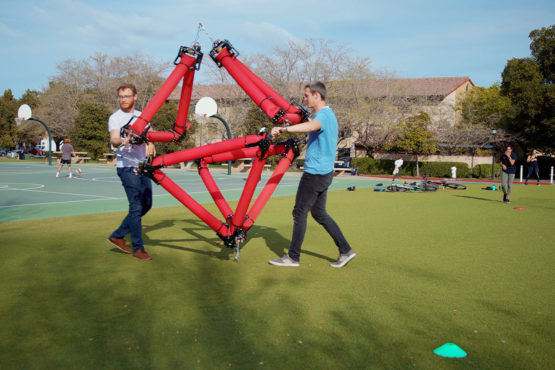
Soft robotics is a newer field, so no one is quite sure what to do with them, but sturdy softness could be useful in homes and workplaces where traditional robots could cause injury. Since they are squishy, they could be tools for disaster response.

For now, they may play basketball. Or at least pick one up. Maybe eventually they will be a delightful companion that can still get down to business like Baymax from the Big Hero 6 cartoon and comics.