Banner
Ousiometrics Analysis Says All Human Language Is Biased

A new tool drawing on billions of uses of more than 20,000 words and diverse real-world texts claims...

Wavelengths Of Light Are Why CO2 Cools The Upper Atmosphere But Warms Earth

There are concerns about projected warming on the Earth’s surface and in the lower atmosphere...

Here's Where Your Backyard Was 300 Million Years Ago

We may use terms like "grounded" and terra firma to mean stability and consistency but geology...

Convergent Evolution Cheat Sheet Now 120 Million Years Old

One tenet of natural selection is a random walk of genes but nature may be more predictable than...

User picture.
News StaffRSS Feed of this column.

News Releases From All Over The World, Right To You... Read More »

Blogroll

Lorena Moscardelli of Statoil North America–Research, Development and Innovation in Austin is not the first to claim evidence to support the existence of a Martian ocean during the late Hesperian–early Amazonian. Viking Orbiter images did that throughout the 1980s and early 1990s.

Others have based their beliefs on alleged paleoshorelines, which has been heavily contested due to large variations in elevation (and some turned out to be of volcanic origin), but Moscardelli uses a new terrestrial, deep-water analogy. 

The increasing use of chemical herbicides, both synthetic and organic kinds, is often blamed for the declining plant biodiversity in farms, but it is simplistic to think herbicide exposure is solely to blame.

The science doesn't add up. If herbicides are a key factor in declining diversity, then thriving species would be more tolerant to widely used herbicides than rare or declining species, according to J. Franklin Egan, research ecologist, USDA-Agricultural Research Service. But that isn't the case.

Almost one-third of US adolescents consume high-caffeine energy drinks and the teens who do also report higher rates of alcohol, cigarette, or drug use, according to a paper in the Journal of Addiction Medicine.

The same characteristics that attract young people to consume energy drinks—such as being "sensation-seeking or risk-oriented" — may make them more likely to use other substances as well, suggests the new paper by Yvonne M. Terry-McElrath, MSA, and colleagues of the Institute for Social Research, University of Michigan, Ann Arbor. 

For decades, scientists have been pushing toward the goal of creating artificial building blocks that can self-assemble in large numbers and reassemble to take on new tasks or to remedy defects. Researchers from the University of Southern Denmark have taken a step toward that.

"The potential of such new man-made systems is almost limitless, and many expect these novel materials to become the foundation of future technologies," says Dr. Maik Hadorn from Department of Chemistry and Applied Biosciences at ETH Zürich. "We used short DNA strands as smart glue to link preliminary stages of artificial cells (called artificial vesicles) to engineer novel tissue-like structures."

Do you prize your self on individual initiative or do you feel like the events in your life are outside your control and you just have to react? Do you think there needs to be more rules and regulations to manage things for you, or would you rather make it on your own?

An article in Health Psychology finds that how you view your life can affect your risk of mortality; people who believe they can achieve goals despite hardships are more likely to live longer and healthier lives, especially among those with less education.

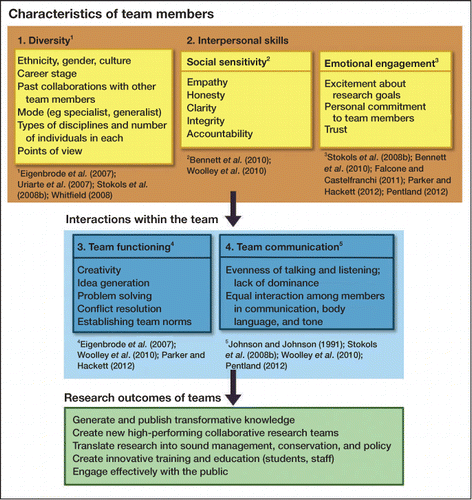
If you want to get quality research, you want the best researchers, right?

Not necessarily. An advanced trend in science academia is social engineering, and that means building a team that isn't simply the best minds, but has a diverse mix of ethnicity and gender and culture that can also communicate well, are socially sensitive and emotionally engaged with each other. 

Good luck quantifying how "emotionally engaged" you are at review time.