Banner
Ousiometrics Analysis Says All Human Language Is Biased

A new tool drawing on billions of uses of more than 20,000 words and diverse real-world texts claims...

Wavelengths Of Light Are Why CO2 Cools The Upper Atmosphere But Warms Earth

There are concerns about projected warming on the Earth’s surface and in the lower atmosphere...

Here's Where Your Backyard Was 300 Million Years Ago

We may use terms like "grounded" and terra firma to mean stability and consistency but geology...

Convergent Evolution Cheat Sheet Now 120 Million Years Old

One tenet of natural selection is a random walk of genes but nature may be more predictable than...

User picture.
News StaffRSS Feed of this column.

News Releases From All Over The World, Right To You... Read More »

Blogroll

Everyone has seen what athletes do after a victory - footballers may take their shirts off and slide on their knees, baseball hitters may pump their fists. 

That instinctive reaction that occurs is a biological imperative to display dominance over opponents rather than a sense of personal satisfaction, according to a paper in Motivation and Emotion.

Marine cyanobacteria are tiny ocean plants that produce oxygen and make organic carbon using sunlight and CO2, and so they are primary engines of Earth's biogeochemical and nutrient cycles.

They nourish other organisms through the provision of oxygen and with their own body mass, which forms the base of the ocean food chain. Researchers have discovered a new benefit of these tiny cells: Cyanobacteria continually produce and release vesicles, spherical packages containing carbon and other nutrients that can serve as food parcels for marine organisms. The vesicles also contain DNA, likely providing a means of gene transfer within and among communities of similar bacteria, and they may even act as decoys for deflecting viruses.

The Battle of Raphia occurred in 217 BC near modern Rafah during the Syrian Wars. It was documented by Polybius and the orders of battles listed tens of thousands of foot soldiers, thousands of cavalry and elephants on both sides, making it the only known battle between Asian and African elephants. 

The Z machine at Sandia National Laboratories is moving us toward a fusion future by stepping into the past - in this case using a 19th century device called a Helmholz coil, which is a pair of circular coils on a common axis with equal currents flowing in the same sense and that produces a nearly uniform magnetic field when electrified. 

In recent experiments, two Helmholz coils, installed to provide a secondary magnetic field to Z's huge one, unexpectedly altered and slowed the growth of magneto-Rayleigh-Taylor instabilities, an unavoidable, game-ending plasma distortion that usually spins quickly out of control and has sunk past efforts to achieve controlled fusion.

Type 2 diabetes, which is blamed for over three million deaths each year, is on the increase and various food pundits and politicians say they can cure it if people would just ban trans fats or sodas or whatever they happen to be against this year.

And then there is genetics. There are genetic variants that have been associated with it but why wouldn't they have been eliminated by natural selection? Obviously if they had some other value but it has been shown that genetic regions associated with increased risk of type 2 diabetes were unlikely to have been beneficial to people at stages through human evolution.

Culturally, it's discussed that being a man in the Western world is going out of fashion. People are instead supposed to be homogenized into some sort of gender-neutral swirl of beliefs and actions, with only slight variation.

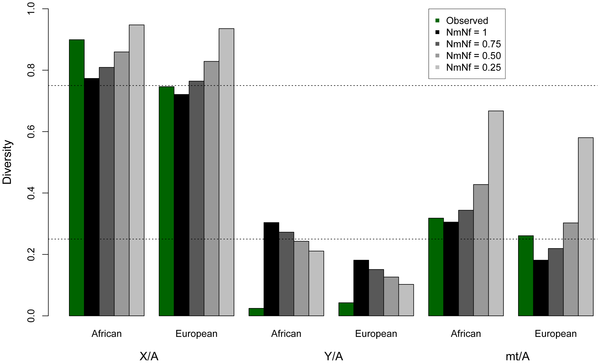
Even the Y chromosome is dwindling. Is it at risk of being lost?

The human Y chromosome contains 27 unique genes, compared to thousands on other chromosomes. Some mammals have already lost their Y chromosome, though they still have males, females and normal reproduction. This has led people to speculate that the Y chromosome is becoming superfluous. But the genes on the Y chromosome are important, they have been maintained by selection.  They're probably not going anywhere.