Banner
Ousiometrics Analysis Says All Human Language Is Biased

A new tool drawing on billions of uses of more than 20,000 words and diverse real-world texts claims...

Wavelengths Of Light Are Why CO2 Cools The Upper Atmosphere But Warms Earth

There are concerns about projected warming on the Earth’s surface and in the lower atmosphere...

Here's Where Your Backyard Was 300 Million Years Ago

We may use terms like "grounded" and terra firma to mean stability and consistency but geology...

Convergent Evolution Cheat Sheet Now 120 Million Years Old

One tenet of natural selection is a random walk of genes but nature may be more predictable than...

User picture.
News StaffRSS Feed of this column.

News Releases From All Over The World, Right To You... Read More »

Blogroll

Screening for colorectal cancer (CRC) in European countries is highly effective in reducing mortality from the disease. Some of the resources currently being devoted to breast and prostate screening programmes, where the evidence of effectiveness is much less clear-cut, should be reallocated to the early detection of CRC, the 2013 European Cancer Congress (ECC2013) [1] will hear today (Sunday).

The first Phase II study to investigate the use of the anti-cancer drug, everolimus, for the initial treatment of advanced papillary kidney cancer has shown that it is successful in slowing or preventing the spread of the disease, according to research to be presented today (Sunday) at the 2013 European Cancer Congress (ECC2013) [1].

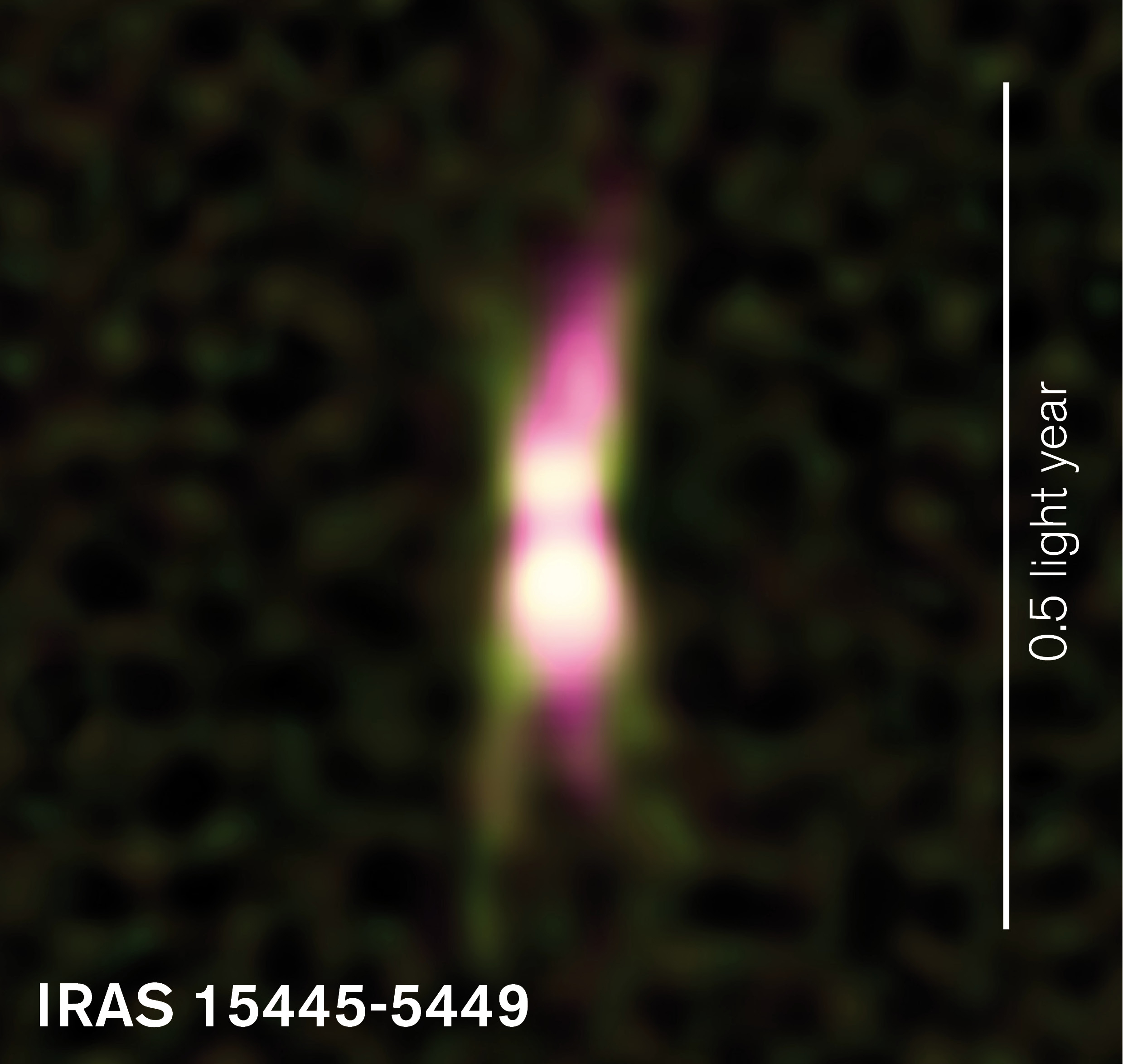
 An old star, IRAS 15445-5449, is "blooming" in the southern sky — it has begun to push out a jet of charged particles that glow with radio waves. And astronomers are on the hunt to determine why 

Researchers recently used a laser to accelerate electrons at a rate 10 times higher than conventional technology in a nanostructured glass chip smaller than a grain of rice, an advance that could dramatically shrink particle accelerators for science and medicine.

 Because it employs commercial lasers and low-cost, mass-production techniques, the researchers believe it will set the stage for new generations of "tabletop" accelerators.

At its full potential, the new "accelerator on a chip" could match the accelerating power of SLAC's 2-mile-long linear accelerator in just 100 feet, and deliver a million more electron pulses per second.

Instead of letting them mess around on the Wii or, worse, watching a "Baby Einstein" video, the way to make kids of all ages and incomes smarter could be as simple as handing them a few blocks.

Playing with blocks may help preschoolers develop the kinds of skills that support later learning in science, technology, engineering, and math (STEM), according to a new study.

More than a hundred 3-year-olds of various socioeconomic levels took part in the study. Children who were better at copying block structures were also better at early math, the study found. Among the skills tested were whether children could figure out that a block belongs above or below another block and whether they aligned the pieces.

Streamers may be great for decorating a child's party, but in dielectrics they are the primary origin of electric breakdown and can cause catastrophic damage to electrical equipment, harm the surrounding environment, and lead to large-scale power outages. 

Understanding streamers and the mechanisms behind their initiation, acceleration and branching is necessary to devise better solutions to avoid them. A team of researchers at MIT have developed an accurate 3-D model of streamer propagation that qualitatively and quantitatively describes the streamer development, an advance that may impact applications such as medical imaging, aerospace engineering, power transmission, atmospheric sensing, natural sciences, sensing technologies and large-scale industry.