Banner
Ousiometrics Analysis Says All Human Language Is Biased

A new tool drawing on billions of uses of more than 20,000 words and diverse real-world texts claims...

Wavelengths Of Light Are Why CO2 Cools The Upper Atmosphere But Warms Earth

There are concerns about projected warming on the Earth’s surface and in the lower atmosphere...

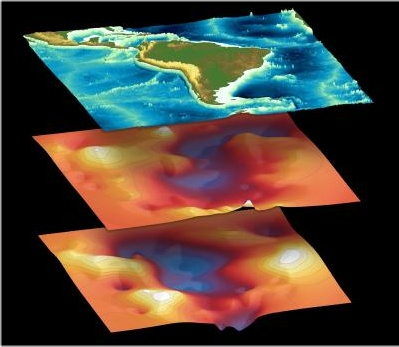
Here's Where Your Backyard Was 300 Million Years Ago

We may use terms like "grounded" and terra firma to mean stability and consistency but geology...

Convergent Evolution Cheat Sheet Now 120 Million Years Old

One tenet of natural selection is a random walk of genes but nature may be more predictable than...

User picture.
News StaffRSS Feed of this column.

News Releases From All Over The World, Right To You... Read More »

Blogroll

 Akawaio penak,  a previously unknown genus of thin, eel-like electric fish, was discovered in the shallow, murky waters of the upper Mazaruni River is northern Guyana.
University of Toronto Scarborough professor Nathan Lovejoy.

If you began to travel to the star nearest to us after ol' Sol, named Alpha Centauri, it takes about four light years.  

Now imagine there were instead 10,000 other stars crammed into that 25 trillion miles of space rather than none - that's the kind of density of a galaxy that was recently discovered.

New evidence suggests than no continental ice sheet formed during the Late Cretaceous Period more than 90 million years ago, when the climate was much warmer than it is today, though it has been commonly believed to have happened that way. 

Psychopathy is a personality disorder characterized by a lack of empathy and remorse, shallow affect, glibness, manipulation and callousness. Though less than one percent of the general population meet the criteria, the rate of psychopathy in prisons is around 23%. 

As you might suspect, psychopaths don't much care when people are in pain. 

A new paper using functional magnetic resonance imaging (fMRI) on the brains of 121 inmates of a medium-security prison in the USA finds that in psychopaths, the brain areas necessary for feeling empathy and concern for others fail to become active and be connected to other important regions involved in affective processing and decision-making. 

A new study finds that a 'microbial clock' may help forensic scientists who are attempting to determine the time of death in cases involving human corpses. 

The 'clock' in this instance is essentially the lock-step succession of bacterial changes that occur postmortem as bodies move through the decay process, much like estimates used to be made involving knowledge of rigor mortis.

Currently, investigators use tools ranging from the timing of last text messages and corpse temperatures to insect infestations on bodies and "grave soil" analyses, with varying results. And the more days that elapse following a person's demise, the more difficult it becomes to determine the time of death with any significant accuracy. 

Deep earthquakes occur where the oceanic lithosphere, driven by tectonics, plunges under continental plates – examples are off the coasts of the western United States, Russia and Japan.

Some new research is a step toward replicating the full power of these earthquakes to learn what sets them off and how they unleash their violence and was made possible only by the construction of a one-of-a-kind X-ray facility that can replicate high-pressure and high-temperature while allowing scientists to peer deep into material to trace the propagation of cracks and shock waves.