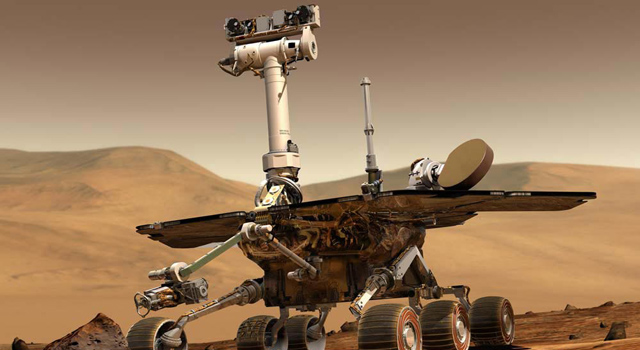
The team operating NASA's Mars Exploration Rover Spirit plans diagnostic tests this week after Spirit did not report some of its weekend activities, including a request to determine its orientation after an incomplete drive.
On Sunday, during the 1,800th Martian day, or sol, of what was initially planned as a 90-sol mission on Mars, information radioed from Spirit indicated the rover had received its driving commands for the day but had not moved. That can happen for many reasons, including the rover properly sensing that it is not ready to drive. However, other behavior on Sol 1800 was even more unusual: Spirit apparently did not record the day's main activities into the non-volatile memory, the part of its memory that persists even when power is off.
Recent studies have suggested that autism spectrum disorder (ASD) may be more prevalent among children born very prematurely. The early symptoms of ASD are also associated with other conditions related to preterm births, such as cerebral palsy, which can make it difficult to correctly screen children for ASD. Because of this, researchers have begun to explore the relationship between preterm birth, cognitive and developmental impairments, and ASD.
Two articles soon to be published in The Journal of Pediatrics explore this possible correlation between preterm birth and ASD.
We get a spectacular new into the active galaxy Centaurus A - NGC 5128 - as the jets and lobes emanating from the central black hole have been imaged at submillimeter wavelengths for the first time.
Centaurus A is our nearest giant galaxy - about 13 million light-years away in the southern constellation of Centaurus. It is an elliptical galaxy, currently merging with a companion spiral galaxy, resulting in areas of intense star formation and making it one of the most spectacular objects in the sky. Centaurus A hosts a very active and highly luminous central region, caused by the presence of a supermassive black hole (see ESO 04/01), and is the source of strong radio and X-ray emission.
Taking up valuable land and growing edible crops for biofuels poses a dilemma: Is it ethical to produce inefficient renewable energies at the expense of an already malnourished population? David Pimentel and colleagues from Cornell University highlight the problems linked to converting a variety of crops into biofuels. Not only are these renewable energies inefficient, they are also economically and environmentally costly and nowhere near as productive as projected.
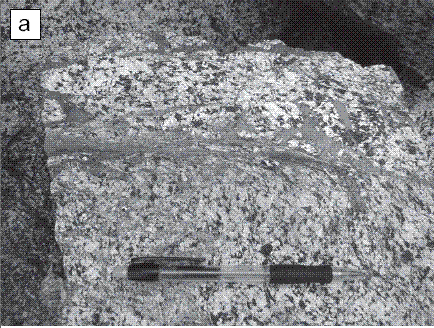
Rocks formed only under the extreme heat and friction during earthquakes, called pseudotachylytes, may be more abundant than previously reported, according to new research focused on eight faults found in the Sierra Nevada. The research appears in the February issue of the Bulletin of the Seismological Society of America.
Geologists have previously debated whether these rocks are rarely produced or not based on an apparent absence in the rock record, most likely brought about by the difficulty in identifying them. Only a small fraction of the energy released in an earthquake is consumed by seismic waves, the formation of pseudotachylytes reveals the importance of the heat generated by the earthquake process.
How the brain keeps tabs on what happened and when is still a matter of speculation but a computational model developed by scientists at the Salk Institute for Biological Studies now suggests that newborn brain cells—generated by the thousands each day—add a time-related code, which is unique to memories formed around the same time.
They didn't set out to explain how the brain stores temporal information but were interested in why adult brains continually spawn new brain cells in the dentate gyrus, the entryway to the hippocampus. The hippocampus, a small seahorse-shaped area of the brain, distributes memory to appropriate storage sections in the brain after readying the information for efficient recall.


 Synchrotron Could Shed Light On Exotic Dark Photons
 The Pain Scale Is Broken But This May Fix It
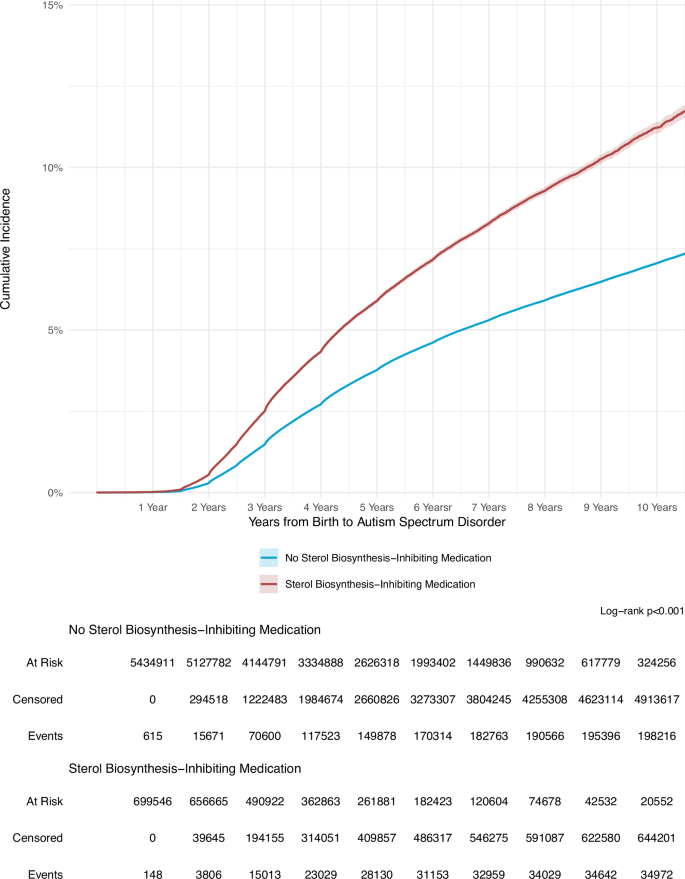 Study Links Antidepressants, Beta-blockers and Statins To Increased Autism Risk
 Pilot Study: Fibromyalgia Fatigue Improved By TENS Therapy