




Get ready for the world's first atomic microscope.
A team of physicists from the Autonomous University of Madrid (UAM) and the Madrid Institute of Advanced Studies in Nanoscience (IMDEA-Nanociencia) has created the “quantum stabilized atom mirror”, the smoothest surface ever, according to this week's edition of Advanced Materials magazine.
One of the study's authors, Rodolfo Miranda, professor of condensed matter physics at the UAM and director of the IMDEA-Nanociencia, explained to SINC that the innovation with this almost perfect mirror is the ability to reflect “extraordinarily well” most of the atoms that affect it, through the use of materials of nanometric thickness whose properties are dominated by quantum effects.
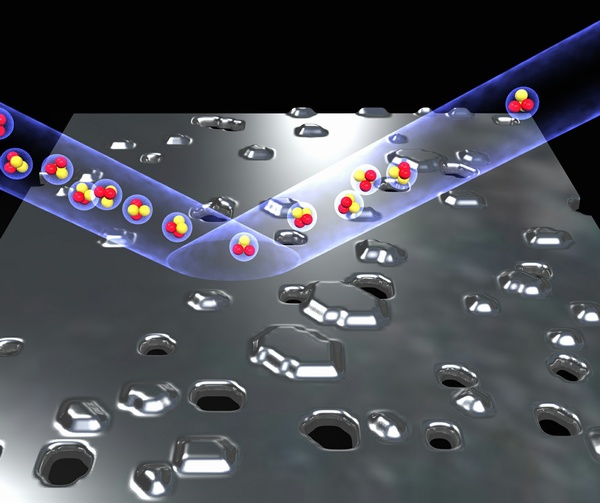
The mirror resembles a curved wafer. It is made up of a thin silicon crystal with a thickness of 50 microns, and covered with a very fine layer of lead, 1 or 2 nanometres thick. To study the reflection on this metal, the scientists used helium atoms. Until now mirrors made solely from silicon reflected 1% of helium atoms, but by adding the layer of lead they have managed to achieve a reflection of up to 67%.
The lead is deposited on the silicon at a temperature of between -173º and -133º C which, together with the nanometric thickness of the lead, allows its quantum properties to “come to the surface”, and, in an “astonishing and spontaneous” way, bumps on the surface become evened out and a super flat layer is created. “The extraordinary thing about this process is that when the material is heated to room temperature, it does not distort or break, but instead becomes even flatter, enhancing its reflection properties”, Miranda indicated.
These types of mirrors are vital for manufacturing future atomic microscopes. Until now electronic microscopes have achieved the highest resolutions when it comes to viewing objects, but with the disadvantage that the accelerated electrons they use destroy the most delicate biological samples, such as cell membranes or certain protein structures. “With atomic microscopes we hope to achieve the same resolution but without damaging samples”, said the professor of physics.
Miranda pointed out that atoms have a much greater mass than electrons, “which is why we can achieve the same wavelength with far lower energy, allowing us to observe things as small as those observed with an electronic microscope, but without destroying what we are viewing”.
The Spanish researchers, together with the team led by Bill Allison at the University of Cambridge (United Kingdom) and Bodil Holst at the University of Graz (Austria), are now working with the first prototypes of atomic microscopes that use quantum stabilised mirrors, and are confident that the first images obtained with them will be ready next year.
Article: Daniel Barredo, Fabián Calleja, Pablo Nieto, Juan José Hinarejos, Guillame Laurent , Amadeo L. Vázquez de Parga, Daniel Farías, Rodolfo Miranda. “A Quantum-Stabilized Mirror for Atoms”. Advanced Materials 20 (18): 3492. SEP 2008





Comments