




The value of public education over home-schooling or private has been touted by proponents as social adjustment, so there was also concern about how children might be stunted by not having access to anything except close family and device screens.
A new paper says the damage of extended lockdowns will be expensive and time-consuming to fix, because long lockdowns hindered children’s executive functions, like ability to regulate behavior, stay focused and adapt to new situations. Students who were just entering the age of schooling were impacted the greatest. They showed less growth in their self-regulatory and cognitive flexibility scores over time compared to a second group of children who were in preschool when the pandemic started.
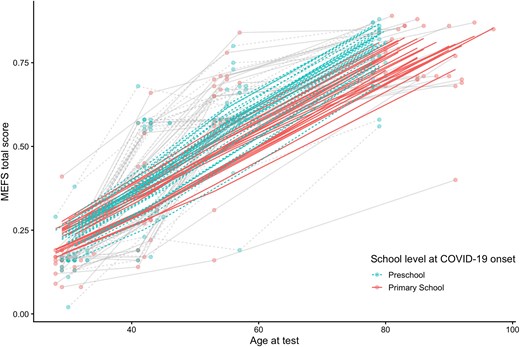
Individual trajectories of Minnesota Executive Function Scale total scores over ages at test for children from cohort 2 with three or more observations. Solid gray lines connect data points (red dots) for each child longitudinally for children who were in primary school during the first COVID lockdown in the United Kingdom. Solid red lines show predicted linear trajectories for these same children from the linear mixed-effects model. Dashed lines connect data points (blue dots) for each child in preschool during the first COVID lockdown; dashed blue lines show predicted trajectories for these children.
It happened because there was already a long-term study tracking youngsters from toddlerhood to early school years when the SARS-CoV-2-caused pandemic erupted from Wuhan, China and spread across most of the world. It included 139 children aged between two-and-a-half and six-and-a-half years old, including 94 families who joined the study before the pandemic. Having a baseline of children’s abilities before the pandemic began allowed them to track exactly how development changed during and after the lockdowns. They used the Minnesota Executive Function Scale to measure the same cognitive skills at regular intervals.
Kids just entering school were impacted because classrooms were closed, routines collapsed overnight, and opportunities for social interaction were severely limited. Results showed that
self-regulatory skills didn’t develop as quickly year-on-year after the lockdowns ended.
Individual differences in executive function abilities were stable. Children who had stronger skills at two-and-a-half years old tended to remain ahead at six-and-a-half years but COVID-19’s impact was evident. Children who would've entered school at the start of the pandemic made fewer improvements in executive function compared to those still in preschool.
Citation: Eleanor Johns, Samuel H Forbes, Lourdes M Delgado Reyes, Charlotte Buck, John P Spencer, Tracking the trajectory of executive function from 2.5 to 6.5 years of age and the impact of COVID-19, Child Development, 2026;, aacag002, https://academic.oup.com/chidev/advance-article/doi/10.1093/chidev/aacag...




Comments