Fake Banner
    Introduction To Radiation
    By Siju Mammen | March 17th 2011 08:42 AM | 61 comments | Print | E-mail | Track Comments
    About Siju

    A computer engineer from South Africa currently busy studying nuclear engineering....

    View Siju's Profile
    Given the general fear regarding radiation levels around Japan, this seems the perfect time to give a short introduction to this important topic. There is a lot of confusion regarding radiation and radiation poisoning and this article will try and break it down. 

    Radioactive decay

    To start off with, here is a little recap of the physics that is important. Atoms can be thought of as made up of protons, electrons and neutrons. The type of element is determined by the number of protons. The number of protons in any element is fixed, but the number of neutrons is variable (within limits). When you get 2 atoms of an element, with a different number of neutrons, they are known as isotopes of that element. The number of neutrons affects the stability of the atom and for every naturally occurring atom, there is a optimal number (or range of numbers) of neutrons needed to keep the atom stable.

    During fission reactions (the type of reactions in all commercial nuclear power stations), unstable isotopes of an element are created from the splitting of an atom. These unstable isotopes will eventually decay via one of various decay processes. Three of these processes are important for our discussion: alpha, beta and gamma decay. 
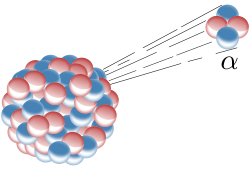


    During alpha decay, the unstable atom emits a helium nuclei (composed of 2 neutrons and 2 protons) from the atom. 


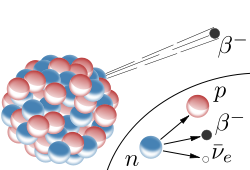
    There are 2 types of Beta decay (Beta- and Beta+).  
    •  Beta- decay occurs for isotopes with an excess of neutrons. During this decay, a neutron is converted into a proton (thereby changing the element) while releasing an electron and another elementary particle known as a neutrino. (N.B. The neutrino is largely irrelevant for this discussion due to the fact that they (for all practical purposes) do not interact with everyday matter.)
    • Beta+ decay can occur if there are too few neutrons in the nucleus. In this case, a proton is converted into a neutron while emitting a positron (same as a electron except that the charge is positive instead of negative) and a neutrino. Beta+ decay can only occur if the atom has enough energy to overcome the mass difference between an proton and a neutron. (If the atom doesn't have enough energy, a process known as electron capture occurs where a proton captures an electron to become a neutron while emitting a neutrino - this process doesn't emit anything (except the neutrino which is irrelevant) and therefore cannot be considered a form of atomic decay.)
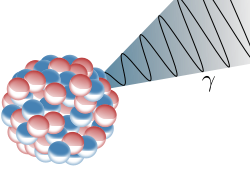


    The last form of radioactive decay to be discussed here is gamma decay. Generally this type of decay will accompany an alpha or a beta decay. After an alpha or beta decay, the remaining atom can be in an excited state. In this situation, the atom can radiate a high energy photon to lose some of the excess energy that it possesses.


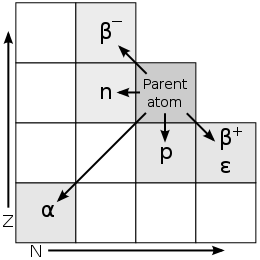
    (Added during editing) During the alpha and beta forms of decay described above, the parent element will change to another element. The resulting atom can easily be determined by identifying the remaining number of protons and neutrons. The following graphic clearly depicts the outcome of these 2 types of radiation as well as the atomic changes that occur when an atom loses a proton (p) or a neutron(n). A change in the row means that a change in element.


    Ionizing radiation

    Ok, now that most of the relevant nuclear physics is covered, lets move on to another important concept. Radiation is known as ionizing, if when it interacts with an atom, it creates an ion (a charged particle). This occurs when the emitted radiation detaches electrons from another atom or molecule. 

    Whether or not radiation will be ionizing is dependent on the energy of the radiation. In other words, a single particle or photon of radiation must posses a certain amount of energy before it is able to ionize an atom or molecule, the cumulative amount of energy is irrelevant. 

    Ionizing radiation is important because the resultant charged molecule or atom (aka free radicals) is chemically quite reactive. If the radiation has ionized a molecule within living organism, then the resulting free radicals can damage the DNA within a cell. In addition to this, Ionizing radiation can directly damage the DNA by ionizing it or by literally breaking through the bonds of the DNA molecule. 

    It is clear then that being exposed to large amounts of ionizing radiation is detrimental to health. 

    The Lingo 

    Now that we know the types of radiation and how it can potentially effect us, let us try and work through the different terms that is common when dealing with radiation. Most of us think we know exactly what it all means, but the reality is a bit different. The following are the most important terms to know:

    Absorbed dose: this refers to the total energy that has been deposited into a certain mass of an item - measured in units called grays.

    While this measure is important, it is an incomplete measure of the effect that a certain amount of radiation will have on a biological entity. Due to the fact that a minimum amount of energy is required for ionization, a photon will not be able to affect a cell in the same way that an alpha particle of the same energy would. As a general principle, the heavier the particle, the more biologically damaging it is. To cater for this, weighting factors are added to this measure so that a more synthetic, but more biologically significant measure of radiation is identified. 

    Equivalent dose: this refers to the absorbed dose weighted by a weighting factor dependent on the mass of the particle and it's energy - measured in a unit called sieverts. A weighting factor table can be found in Wikipedia's "Equivalent dose" entry (http://en.wikipedia.org/wiki/Equivalent_dose)

    The earth naturally exposes us to radiation, and while the cumulative dose has its value, the more prudent measure would be the absorbed dose rate and equivalent dose rate.

    (NB. What gets reported in the the media is the Equivalent dose rate. Well if you ask, how do they identify the type of particle depositing the energy so that you can multiply the weighting factor, the simple answer is that they don't. Luckily the radioactive material that is released into the environment due to the venting of steam and other non-catastrophic releases, decays using beta and gamma decay. The weighting factor for these 2 types of radiation is 1 which means that the total energy absorbed is equal to the equivalent dose. The instruments used to measure them are actually measuring the total energy)

    Geiger counter: this is the device that gets used to measure the energy of ionizing radiation in an area. This device is a useful portable device and can measure beta and gamma radiation quite well. 

    Half-life: this refers to the time taken for half of a certain isotope to decay. It is impossible to predict when an individual atom of an isotope will decay, but the half-life can be used to determine approximately how many atoms of an isotope can decay in a certain time period - which in turn allows us to know how much energy is released in that time period due to the decay. 


    Biological half-life: This is not a very commonly used term outside of the medical industry, but it is important none the less. The Biological half-life refers to the amount of time it will take for about half of a certain substance to be flushed out of a human's system. The substance can be a drug, radioactive substance or any other consumed substance. 

    The reader should now have sufficient knowledge about this topic to understand what typically can occur when exposed to radiation. This will be the topic of the next section. 

    Direct exposure from the outside

    As mentioned, the heavier the decay particle, the more effect it will have on biological cells. As such alpha particles will have a greater effect on an individual than lighter photons or gamma particles. Alpha particles are generally only released by large heavy atoms. These large atoms, when they are produced in a nuclear reactor, are trapped within the fuel pellet of a reactor and will not be transported outside of the fuel unless the fuel is severely damaged and the containment is completely breached. Because of this almost all of the alpha particles released will be in around the fuel rods. Alpha particles can however be easily stopped by something as thin as a sheet of paper and are therefore not an extremely dangerous threat.

    Beta particles are a lot lighter than alpha particles and therefore their effects are not as severe. However, these particles are more difficult to shield against than alpha particles. Without aluminium shielding, Beta particles can penetrate the skin of a person and ionize molecules within his body.

    Gamma particles are high energy photons. These particles are the most difficult to shield against, and requires several inches of lead or concrete to protect against them completely. There will be a constant barrage of gamma particles around exposed spent fuel rods and this is one of the reasons why there will be severe problems if a worker is exposed to a spent fuel rod directly. These concentration of gamma particles will decrease as the distance from the source increases and therefore the highest risk will be closest to the reactor. 

    Radioactive particles released to the environment

    Radioactive isotopes can be broadly categorized into short-lived, medium-lived and long-lived isotopes. While there is no strict definition of what constitutes any category, these categories can be used to identify an important characteristic of radiation. 

    As was indicated previously, the rate at which energy is released is more important than total energy released. And due to the facts that short lived isotopes have very small half-lives, there will be an initially high rate of radioactive exposure from the decay of these particles. However, because these particles have such short half-lives, their larger environmental consequences are minimal i.e. they might kill everything in sight quickly, but it will be safe for people to live there almost immediately afterwards. (The large spikes in radiation during a nuclear accident are caused by short-lived isotopes)

    The long-lived isotopes are a curious bunch. The energy released is distributed over such a large period of time that their actual biological effects are difficult to ascertain. In other words, your great-grandchild could get a tumor, but the statistical probability of that happening would be equivalent to anyone else's great-grandchild getting a tumor. 


    Now, the so called medium-lived isotopes are a little bit more problematic than the short or long lived isotopes. These isotopes do not decay very quickly, but do not remain stable long enough as to make its effects indistinguishable from the environment. So in other words, its effects might kill you and you probably wouldn't be able to move to an area affected by it for quite a significant amount of time (in human terms).

    So are all the panic buttons ringing now.... hold on for a second. Over 99% of all fission products are retained in the fuel cells. In normal operation. there are virtually no radioactive isotopes escaping the fuel cell. The water used to cool a reactor under normal operations is de-mineralized water and therefore contains virtually no impurities. The neutrons, beta and gamma particles reaching the water does not activate any of the molecules in the water, and it remains safe. In emergency conditions where water with impurities are used (such as seawater) the beta and gamma particles together with some neutrons will slightly activate (make radioactive) the water. However, if the fuel rods are damaged or cracked, then the fission products could mix with the water making it radioactive. If this fuel is then vented to relieve pressure, then these radioactive isotopes will be released to the environment. A certain amount of fission products can also escape from exposed fuel rods if they are damaged. 

    If fission products are released into the environment, then they are free to interact with natural processes like the hydrological cycle and become part of the "chain of life". The larger effect of even modest releases of radioactive materials into the atmosphere will generally be dispersed and would be unlikely to cause above-normal rates of disease. If catastrophic release occurs, like in the case of Chernobyl, where almost all the fission products were released into the environment, then significant measurable consequences will occur.

    Main isotopes to watch out for

    While there are countless fission products being produced in a reactor, not all of these products will cause the same amount of damage to humans. Many of the fission products can be avoided by staying indoors and by thoroughly cleaning yourself if you are exposed. Many others will be inhaled as you move about but have such short biological half-lives (a measure of the time the isotope will stay in your body) that they will not cause serious health risks to the public. There are 3 main isotopes that could be potentially harmful:

    Iodine-131: This is a short-lived radioactive element. It can easily enter your body since your thyroid gland can easily absorb Iodine from the environment. Iodine-131 has a half-life just over 8 days and can cause significant damage to cells by Beta decay. Absorbing Iodine-131 will increase the risk of thyroid cancer. Potassium Iodide capsules can be taken to prevent the body from absorbing the radioactive Iodine. The Potassium Iodide saturates your body with Iodine preventing further absorption. The capsules must be taken daily for as long as a significant threat exists. 

    Caesium-137: This is a medium-lived radioactive element. It is a soluble toxic element that has a half-life of about 30 years. Within a human body, it has a biological half life of around 70 days, but untreated, could cause significant damage if the equivalent dose is high enough. Caesium will biologically act similar to potassium but cannot be absorbed through inhalation. If accidental ingestion does occur, Caesium can be treated with the Chemical Prussian blue - a dye with some medical uses.

    Strontium-90: This is also a medium-lived radioactive isotope with a half life of around 29 years. It can behave similar to Calcium. It usually enters the body through drinking or eating contaminated foods and drinks. It will attach itself to bones and can cause cancer if the dose is high enough. 

    Biological Effects

    Well now that you know all of this, what does this mean to us? Well - once the DNA in a cell is damaged, it is not the end for us. Not by any long shot. DNA is an interesting chemical in that it has the peculiar ability to be able to repair itself. Given that, the following  scenarios could occur:

    1. The DNA in the cell is damaged but it is able to repair itself  
    2. The DNA in the cell is damaged and cannot repair itself - the automatic cell death occurs  
    3. The DNA in the cell is damaged, it cannot repair itself, and has damaged the automatic cell death mechanism - the cell continues it's function in a damaged way, but cannot propagate the damaged genes  
    4. The DNA in the cell is damaged, it cannot repair itself,  has damaged the automatic cell death mechanism, the cell continues it's function in a damaged way, it propagate the damaged genes, but does not cause a malignant tumor  
    5. The DNA in the cell is damaged, it cannot repair itself,  has damaged the automatic cell death mechanism, the cell continues it's function in a damaged way, it propagate the damaged genes, and cannot help but form a malignant tumor  

    Cells have developed these capabilities through evolution as a means to survive cell damage. In fact, one should not be constrained to thinking that DNA damage is only caused by radiation. There are various reasons why free radicals can form within the body and damage DNA. Even a significantly strong heat source will damage cells.

    (Added during editing) The following diagram puts the whole situation into perspective:
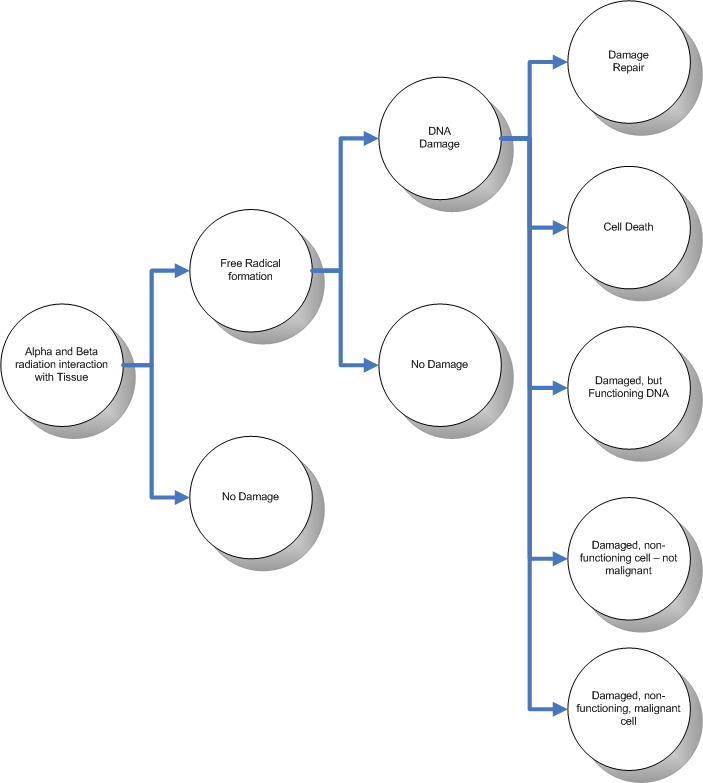


    The various scenarios described above are largely dependent on the extent of the radiation exposure onto the cell. The higher the exposure, the more likely that the exposure will cause detrimental cell damage.

    Doses and Risks

    I hope this discussion has helped give readers a reasonable understanding of how radiation effects people in general. What is important to note is that the amount of radiation that is received is the key to determining what level of biological effect the radiation will have on the individual.  The following list (extracted from wikipedia) will give an estimate of what the effects of a certain amount of cumulative radiation exposure within a short period will be. 

    • 0 – 0.25 Sv (0 - 250 mSv): None
    • 0.25 – 1 Sv (250 - 1000 mSv): Some people feel nausea and loss of appetite; bone marrow, lymph nodes, spleen damaged.
    • 1 – 3 Sv (1000 - 3000 mSv): Mild to severe nausea, loss of appetite, infection; more severe bone marrow, lymph node, spleen damage; recovery probable, not assured.
    • 3 – 6 Sv (3000 - 6000 mSv): Severe nausea, loss of appetite; hemorrhaging, infection, diarrhea, peeling of skin, sterility; death if untreated.
    • 6 – 10 Sv (6000 - 10000 mSv): Above symptoms plus central nervous system impairment; death expected.
    • Above 10 Sv (10000 mSv): Incapacitation and death.  
    A more detailed table can be found on Wikipedia's article on Acute Radiation Sickness. As a general rule of thumb, exposure should be limited to below 100mSv under normal conditions, and even in extreme circumstances no exposure above 1 Sv should be permitted. Once you exceed the 1 Sv level, effects will become increasingly severe.

    (The original article has been extended with clarifications and diagrams to enhance the reader's experience. Where additions have been made, these have been identified. Several grammar and spelling corrections were done and these have not been explicitly stated.)

    Epilogue

    As a final word, I'd like to say a few words about the events unfolding in Japan and to all of us reporting on the incident. The crew trying to control the reactors there are risking their lives to do what they must. Truly selfless individuals! 

    Shame on all of us who have tried to manipulate these events to suit our own agendas. Instead of leaving conjecture and speculation to the side we used this opportunity to nit pick each other's viewpoint. The outcome of these events will be change the outlook of the world, whether we want the change or not. But us bickering over nothings helps no one. I think we owe it to those hardworking men and women who are struggling to overcome these massive challenges to take a step back and just watch the work that they are doing. Leave the commentary for afterwards. 


    Comments

    Bonny Bonobo alias Brat
    Great article Siju, thanks for explaining radiation and radiation poisoning so succinctly, though Im afraid that I don't agree completely with your final comment. I am appalled that people's lives and health are being risked while these challenges are hopefully being overcome, and I think that commentary is better than no commentary in such situations :-
    I think we owe it to those hardworking men and women who are struggling to overcome these massive challenges to take a step back and just watch the work that they are doing. Leave the commentary for afterwards.

    I'm also still confused about the differences between the effects of uranium and plutonium being used as fuel at nuclear reactors, especially when they are malfunctioning.
    Samshive
    The main differences between using different types of fuels in a reactor are that the yields (the amount produced) of certain isotopes will be different. So, for instance, it could be that fuel 1 produces about 5% of the isotope Iodine-131 as a fission product, while fuel 2 produces about 7% (not that these are only guesses of the actual yield - you'll need to read up on what the actual yields are). And since the yields are different, if the fission products are released into the environment, the extent of the effect on humans would be different.
    I'm guessing that your question is more concerned with the dangers of using MOX fuel in reactors - thats another topic altogether. And I want to state clearly that there is no chance that the MOX fuel in the reactor can go critical again because the control rods are inserted. Hype about making the reactor re-critical are out there with Russel's teapot. 
    Bonny Bonobo alias Brat
    So Siju are you saying that this article called 'Plutonium Worse than Uranium' to which there is a link from Science20 under the RealClearScience Section on the RHS of our screens, is misleading or far-fetched? It claims that :-

    Scientists say plutonium may be the worst of all the fission byproducts that could enter the environment as a result of the Fukushima nuclear disaster. That's why MOX fuel rods that are piled up in spent fuel pools near the Unit 3 reactor, which consist of a mix of plutonium and uranium isotopes, have become the number one concern of workers at the plant. Plutonium-239, the isotope found in the spent MOX fuel, is much more radioactive than the depleted Uranium-238 in the fuel.

    but the bit that I found the most worrying was where it also claims :-
    There are documented cases of workers at nuclear weapons facilities dying within days of experiencing brief accidental exposure to plutonium, according to the Hazardous Substances Data Bank.Furthermore, among all the bad things coming out of Fukushima, plutonium will stay in the environment the longest. One isotope of plutonium, Pu-239, has a half-life of 24,100 years; that's the time it will take for half of the stuff to radioactively decay. Radioactive contaminants are dangerous for 10 to 20 times the length of their half-lives, meaning that dangerous plutonium released to the environment today will stick around for the next half a million years.

    Is this true and if so does iodine help protect people against plutonium contamination?

    Gerhard Adam
    This sounds a little like arguing whether it is worse to get shot with a .357 than a .45.  Not sure it much matters to the person shot.
    Bonny Bonobo alias Brat
    Yes, it doesn't really matter to the person shot but what about the environment and life on Earth? I simply can't believe that experts have been saying that these nuclear reactors are almost completely safe (as nothing is completely risk free they claim) if there is even the remotest possibility that dangerous plutonium can be released into the environment and it won't become safe for half a million years. Is this a real risk right now in Japan or a misleading article? That's what I want to know.
    Gerhard Adam
    Yes, this would be a real risk, however it is an ongoing problem since nuclear waste needs to be disposed of in any case.  The long half-life relates to particular isotopes, so that some can be quite long while others quite short.
    http://www.nrc.gov/reading-rm/doc-collections/fact-sheets/plutonium.html

    http://www.atsdr.cdc.gov/ToxProfiles/tp143-c2.pdf
    http://www.atsdr.cdc.gov/toxfaqs/tfacts143.pdf
    http://www.atsdr.cdc.gov/toxguides/toxguide-143.pdf

    http://www.cdc.gov/nceh/clusters/fallon/uraniumfaq.htm

    Bear in mind that radioactive materials, in general, do not go well with biological systems.  The greatest risk is if radioactive materials get ingested or breathed in, since the protection offered by the skin is bypassed with soft tissues being more sensitive to radioactive exposure.

    The long half-lives quoted are often more of a shock than anything else, but in reality it's largely irrelevant, since the concern should be to focus on the next several hundred years (which is sufficiently problematic).  In other words, one of the primary arguments against the way radioactive waste materials are handled, is that the half-life requires containment for periods of time longer than all of recorded human history.  I know few people (even those that downplay the risks) that have an answer for how such waste sites are to be maintained for all those future generations.
    Bonny Bonobo alias Brat
    OK, that explains why the whole world News is focused on Reactor 3 where the explosions keep  happening, because that is where this horrendously dangerous MOX plutonium resides. It also explain why they are not focusing on the millions of stricken Japanese people who are also dying of cold and hunger while wearing their face masks, in more ways than one.
    Gerhard Adam
    I simply can't believe that experts have been saying that these nuclear reactors are almost completely safe (as nothing is completely risk free they claim) if there is even the remotest possibility that dangerous plutonium can be released into the environment and it won't become safe for half a million years.
    Well, I don't want to get you worked up over this, but perhaps you should read this link if you want to see how badly it can be handled.
    http://www.cdphe.state.co.us/rf/plutoniu.htm

    Bear in mind the distinction I've been trying to make with the safety of the science, versus the implementation of the technology, versus the political/economic decisions that determine how it is finally performed.

    The reason I'm point this out is that if you look at how this plays out, you'll see that this has little or nothing to do with science, and everything to do with how such technology is deployed. 
    Bonny Bonobo alias Brat
    Gerhard, thanks for the informative plutonium link, don't worry I'm already worked up, I would rather understand these things than stick my head in the sand, especially the sand around Rocky Flats. I found the answer to this question quite amazing :-
    Can an individual's exposure to plutonium be measured externally or internally?

    A person’s plutonium exposure cannot be measured from outside the body, although estimates can sometimes be made by measuring radiation from other materials deposited along with the plutonium. Urine or fecal samples can be analyzed for plutonium, primarily to evaluate the magnitude of known or suspected intakes. These methods are difficult to interpret when multiple intakes have occurred and because very little deposited plutonium leaves the body.
    Halliday
    All:

    What gets me about this concern over Plutonium/MOX is that there is very little difference between the human/biological risk of Plutonium vs. Uranium:  They have very similar radiation pathways, they have very similar chemical properties, they both have similar chemical toxicities, they both tend to accumulate within your bones (since they are both chemically similar to Calcium and other Calcium replacing elements) where they then slowly decay (and all that implies).

    Furthermore, depending upon the particular isotopes of each element we may compare, they have order of magnitude similar lifetimes (with the more stable Uranium isotopes having longer lifetimes than Plutonium, of course, otherwise Plutonium would be found naturally).

    So why all the extra concern over Plutonium/MOX?

    David
    Samshive
    Thanks David, I agree a 100%.
    Bonny Bonobo alias Brat
    So why all the extra concern over Plutonium/MOX?
    Because according to this article and the various articles it references,  MOX plutonium fuel used in Fukushima's Unit 3 reactor is two million times more deadly than enriched uranium. Hopefully you are going to tell me that it is not true?
    Samshive
    The article you linked to is wrong.
    Bonny Bonobo alias Brat
    Good. Thanks Siju.
    Halliday
    Helen:

    That article used an "apples to oranges" comparison (used by the referenced anti-nuclear site's article, which keeps getting such "information" from the same foreign language [German?] document [Küppers, C. and M. Sailer: 'MOX-Wirtschaft oder die zivile Plutoniumnutzung', IPPNW, 1994] that I cannot check) in order to come to the 2 million to to one conclusion.  Considering the nature of the sites involved, one can simply guess as to the reason.

    David
    Bonny Bonobo alias Brat
    Considering the nature of the sites involved, one can simply guess as to the reason.
    Yes David, natural health and plutonium are probably not a good mix but then neither is comparing apples with oranges.

    Halliday
    Helen:

    You said:
    Yes David, natural health and plutonium are probably not a good mix ...
    The point, of course, has been that in almost all ways, Plutonium is no more a "bad mix" with "natural heath" than is Uranium, or so many other radioactive heavy metals.

    In fact, about the only thing that makes Plutonium any less natural than Uranium is that the lifetime of its longest lived isotope is sufficiently short that any Plutonium created along with the other elements beyond Iron that make up this planet became undetectable before modern times.*

    On another aspect of "natural health":  Considering the apparent link between active plate tectonics and a living planet with life in and on its surface (at least Carbon based life), and the apparent nuclear processes that generate the heat that drives that plate tectonics, it seems that the "natural health" of this planet owes its existence (or, at least, continued existence) to nuclear materials.  ;)

    David

    *  I do wonder about the potential for Plutonium generation within the natural Uranium reactors that have been found on this planet, so far.
    Bonny Bonobo alias Brat
    David, I was simply alluding to the fact that the natural health of living, biological organisms like you and I, is not usually a good mix with plutonium or uranium for that matter. Also most of the plutonium on our planet surface is not naturally occurring as it has been man-made in the 20th (and now the 21st century) and scattered across the land as a result of nuclear testing, nuclear weapons and nuclear reactor accidents etc.

    With regard to whether plutonium is more toxic somehow than uranium, well you and Siju have allayed most of my fears, though I do still wonder why according to Wiki answers at  A Difference between uranium 235 and plutonium 239? It claims that :-
    Uranium 235 has 92 protons and electrons, 143 neutrons, atomic mass is cca. 235, is a natural isotope. Plutonium 239 has 94 protons and electrons, 145 neutrons, atomic mass is cca. 239, is an artificial isotope. Plutonium is more toxic than uranium. Also are differences in the types of radiations emmited, half-life and many other chemical and physical properties.
    Yes it is interesting what you said on the aspect of natural health and plutonium :-
    Considering the apparent link between active plate tectonics and a living planet with life in and on its surface (at least Carbon based life), and the apparent nuclear processes that generate the heat that drives that plate tectonics, it seems that the "natural health" of this planet owes its existence (or, at least, continued existence) to nuclear materials.  ;)
    Which of course immediately brings to my mind the nuclear planet hypothesis of J. Marvin Herndon Phd, that there is a nuclear fission georeactor at Earth's center. Apparently, his discovery of the highly reduced, low-oxygen, chemical composition of Earth's interior led to his hypothesis that substantial quantities of uranium would occur in Earth's core, settle by the action of gravity to the center of the Earth, and begin to function as a natural nuclear reactor, which is different to the more generally accepted iron core hypothesis. What do you think about this?
    Samshive
    Hi Helen, 
    Honestly, I think there is a lot of hype around plutonium. Plutonium will not be released into the environment unless they fuel actually explodes - (like in the case of Chernobyl).  I must clarify something I said in my original reply - I commented that the fuel in the reactor will not go re-critical. This is 100% true, but the concern of the authorities are not the fuel in the reactor, but in the spent-fuel pool. There is a slight chance that these could go critical-again, and that is why the authorities are trying to cool down the spent-fuel tanks. 

    I think I might need to write another article about criticality and what it means, but for now, it is sufficient to know that it just means that the chain reaction is started again -  adding boron into the SFPs will prevent this from happening - that is why other countries are sending boron to Japan. So that is one of the concerns in Unit 3. 

    Re-criticality can occur regardless of the type of fuel used - and that is why the spent fuel pools need to be kept cool. And, in the case of MOX fuel - the characteristics of the fuel is slightly different from pure Uranium fuel and that very slightly increases the chance of re-criticality. But to be on the record, even if all the water is dried up in the SFPs, the actual probability of re-criticality is very, very, very low, even in the case of MOX fuels. There are of course other reasons to keep the fuel submerged as exposed fuel-rods (not just MOX fuels) are extremely radioactive. 

    As to the half-life of Plutonium, this will be classified as a long-lived isotope, and as mentioned, it is difficult to correlate the the causes of any adverse health conditions to long-lived isotopes. Also not that plutonium radiates an alpha particle - which is quite easy to shield against.

    As to the documented cases of deaths due to exposure to plutonium, I would have to see these documented cases, but I find this claim highly suspect. Plutonium in weapons facilities are not very radioactive. If the individuals actually consumed the plutonium (which I doubt), he would probably die due to heavy metal poisoning rather than radiation poisoning.  

    And as for your last question, iodine does not protect against plutonium. But, there will be no plutonium being released into the environment unless an explosion in the fuel occurs that sends the fuel flying.

    Don't believe the hype - people just associate plutonium with Bombs, that is where most of the worry stems from. It is no more dangerous than any other nuclear fuel.  
    vongehr
    Fine article, mostly agree, although the alpha radiation is not dangerous because it is especially ionizing (the structure of your article kind of implies this), but because its high momentum can directly break DNA. Just about your last comment that you could not hold back:
    Saying that people are dying of cancer (as by now is clear at least many of the first responders will given the dose they have already gotten) yet saying that this should not be used for a political agenda - sure, just that the agenda was in this case to make nuclear power safer so people do not have to die! Reminds of the water canons that are used to douse the reactors now, which were bought in order to disperse anti-nuclear power protesters.
    Samshive
    Thanks for the clarification about alpha particles. While alpha particles are interesting in their own right, I included the information on them for mostly information purposes. Alpha emitters are usually heavier isotopes and are not easily dispersed in a non-explosive incidents (where the fuel actually explodes), and the effect of alpha particle radiation is mostly irrelevant for the public at large compared to beta and gamma radiation.
    Stellare
    Great, factual and sober article.

    My thoughts also goes to the workers trying to reduce the damage of the nuclear power disaster and hence save lives in Japan right now. It is real heroic work.
    Bente Lilja Bye is the author of Lilja - A bouquet of stories about the Earth
    Samshive
    Thanks a lot. I appreciate the comment.
    logicman
    A great article - now featured.

    One small point:
    ... concentration of gamma particles will decrease as the distance from the source ...

    Square of the distance ?

    MikeCrow
    Since it's light, it follows the inverse square law.
    Never is a long time.
    logicman
    Since it's light, it follows the inverse square law.

    Light?  Electromagnetic radiation!

    I can be a real pain pedant at times, Mi Cro.  ;-)
    rychardemanne
    Do single photons follow the inverse-square law?
    ;-)
    MikeCrow
    Only if there's more than one :)
    Never is a long time.
    MikeCrow
    Technically, you are 100% correct.

    But when you say Electromagnetic Radiation I'm afraid non technical people only see the last word, and they don't get what we're really talking about are photons, ie light.

    An example of this is, I hear many people (including myself) when talking about throwing something into a microwave, referring to 'Nuking' their food.......
    Never is a long time.
    logicman
    Only if there's more than one :)

    There can be only one.  (For Highlander fans.)

    But when you say Electromagnetic Radiation I'm afraid non technical people only see the last word ...

    Ain't that the truth?  That's why I mentioned pedantry.

    Right, I'm hungry.  I think I'll go nuke some grub!    ;-)
    Samshive
    Thanks Patrick for featuring my article - I really appreciate it.
    Bonny Bonobo alias Brat
    Patrick, ever since Siju edited this article to put in some pictures as requested, it has stopped being a featured article. Do you know of any way to get it to be a featured article again? For the first time that I have ever noticed, Hank's avatar is not online, maybe his jumping off the chair experiment to test the supermoon effects went wrong?
    logicman
    Helen: Hank travels a lot.  I don't think the mighty Thor ever sleeps, though. ;-)

    Articles slide off the top featured list as new ones replace them.  I think the number of hits also has something to do with it, but don't quote me.

    I'll leave it to others to decide if this article needs a further bump - I don't want to wear out my bump button.  ;-)
    Bonny Bonobo alias Brat
    Wow, do you have a bump button? I'm just a lowly blogger with no whistles, bells or buttons but once I pointed out something wrong in Sascha's article that he might want to edit (yes I was living life dangerously as usual) and he said he couldn't edit it because it would stop it from being a featured article, so presumably he had worked that out from past experience.

    I have never had a featured article and probably never will, so I can't test it myself. It just seems a shame that Siju's article was sitting at number 1, everyone was obviously enjoying it and finding it very informative and then he edited it as requested and unlike the nuclear radioactive particles it discusses, bang and it was gone!
    Samshive
    Thanks for asking to put my article back on the featured list. I really appreciate it.
    logicman
    Siju: I hadn't realised that your edits may have triggered a bug.

    Problem solved.  :)
    Samshive
    Thanks Patrick
    rychardemanne
    Generally agree, although I think it difficult to write a quick guide to such a complex subject. However, on nomenclature: "As mentioned, heavier radioactive particles, such as alpha particles, have a will affect an individual more than lighter particles." It is not the alpha particles that are radioactive but the alpha-emitters - and beta- and gamma-emitters too. Alpha-emitters are also far more dangerous inside the body than outside, as are beta-emitters - hence the scenes of people breathing through wet towels in order to trap as many airborne radioisotopes as possible. Eating is a difficult one as people need to do it; peeling everything is a small safety step.

    On your last point, have to agree with Sascha; I think it wholly legitimate to criticise 'experts' who appear to be wheeled in to placate a worried populace by giving a rosy picture. I also hear a lot about the sensationalism of some mainstream media: rightly or wrongly I don't have the time or inclination to follow such channels but in principle find such scaremongering equally distasteful.

    On a related topic, I've just been teaching nuclear physics to three different classes at my school. The subject is widely taught between the ages of 14 to 18, so I assume there must be millions of people out there who sat through similar lessons. I guess they remember nothing :-(

    Samshive
    Hi Rycharde
    You are correct that I should not have used the word radioactive in the sentence above but rather - radiated. Also, sorry for my grammar there - I was writing the article late last night :). So the sentence should have read:
    As mentioned, heavier radiated particles, such as alpha particles will effect an individual more than lighter particles.
    rychardemanne
    Hi Siju
    noticed you're a fairly new writer here - I've been away for months, working, so "Hi!" - and getting this onto the front page I hope you get many readers, so... a little pigeon has told me that it would be really good if you could add some images to break up the text and illuminate some of the different types of radiation/particles. There are lots on wikimedia etc. I know, it's time-consuming but might be worth it :-)

    I know how hard it is to make scientific jargon stick when the same common word has other meanings: "alpha, beta, gamma, these are the 3 types of nuclear radiation, except that they don't radiate but rather 2 are particles and one is a photon. erm, let me start again: we have 3 particles, except that only 2 are particles and one is electromagnetic radiation. damn!"

    oh btw, it's 'affect', not 'effect'. Thanks for the article.

    "Physicists often discover things and need to give them a name before they know what they really are. Like walking along a beach you come across a pretty blue crystal and pick it up; you don't know what it is but decide to call it "bluey". You find others and before long you meet other people who collect them. Nobody knows what they are but they all understand what a bluey is. You then find another bunch of people talking about alpha, beta and gamma rays. They can show you one but they also don't know what they really are..." My students like the story and stops them thinking that the names themselves are important.
    Samshive
    Hi Rycharde
    Thanks for the welcome. I have actually been here for about a year, but I haven't posted much. I would love to edit the article and add media and correct all of the stupid mistakes that I have made (like effect instead of affect), but I'm not too sure about the rules in editing an already published blog. I'll find out from Patrick or Hank and if there is no problem in doing so, I'll edit it.
    Hank
    You can edit anything you want.   We don't have editors to catch spelling errors so it makes sense.  The only time I don't edit something is if I made an error in thinking and the comments showed my error or changed my thinking - because then the comments make no sense.  If I do edit for a missing ',' in a number caught by commenters I strike out the old one and italicize the new one inside (edit) parentheses.   But everyone makes spelling errors and adding media is always good so that's no big deal.
    Samshive
    Thanks Hank, I've added a couple of diagrams, and made a few corrections. Overall, I didn't want to go too extreme with adding media, but I think the last image I added quite adequately identifies what will happen when we get exposed to radiation.
    Pardon a dumb question: I know B+ (positron) emission supposedly results in conversion of a proton to a neutron via the weak interaction. On the other hand conventional physics says protons do not decay. Can someone explain in a simplified way how both of these facts are true? Does the customary "protons don't decay" only apply to isolated protons as 1-H or H+ where (I presume) the weak interaction does not apply?

    Marty,

    The decay depends on whether there is energy available. As individual particles the proton mass is 938.27 MeV while the neutron mass is more: 939.56 MeV. Therefore neutrons can decay into protons but not the other way around.

    The mass of a nucleus comes from the individual masses of all the protons and neutrons it contains, but also the binding energy from the nuclear force that holds them together. In general, nuclei would rather have an even number of protons and an even number of neutrons. The binding energy in even-even nuclei is greater, and consequently their total energy is less.

    As an example, the Potassium-40 nucleus has 19 protons and 21 neutrons, making it odd-odd. Its next door neighbors are both even-even: Argon-40 with 18 protons and 22 neutrons, and Calcium-40 with 20 of each. Both are lower energy. Consequently Potassium-40 is unstable and can go either way: emit a positron and turn into Argon-40, or emit an electron and turn into Calcium-40.

    Bill,

    Thanks very much for your answer. I hadn't realized there is a difference in binding energy related to odd vs even numbers of nucleons. Or do I have this wrong, and the lower binding energy is associated with matching numbers of protons and neutrons, no matter whether they are even or odd in number?

    If I understand things correctly (and perhaps too simply): an isolated proton can't change, whereas a proton within a nucleus of more than one nucleon--preferably a nucleus with unbalanced or odd proton-neutron numbers--may decay because it can "use" some of the binding energy to change as long as enough is left over for the required binding energy of the resultant nucleus.

    I guess the word "decay," if it's a proper technical term, must also imply conversion into a lesser-mass particle. In the case of B+ and B- emission, I see that a proton doesn't do this. Obviously a proton can change to a neutron, but I guess that doesn't constitute "decay."

    Marty

    Top notch article. It should be required reading for every journalist in the world.

    But of course it won't be. :(

    Marty:

    Good question. Not dumb; fundamental, therefore very important.

    B+ decay does not really involve the decay of a proton. A proton is converted to a neutron by the ADDITION of mass. Neutrons are slightly heavier than protons.

    Remember that E = MC is the equation of the equivalence of matter and energy as two different forms of the same thing. The energy binding a heavy nucleus actually has mass, in the form of subatomic particles I believe, and in some cases of radioactive decay it is that mass which is converted to energy and not any of the neutrons, protons or electrons.

    In B+ decay, the mass that is converted to energy is the leftover mass from the conversion of a proton to a neutron. Either it absorbs an electron or the energy binding the nucleus itself provides the mass. A neutrino is emitted and the new neutron is heavier than the proton it was made from. But the neutrino and the added mass of the neutron do not account for all of the mass involved in the B+ decay event. It is that remaining mass which is converted into the energy of the decay event.

    Again, good question. Fundamental, not "stupid". But even if it were a "stupid" question, let me leave you with an old proverb beloved of U.S. Army seargents: "There are no stupid questions. Only stupid mistakes."

    Regards,

    Jay Maupin

    Thanks very much Jay! Marty

    Ladislav Kocbach
    I also think that this is a very good article, but ... It is perhaps too long for those who really should read it, like journalists, polititions. It brings me to thinking: you would not consider to make this into a collection of about three charts summarizing the most essential facts? 
    To read this article, one must sit quietly and think. Many people seem not to have time for that. And you might like to address exactly those people.

    Perhaps somebody already made such charts? Does anybody know about something similar?
    Samshive
    Hi Ladislav, thank you for the comment, and I would love to draw up such a chart. Unfortunately, I do not have the time to do so at present. I have however included a few graphics to doll-up my article a bit.
    Good article. Stands out as factual and informative, and in strong contrast with some other articles here also triggered by the tragic events in Japan.

    You might like this graphics: http://xkcd.com/radiation/

    Samshive
    Thanks for the link. It is very interesting. I'm sure everyone will appreciate it as well.
    Aitch
    Linked in one of Sascha's articles, but worthy of inclusion here, I think....

    http://umrscblogs.org/2011/03/13/the-fukushima-nuclear-reactor-disaster-...

    plus a visual aid,


    Aitch
    Samshive
    Thanks Aitch - the link was interesting and a graphic is always something that will enhance an article. 
    Wayne Turner
    Fantastic article Siju. I had learned all of this in college but from lack of 'exposure' had forgotten most of it.

    Wayne
    rholley
    Two things here.  Firstly, plutonium.  This  brings to mind the career of Eric Voice (1924 – 2004), who volunteered himself as a human guinea pig to test the effects of that element.  Two British newspaper obituaries contract each other on the significance of the result.  The Times obituary states:
    Voice enjoyed good health after inhaling the plutonium. It was of motor neurone disease that he died, six years after the experiment. The plutonium isotopes he inhaled were, however, of a different type from those to which workers in the nuclear industry are normally exposed. The latter have a considerably greater inhalation toxicity than the former: the inhalation of just a few tens of micrograms (a speck too small to see with the naked eye) of the plutonium normally used in nuclear establishments has a very high probability of causing lung cancer.
    The Telegraph obituary treats this more extensively:
    His career as "the most radioactive man on the planet" began in 1992 when he volunteered to be a guinea pig in EU-funded research carried out at AEA Technology's biomedical research laboratory at Harwell.

    The results of the trials showed that, in males, plutonium injected into the bloodstream accumulates in the liver but does not lodge in bone or reproductive organs, as widely claimed.

    In subsequent experiments Voice was one of a dozen guinea pigs who inhaled trace amounts of plutonium isotopes of the sort found in nuclear reactors. Measurements were then made tracking the progress of the substances through the body. The study was designed to find out how to treat people in the event of a nuclear accident.

    The experiments involved some personal inconvenience. Voice's excreta had to be removed daily for analysis and, when visiting friends, he had to bring a bag full of bottles. "People assume I've brought them a gift," he said. "When I explain I can't use their facilities, their expressions are extremely comical."

    In 1999, the Atomic Energy Authority announced that everyone involved in the tests remained healthy. Supporters hailed the results as vindicating their view that nuclear power is safe.


    Second thing, the emission of electrons in beta-decay.  The process can occur in reverse in the degenerate core of a dying star, provided it is massive enough.  As the amount of material in the core increases, the core contracts under its own gravity.  Because of the Pauli exclusion principle, each new pair of electrons has to go into a higher energy level, and eventually the energy is so high that it becomes favourable for them to combine with protons and form neutrons, rather than the other way round.  Too much of this and neutronization gets under way, the core collapses to a neutron star, and the star goes supernova.  (If the star is even more massive, the neutron core can collapse to a black hole, giving rise to a hypernova.)

    Less massive cores can hold up under the pressure of the electrons, and one is left with a white dwarf.
    Robert H. Olley Quondam Physics Department University of Reading England
    Hi Siju

    Thank you for the short description, and I do agree with your final epilogue. What my concern is, however, what is the likelihood and possible prevention of a large scale contamination. I know that people are doing everything that they possibly can - and that people in general concern themselves far too much with potential risks more than real risks. Nevertheless, this sort of thing is a real risk and after this catastrophe settles, which we all pray that it will, many questions will be raised. They will not be easy to answer.
    One genuine question though, which I'm not sure you could answer - how does the medical profession deduce that a cancerous tumour would be caused by radiation exposure? If treated by chaemotherapy, could it actually worsen the case?

    Siju,you do not mention the effect on the body of drinking water contaminated with alpha particles which presumably would be more readily absorbed due to its contact internally with softer tissue.especially as Tokyo's water supply is already showing signs of contamination.The cumulative effect in the body{body load] of the longer living isotopes are also of concern.I suppose the first reaction of grief is outrage as to why it has happened within any family and i think you can expect this.I and my wife and family lived within 2mls of the chemical complex where i worked and i was very aware of this always in the way i did my job not feeling a hero or anything but responsible to our neighbourhood.after testing a vessel for safe entry by maintenance the next day i felt the first person to trust my safety test should be me and would get into the vessel and walk around.The neuclear scientists in japan should be first in line for radiation as well as their families it is the simple fishermen and their families that i reserve my gutwrenching compassion for.Perhaps siju since you think it so safe you and your family should go and be with these heros of the neuclear industry and then your blog would have more credence.

    Samshive
    Hi Don, 

    This article was meant as an introduction to radiation, and not a concise reference. However, regarding alpha particles, they were referenced in the article mainly for information purposes, they are not a major health hazard as long as no one is in close vicinity of exposed fuel. 


    As for longer lived isotopes,  I hope that this article would convey the fact that what is relevant to someone having adverse health conditions due to radiation is determined by the equivalent dose rate. With long lived isotopes, any individuals equivalent dose rate will be well below limits for non-catastrophic accidents. 


    I take it that the rest of your comment was referencing the last couple of statements in this article - was this the only aspect of the article that in your opinion held no credence, or was it the article as a whole? Granted that the last statements were my opinion, but the rest has credence whether you accept it or not!


    Hi siju,i think that all neuclear scientists should come back from the depths they have gone to and return to heisenburg who says that they are working half blind,and we haven't in science yet found the glasses to see properly so you know what you are doing..It may be alright in such circumstances to fumble around in neuclear science putting your clothes on in a morning and grope around to get your breakfast but not to drive through Tokyo at 200mph or the highway of Chernobyl,without your glasses on.What am i saying then,that we have reached the end of knowledge and should stop learning.No.There is a height to science over which we cannot safely go and there is a depth under which we should not go as well as a breadth beyond which we must not go for all our sakes.But some wonderfull revelations of truth can be seen if we cross pollinate with other areas of science.For instance if you looked out at the universe of planets and stars,is it the same as looking in at the internal universe of molecular and atomic particle science.If we look at the breadth of science does it hold the key to the way we see the relationship[einstein again]between the outer and inner universes.We have sent a spaceship from our huge particle earth to our less huge particle the moon with a man on it so he could send back direct on the spot observations to us.What if we could send a super minuterised spacecraft with a super minuterised man to the neucleus of say a hydrogen atom.Then we would have our glasses as he could send back and tell us exactly the path an electron is taking."This neucleus is just like earth but inside out and upside down and works in a symbiotic opposite way to our earth," he would say."Just like the relationship between our human body and our green environment on earth.The poles aren't together like on earth but separate particles and we arn't going around the sun but the sun [an electron ]is going around us,Here the sun really does rise and fall in a day.I wouldn't like to travel any further into the depths of this inner universe though it looks chaotic in there ,black holes.supanovas going off and massive collisions of stars"I think He's right we don't need to go any further just observe what is around us .

    Add a comment

    The content of this field is kept private and will not be shown publicly.
    • Allowed HTML tags: <sup> <sub> <a> <em> <strong> <center> <cite><TH><ul> <ol> <li> <dl> <dt> <dd> <img> <br> <p> <blockquote> <strike> <object> <param> <embed> <del> <pre> <b> <i> <table> <tbody> <div> <tr> <td> <h1> <h2> <h3> <h4> <h5> <h6> <hr> <iframe><u><font>
    • Web page addresses and e-mail addresses turn into links automatically.
    CAPTCHA
    If you register, you will never be bothered to prove you are human again. And you get a real editor toolbar to use instead of this HTML thing that wards off spam bots.