

Banner
    ATLAS vs CMS On The Dimuon Resonances
    By Tommaso Dorigo | January 24th 2011 02:28 PM | 19 comments | Print | E-mail | Track Comments
    About Tommaso

    I am an experimental particle physicist working with the CMS experiment at CERN and the CDF experiment at Fermilab. In my spare time I play chess...

    View Tommaso's Profile
    Just a quick post today, to show the invariant mass distirbution of pairs of opposite-sign muons collected by the ATLAS and CMS experiment. Such plots are incredibly rich in information, as they contain the signal of ten different resonant states, and allow one to figure out the masses and production rates that these particles have, as well as the resolution of the detectors. I have shown an early such plot by CMS some time ago, but now the graph has been updated to contain all the relevant data collected in 2010 by the detector.

    What is more, I could find the corresponding picture by ATLAS: the comparison shows an additional interesting datum -the relative collection efficiency of the two apparata. Now, to be fair, I believe the figures cannot be directly compared, at least as far as the low-mass region is concerned: the ATLAS figure only includes data collected by their high-Pt muon trigger, while I believe that the CMS figure includes also lower-Pt muon triggers. In other words, the CMS figure is expected to contain more low-mass resonances than the ATLAS one. Still, the comparison is quite interesting.

    Here is the CMS figure: entries per bin are normalized to counts per 1 GeV (the same as is done for the ATLAS plot following below).
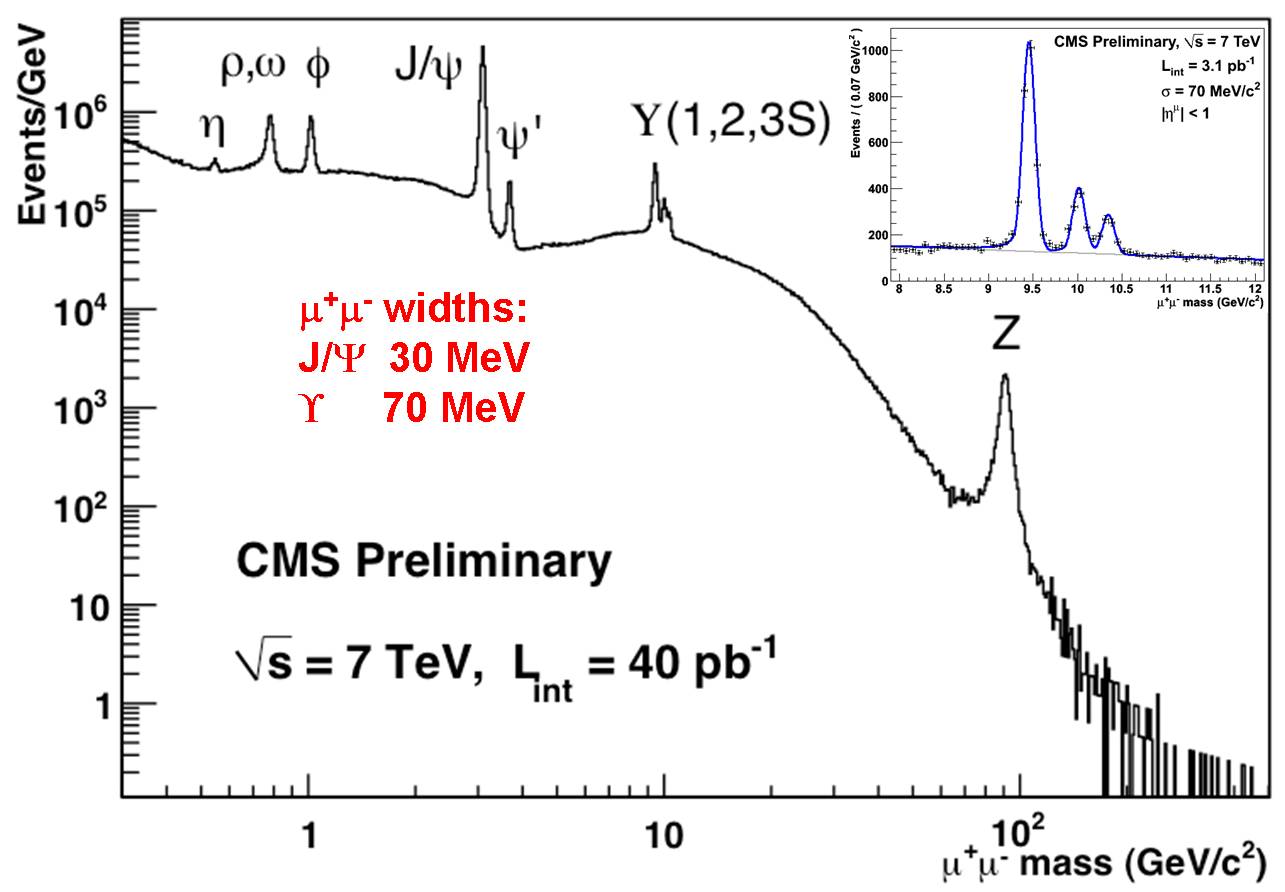

    And here is the ATLAS figure. As you immediately notice, the number of Z events is quite similar in the two graphs, but the lower resonances are much more numerous in the CMS plot. For instance, the upper plot has a peak of the particle labeled "J/Psi" (the famous charmonium state, discovered in 1974) which gets to 5 million entries per GeV, while in ATLAS they get only 100,000 per GeV. And the lower-energy resonances are much less distinguishable below -the particle labeled "eta" ( ) does not even appear. As I said, it is due to the trigger. But still, it is not by chance that the "M" in CMS stands for "Muon"! 1-0 for CMS as far as dimuon resonances go!
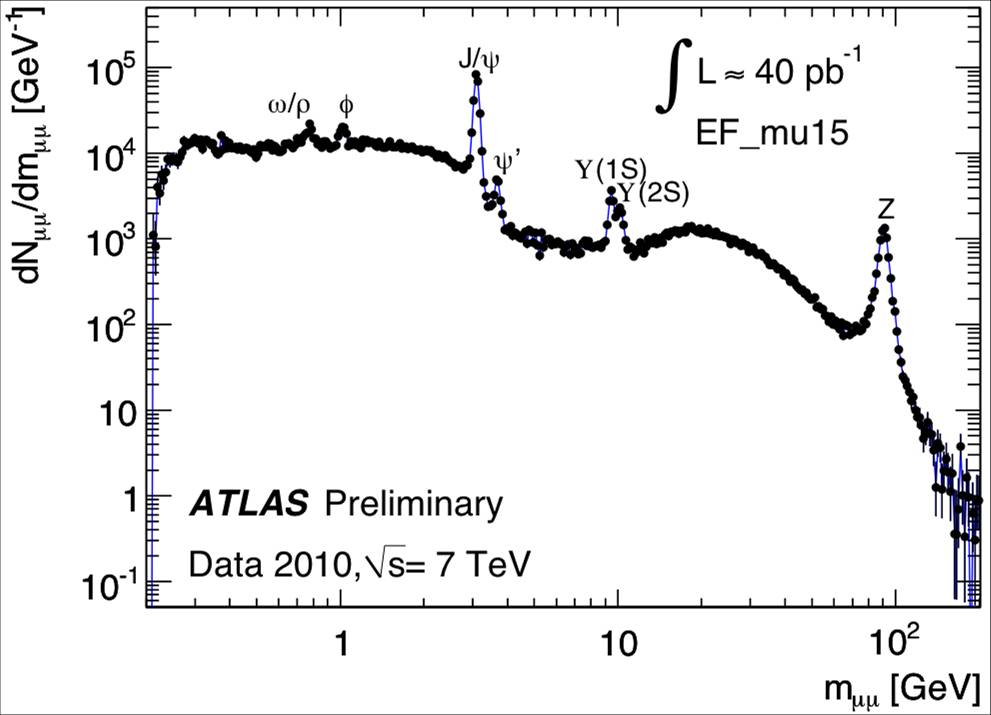


    I think these graphs are terrific in their capability to convey a particle physicists' awe at the subatomic world. These particles are not just coming out of our imagination -they are as real as bread and butter!


    Comments

    Vladimir Kalitvianski
    Are they real or bare, these particles?
    dorigo
    They are as real as your keyboard, only they go off warranty in 20 to 30 orders of magnitude less time.

    T.
    - I wonder how they accumulate fractional counts per bin.

    - And I wonder why they cut off the x-axis at a few GeV/c2.
    Wound't any single event with such a high invariant mass be interesting in its own right?

    dorigo
    Quite simply anon, the bins have a variable width, to show up well in the graph which has a logarithmic x axis. The height of bins reflects that, such that the height still represents the number of events per GeV. For instance, if you have a 5-GeV bin with 12 entries and the nearby bin has 8-GeV width and contains 6 entries, the first gets a height of 12/5, the second of 6/8. Clear enough?

    The purpose of these plots is not to show what are and where lay the highest-mass dimuon events that the experiment collects. Those events may be worth a paper by themselves, so they are not shown in a public-relations graph such as this one. Different experiments have different policies on the matter, though. So CMS shows without fear their data up to the highest masses recorded -500 GeV. ATLAS  chose not to do so here, and I take it that the reason is the one I mentioned.

    Cheers,
    T.
    ... perfectly clear. Thanks, Tommaso.

    Ah, dear Vladimir, you would drive nuts any speaker with such eternal question!

    Vladimir Kalitvianski
    No, dear Onan, of course not. I prefer dealing with real particles and I ask to make sure they are.
    dorigo
    Vlad, LOL, that beats me - I should have used your abbreviated version of the anonymous posters' nickname a few times in the past! Thanks for this!
    T.
    It seems just right that Vladimir came up with that Onan, right? And clearly he prefers bare particles for his mental masturbations.

    Vladimir Kalitvianski
    Wrong. As soon as bare particles are very different from the real ones and do not exist anyway, I prefer dealing with the real one on experiment as well as in the theory, - that's what should have been clear to you.
    Hi Tommaso,

    I think that the right word for these graphs is "sexy". They are sexy indeed!

    Cheers,

    Marco

    Impressive plots, indeed! They can trigger interest in particle physics to a broad audience as well.

    By the way, since these particles decay, they are never real in the quantum mechanical sense... only close to "on-shell"... they are all virtual.

    Now as for bare, that is a definition operational only for the theorist doing calculations. It doesn't mean anything for experimental data such as these...

    Vladimir Kalitvianski
    I am not sure if we can call resonances "virtual particles" because of their being "off shell". Probably not. Probably the word "resonances" it good enough. I did not tell you, but I am against the notion of virtual particles either.
    dorigo
    You are against the notion of virtual particles, Vladimir ? Could you explain what you mean with that statement ?

    Particles are called virtual if they are not asymptotic states. What disturbs you there ?

    Cheers,
    T.
    Vladimir Kalitvianski
    I am not sure it is a right place to discuss this topic. Briefly, if you take QED in the Coulomb gauge where the potential term 1/r is separated from the transverse field, you will see that 1/r is "instant" and is a property of charges, not virtual particles. Many say that it is a photon propagator that "mediates" the interaction, in particular, the retardation effects, but they always omit another contribution of retardation - the radiation. So they perform incorrect comparison and argumentation.

    I do not have problems with interaction of particles in asymptotic states. I do not understand why people want to switch off the interaction in asymptotic states. It is not physical and leads to known conceptual and mathematical problems.
    Any good book on QED answers the questions you are raising, Vladimir. I think it would be a good idea to get hold of one and read it, as it would clear up most of your confusion. Not necessarily a recent one either, just one written since perhaps the 1960's.

    Vladimir Kalitvianski
    Dear Bill,

    I have many QED and QFT books; I sleep on them but it does not help: the knowledge does not diffuse from them into my head. On the contrary, I feel like my knowledge to diffuse into them.
    dorigo
    Hi Anonymouse,

    although you are perfectly right, this is the kind of inaccuracy that I do try to enforce in this blog: glossing over detail that cannot be appreciated for clarity.

    Cheers,
    T.

    Add a comment

    The content of this field is kept private and will not be shown publicly.
    • Allowed HTML tags: <sup> <sub> <a> <em> <strong> <center> <cite><TH><ul> <ol> <li> <dl> <dt> <dd> <img> <br> <p> <blockquote> <strike> <object> <param> <embed> <del> <pre> <b> <i> <table> <tbody> <div> <tr> <td> <h1> <h2> <h3> <h4> <h5> <h6> <hr> <iframe><u><font>
    • Web page addresses and e-mail addresses turn into links automatically.
    CAPTCHA
    If you register, you will never be bothered to prove you are human again. And you get a real editor toolbar to use instead of this HTML thing that wards off spam bots.
