




These activities have paid off with the winning of a large grant from the European Innovation Council, which will allow us to explore the prototyping of a neuromorphic computing implemented through nanowires communicating via nanophotonics circuits. The basic idea from which the grant application arose is that particle detectors natively produce near ultraviolet light, which can be used without transduction to feed a computing circuit where photons, rather than electrons, are the messengers, and where nanowires are the neuromorphic sensing elements. I will have time to write more about this project in the near future, but for now this is all I can say about it (but you can read a publication exploring these ideas for the readout of calorimeters here: https://www.mdpi.com/2571-712X/8/2/52 ).
So, how is it living in northern Sweden? I must say there are pros and cons for me, who am accustomed to life in northern Italy. During the past 59 years of my life I have spent significant time in the US (4 years if you integrate the various periods, the longer of which was of 2 years), but despite intense travel I have not been a resident of any other countries for long periods of time. Sweden is a very civilized country, and its inhabitants are very different from Italians on one count: they trust the system they live in. They do complain when things do not work the way they should (an obvious example is the transportation system, which is far from the perfect efficiency model one would imagine), but they have an attitude of abiding to rules because they think they generally work. I could make many examples of this, so let me make none and move on; I will anyway touch on this subject again below.
Swedes are more hospital and friendly than you would think by basing your biases on century-old stereotypes. They do mind their own business more than Italians, that's a fact - you will rarely meet somebody in a bus or on the street who spontaneously starts chatting. But they are keen to opening their house to you, and their hospitality is no different from that of a southerner. They do greet one another in a slightly "colder" way than we are used to - e.g., kissing one another is not common; more common is hugging overall. But I found I prefer hugs to kisses in these circumstances.
One thing I found surprising here in the north is that people do not worry much about security of their property. There are two aspects of this that are remarkable. First of all, there is a law (common to all nordic countries) called "allemansratten", which guarantees everybody the right of access and crossing of private property. If you own a large swath of land or a small garden patio, you will not be able to complain if somebody casually walks by or picks up flowers or mushrooms in your property. The level of maturity and civility behind this simple law is off-scale for Italian standards, but I would say this puts nordic countries at odds with most other places in the world.
The second point is that breaking in houses is very uncommon here - maybe we can ascribe it to the generally lower level of criminal activities in Sweden, or simply by the smaller number of people below poverty income levels. Anyway, this has the consequence that homes do not have complicated locks at the doors. My house has one key to open it, and it takes a half turn to do that. I imagine an expert could open the lock in five seconds with no key. Not to worry, nobody will. In fact, it is common here in the north of Sweden to leave the front door unlocked in the winter, especially if you are away. The rationale is that the weather can become life threatening at times, with temperatures going below minus thirty Celsius. In those conditions, you have to be considerate and imagine that somebody gets stranded - e.g. by simply having lost their home keys - so they need to get in to warm themselves up.
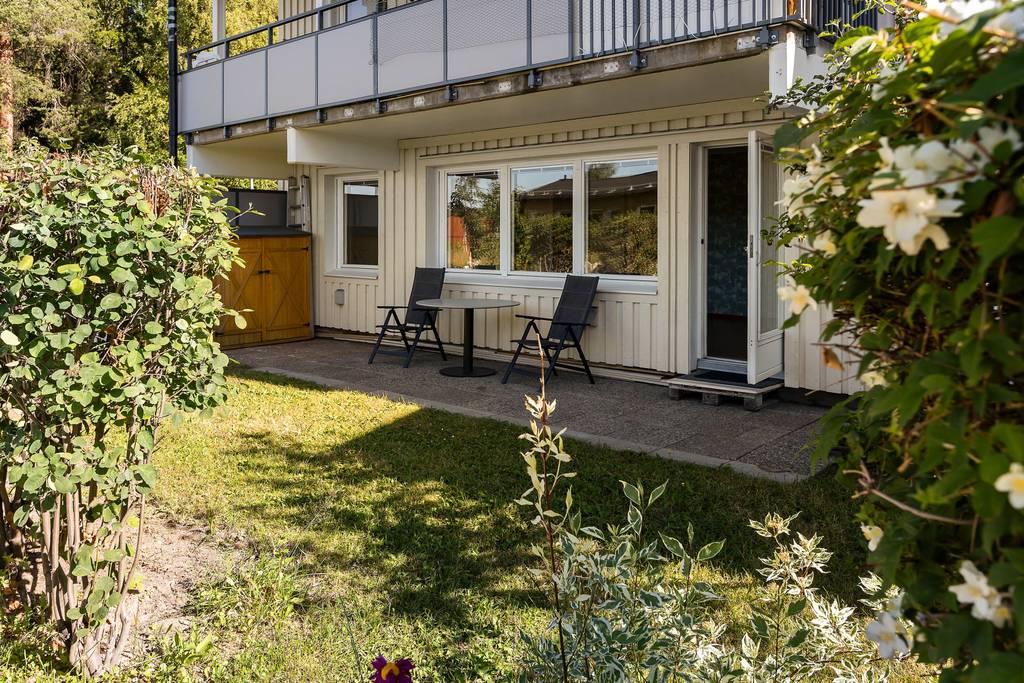
Above: my home in Lulea has a small but very nice garden, and is right next to a very beautiful forest
Many other things struck me as quite at variance with what I am accustomed to in Italy. Driving is one. People here normally respect speed limits and other street rules much more than in southern countries. But they are also more considerate to others. One day, after a visit to a groceries store, I was walking fast on an icy sidewalk with two heavy bags in my hands, to reach the bus stop some 100 meters ahead. A car overtook me; behind it was the bus I was obviously aiming to jump into. I would have lost the bus in normal circumstances, but the car driver understood the situation and slowed purposedly down to almost walking speed, such that the bus only arrived to the stop after I had gotten there. I think you can live in Italy for a hundred years and never get to experience this kind of random kindness.
The health system in Italy (particularly in the north) is not something we can complain about - things work generally well and the quality of care is high. However, it may take a long time to get an appointment. Here in Sweden I found it much easier to get medical screening. And when you book an appointment, you get a full hour slot all for you! This may not necessarily be used in full, but if you need the time, you have it. But be on time at the appointment, or you will piss people off. That, by the way, is another difference with the italian system: in Italy, if you book a doctor appointment for 10AM, you usually have to wait 30 to 40 minutes to see the doctor. In Sweden, they will invariably look for you a few minutes before the scheduled time!
Another surprising thing is the care they take when they visit you. They are generally more thorough and careful. Whenever they plan to do something they first explain the procedure to you, and ask for permission. And they pay attention to provide the best service possible! My wife saw a gynecologist and during her visit she mentioned something of minor importance, but received no comment on it because the discussion turned to some other more important point. A full week later, she received a direct call from the doctor in person, who explained she had failed to answer that point and she wanted to do so. This, again, is something that I have never heard happening in Italy.
There are things on which my knee-jerk reaction is initially "I do not like this" here in Sweden, too. One is their obsessive reliance on queueing systems. I agree that queues are a democratic way to handle distribution of services or goods of limited availability; but this somehow fights with my instinct that there could be ways to handle the matter that included more care for different needs and urgency of different people. But no, I have to correct myself - the system is sound, and I am the moron.
For example, I recently bought a house here and only then could I register myself in a queue for getting to rent a garage nearby from the same company that owns the housing complex. I would have imagined there could be some way to expedite the procedure - e.g. if you could trade the parking spot with the garage instead of getting it on top of it, you might be given precedence; or spending some extra money. But no - you can stick your money up yours; this is socialism, and I must say I like the general concept so I had to digest this.
But there is one specific thing that horrified me. It happened to a colleague. She went to a veterinary with her sick cat. The cat was basically unresponsive and apparently paralyzed. Soon the doctor told her the cat was terminally ill and had to be put down. She said she would not agree to that and wanted to leave, but the doctor said she could not - the cat had to be put down because that was his judgment (the rationale, as we later learned, is that the law forbids unnecessary pain inflicted to animals, and keeping an animal alive if it is in strong pain is considered in that category). She called the police for help, and the police informed her that the vet had the right to put the animal down even against her will! What happened next is somewhat extraordinary - just as the doctor prepared to inject a tranquilizer, the cat suddenly revived, and started running around the room. The doctor had to modify his judgment and my friend was allowed to take the cat and leave.
The horrific aspect - to my standards - of the above anecdote is that in Sweden you may be surprised by having to release control on things you would normally be accustomed to keep it. The law is, in a way, more "invasive", but it is so by design - it enforces some rules that are generally designed to be of benefit to the collectivity.
Another example in this category has to do with childcare. If you have a son or daughter in a kindergarden, you have to accept that the wards may "report" you to social systems if they believe something is wrong with the way you treat your child. This is commonplace everywhere, but e.g. in Italy it only applies to extreme circumstances, when the wards observe situations of neglect or harassment. Here, though, the wards need only grow a faint suspicion that you are, e.g., feeding too little your child at breakfast, or see that your child does not have clean clothes on, to get you reported. And getting reported means you will get more invasive questioning from social systems; and they have the power to take your child away if something is really amiss. That is still extreme here as it is anywhere else, but the whole matter demands some consideration for how different things are here with respect to other countries.
I could speak at length about the fact that the working environment here in northern Sweden is much more pleasant than almost anywhere else I visited (and yes, I have been in many universities around the world that this place compares favourably with). For one thing, there is a lot of space - for common activities, e.g.. You can bring your lunch and there is a fully equipped kitchen with everything you need, plus place to eat, rest, have a coffee with colleagues. There is a billiards table if you want to take a break. And the facilities are clean and accessible.
The weather, instead, can't compare with Italy, of course. Here in Lulea you get six months of spring and six months of winter. Basically the year is so divided: January, January, January, April, April, April, May, April, April, January, January, January. Temperatures can drop to minus forty, but in any case they will be hardly above zero for a full six months. And there is really little daylight to speak of during December and January. But I must say I have grown accustomed to that pretty quickly.
One thing I did was to get equipped with a Volvo V60 B4 Cross country, a very nice car that handles very cold climates perfectly. You set the time you want to leave with an app from the warmth of your home, and wherever the car is, it starts warming up, so that by the time you get to the car it is perfectly conditioned. To be fair I must say that this very system did break already (the car is three years old), and I had to replace it; but it works again fine now. (The servicing involved getting in another queue, but it was not for long).
So there - I think overall living in Sweden is a good choice, and although I am doing it for research reasons, I would consider living here long term. Since my wife has started a PhD at LTU last May, that is anyway what is going to happen for the next few years anyway....



Comments