




It is the case of an article on Muon Tomography, titled New Muon Detector Could Find Hidden Nukes. The article appeared a few days ago on Wired. It is centered on Lisa Grossman's interview to Marcus Hohlmann, a colleague from the Florida Institute of Technology. In a nutshell, the article explains how muon particles from cosmic rays can be used to detect heavy elements (as in nuclear fuel) hidden in transport containers. And what makes things sexier is that the used technology is a spin-off from experiments from particle physics.
A One-Page Explanation of the Physics
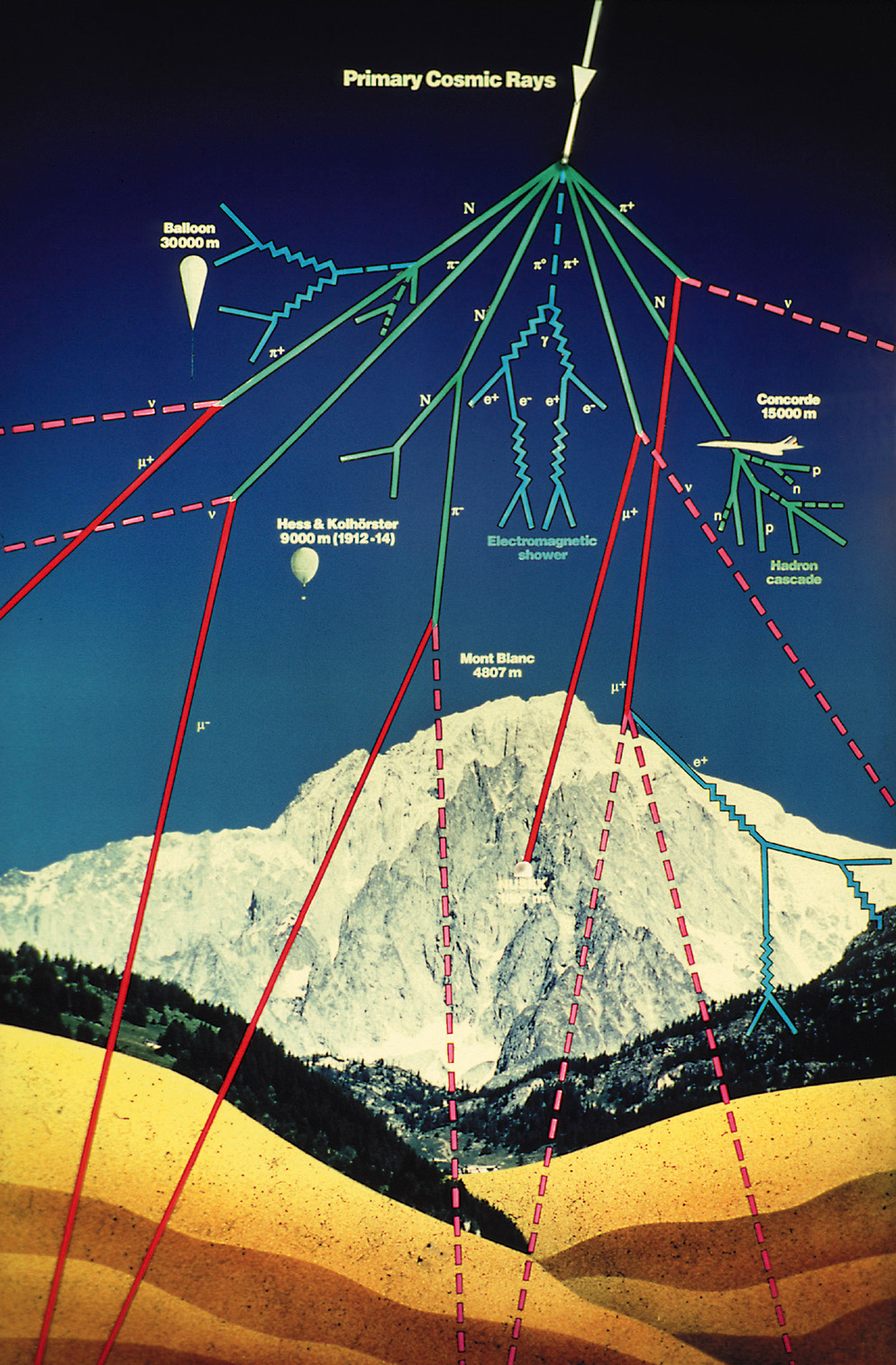 Muons are very penetrating particles, which suffer only small deflections in the interaction with hadronic matter (nuclei). They rain down from the upper atmosphere to sea level as they are created in the decay of light hadrons that get produced in energetic collisions between primary cosmic rays (protons and light nuclei) and the nuclei of Nitrogen or Oxygen of air. The picture on the right explains the creation of secondary cosmic ray muons (the red tracks) better than the above sentence, so let us leave it at that.
 We can detect muons using the fact that their passage through a gas ionizes the gas molecules. An electric field will prevent the recombination of the ion-electron pairs, and will direct the ionization charge to electrodes which collect the signal. A suitable electronic apparatus then converts the charge impulse into a well-encoded digital signal. If several planes of thinly spaced electrodes are crossed by the muon, the trajectory can be determined efficiently and precisely. Details of the precise geometry, materials, amplification and electronics vary, but the principle is always the same. For instance, on the right is shown a cut-away view of a simple wire chamber: the wire is at higher electric potential than the inner walls, so electrons stripped from the gas atoms by the passage of the muon drift toward the wire, suffer some multiplication as they approach it, and produce a detectable electric impulse.
The scattering angle of muons crossing a given volume is a very good means of determining how much material the muon had to traverse before emerging from it. And the linear deviation from the original direction also tells us where most of the deflection took place! These two pieces of information can be combined to provide a picture of the distribution of heavy material within a detector. On this concept is based the idea of performing muon tomography: by allowing cosmic ray muons to impinge on a box containing unknown materials, we can "see inside the box" if we study with enough care the distribution of deflections that muons were subjected to in their interactions within the box. This is illustrated in the figure below.
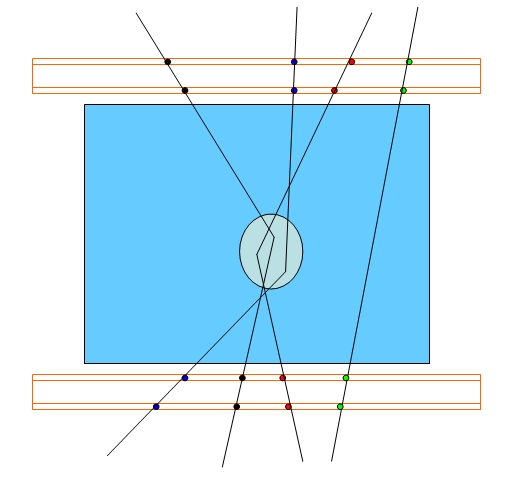
In the schematic picture the muon tracks leave "hits" (the colored points) in two layers of detector elements above a box containing unknown materials, and in two layers below it. The quadruplets of points collected in temporal coincidence allow to reconstruct a straight track (as is the case of the green hits) or a deflected one (as in the other three cases). A likelihood function can resolve the oval structure and its density, if enough muons are recorded.
Dissecting the Wired article
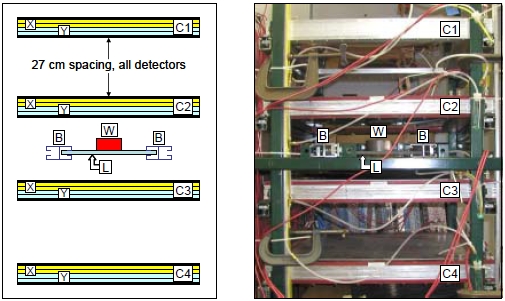 The idea discussed in the article is not new: as the article quotes, it was developed in Los Alamos where a group "built a prototype using drift-tube detectors in 2005" (actually in 2003), but which also, I feel compelled to add, defined the complete formalism of the technique -the article in Wired omits to recognize the seminal contribution of the Los Alamos colleagues. On the right you can see the Los Alamos apparatus.
Reading on we learn that "This is the first time that we actually built and operated successfully the equipment to actually do this in real life, rather than in a computer". This looks like a gentle way to say that Los Alamos group did not go much further than a formal approach and a well done simulation; and to pretend to have realized the first real, quasi-on-scale, prototype for practical applications.
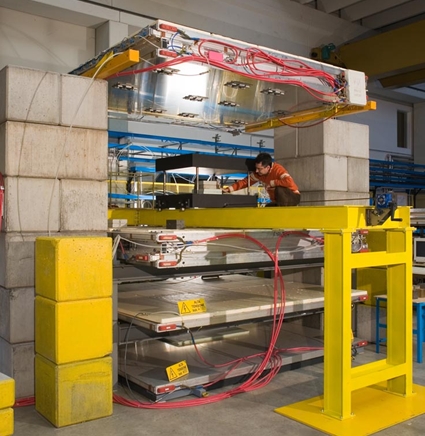
The work cited in Wired is an interesting study. However, it must be remarked that a much more successful test has already been carried out since several years by an Italian group operating a set of muon detectors, this one indeed able to inspect a large volume and to detect heavy elements even when embedded in iron. The Italian group presented their results to several general and dedicated conferences, published their results in Nuclear Instruments and Methods and other journals and, last but not least, also used the same technology of a particle physics experiment operating at CERN.
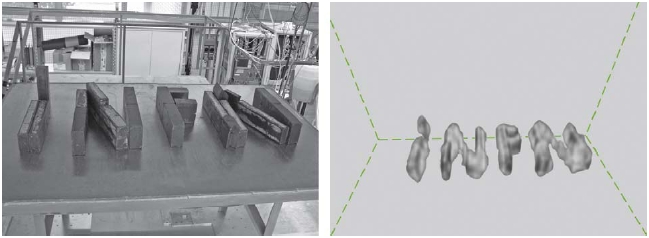
It seems quite strange that Wired, normally a careful magazine, falls in the mistake of totally neglecting the more important study of Italian researchers, as well as the minor sin of providing insufficient recognition to the Los Alamos colleagues. The picture below is worth a million words: the INFN acronym (the Italian Institution for particle and nuclear physics research) written with lead bricks in the test stand on the left is reconstructed by the software with 8 minutes of cosmic muons data (right).
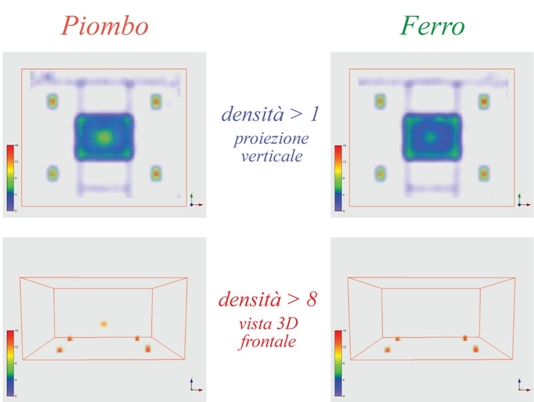
Or have a look at the following setup: clearly its scale is much closer to the one that will be needed for practical applications of container scanning. A lead brick is inserted within a 15+15 cm thick iron sandwich:
and it is clearly distinguished by the reconstruction:
Muon radiography is indeed a promising technique for several applications, not only against smuggling of nuclear material or -God forbid- nuclear weapons. The Italian researchers are involved in a European Union funded project to detect screened radioactive sources illegally introduced into trucks bringing scrap iron to foundries. Several other applications are proposed by many groups all over the world: Imaging of large engineering constructions, Nuclear fuel Drums monitoring, monitoring of the stability of large mechanical structures, analysis of radioactive waste containers, etcetera. This is a lot of work for many people; definitely room for a collaborative effort, rather than for claiming primacy in a field already well developed.
Further Reading
- The seminal work by Los Alamos scientists is L.J.Schultz et al., "Image reconstruction and material Z discrimination via cosmic ray muon radiography", Nuclear Instruments and Methods in Physics Research A 519 (2004), 687-694.
- The main reference of the Italian group is S.Pesente et al., "First results on material identification and imaging with a large-volume muon tomography prototype", Nuclear Instruments and Methods in Physics Research A604 (2009), 738-746.
- A list of contributions at international conferences would be too long for this post. Here I just mention the most recent discussion of the status of the results by the Italian group. It was presented by S.Pesente at IPRD10: "Applications Of Muon Tomography For The Detection Of Hidden Nuclear Substances In Containers", Siena (Italy), 7 June 2010.



Comments