




Calliope is an amateur mission so we play by amateur radio rules. Calliope is armed with a half-watt Radiometrix transmitter. I already have an FCC-issued amateur HAM radio technican-class license, but that is just the first step.
The FCC rules the spectrum, but the International Amateur Radio Union (IARU) are the entity that actually coordinates satellites. I need to file/coordinate with the IARU to use the amateur-band with my personal ham callsign as the satellite's callsign. Like any regulation, there are many details.
The main IARU requirement is 'play nice, and be able to turn off your transmitter at a moment's notice'. My approach will be to have the required 'stop transmit' command, of course. To make this really work, however, I will also have all transmissions time out and shut down automatically after an appropriate interval (10 minutes?). Transmission only starts when a 'start transmitting' command is uplinked, with possibly a few orbits that are pre-arranged to have the satellite automatically turn on based on a clock (if IARU allocates the time).
Since most hams use transceivers (can receive and transmit, for non-hams reading this), it is more fair to only broadcast when someone is willing and able to receive and yet shouldn't reduce the ability to get Calliope data down. I need to do some minor orbit calculations to figure out the optimum window (est: 10 minutes), then apply to IARU to ask to share the frequency.
From a ground station listener point of view, when you wish to listen, you transmit the 'start transmitting' command to Calliope, then it broadcasts for the set time (while you're in range) then shuts down. By definition, you can also shut it down earlier (since you're the one that sent the 'on' and are still in range), so it provides assurance that Calliope won't hog spectrum.
This complies with the IARU requirements without requiring me being able to guarantee 24/7 uplink to the satellite. Note that I have not yet contacted IARU, however, so this remains theoretical. I may be missing an FCC requirement somewhere. There could be roadblocks. IARU may say 'no'. I have no idea how 32 satellites will share spectrum.
It is possible IOS may assist with radio, but this is an area that I have not yet investigated. Ultimately, IOS could offer radio as a service, but it isn't IOS's job, as launcher, to negotiate frequencies. This was one reason I got my ham license. Somethings you just gotta do yourself. It helps with the IARU bit to have a solid launch window, so that's one reason (among many) I haven't pushed faster on this. When I do, I'll be sure to write about the process so others can follow!
I would enjoy my own ground station, beyond my little hand-held test radio. Dream hardware I would love to get is something akin to a satellite-ready rig able to let you adjust for doppler shift. And a nice antenna-- antennas are crucial. Talking with Jeff C. over on the original $8K thread brought out my wish for nice hardware, beyond just a Blance DeBois stance of relying on the kindess of other hams.
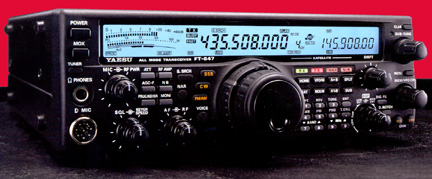
Having a good antenna and a Yaesu FT-847 or Kenwood TS-2000X would run perhaps $2000 for radio gear. At the time I write this, I am only halfway through the excellent "ARRL Satellite Handbook", so I admit be being a little weak on what gear is out there. I will need to be able to handle packet data, directly interfacing with a computer, and I'm happy to take gear recommendations. Fortunately, I enjoy shopping. The price tag, though, after what I've sunk into Calliope already, that's a puzzler. I may have to fundraise to set up a 'Ground Station Calliope', while continuing my hope of working with other hams for better coverage.
I have a friend who considers Calliope a justifiable reason to upgrade his own gear, so I'm happy to be an excuse. Note to any hams-- internal conscience or significant other complaining that you spend too much on gear? Tell 'em it's for SCIENCE! Let me be your excuse!
Alex
DIY satellite news every Tuesday here and at Project Calliope
General space science every Friday at the Daytime Astronomer





Comments