Let's be honest; Nature and AAAS, non-profit or not, have employees and those employees would like to remain so. That requires money and a lot of it. Non-profit has never meant 'free', it just means they can't give money to shareholders - it certainly does not mean charity.
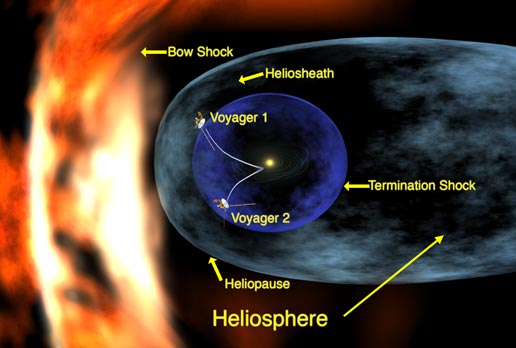
A few years ago Voyager 1 entered the final frontier, that place where the solar wind becomes denser and hotter and pressure from gas between stars causes it to slow - the Termination Shock.
Now that Voyager 2 has reached its edge of the solar system, just under 7 billion miles from Earth, it has confirmed what astrophysicists had believed - the conflict between the solar wind and the interstellar wind has made that part of the solar system slightly squashed.
Gordy Slack,
writing in The Scientist seems to think so.
First things first, I am not in the camp that looks on honest questions as deserving of a declaration of war in that sort of 'you are with us or against us' way the more militant atheist science writers in some places do.
So I looked at Slack's piece on its merits and he makes one point I have often made - it isn't just uneducated religious fundamentalists who maintain a belief without knowing what they are talking about. Plenty of atheists do the exact same thing without knowing a thing at all about adaptive radiation. They believe in evolution because scientists do.
We talk a lot about science education here and of course we all try to do our part by donating time writing in the name of science outreach but we're not the only ones doing something positive that's worth a mention.
Some folks from Johns Hopkins and their affiliates have a place called
cogito.org and I discovered them because one of their writers linked to us but I took a long look around and I liked what I saw and I think you will too.
Why do I like it? Their focus is on the under 18 student with interests in math and science and I think that's terrific. They take their focus pretty seriously.
If you were going to guess at who would uncover a flaw in game theory, you wouldn't guess it would be a fiction writer though, if you did, you almost certainly would not guess it would be Edgar Allen Poe in a story from over 160 years ago.
That's the great thing about game theory - it teaches us humility.
Ariel Rubinstein is an economist and has a new appreciation of Poe (“he’s brilliant”) after finding an old analysis of game theory hidden in "The Purloined Letter", published in 1844.
I won't publish the whole passage here but you can read it all in
this terrific article in Science News by Julie Rehmeyer. I remembered reading it as a lad but that was before I knew what game the
There are lots and lots of ways to reach the site but, for contributors, basically two ways to write blogs and articles (well, 2.5, but one is quite rare.)
There are significant new releases of various browsers out there and those always bring some problems. Firefox 3 we anticipate issues because, really, Firefox 2.X never worked all that great, so we're still testing that on various configurations (primarily XP and Vista - everything else works okay.)
Sometimes you just have to wait until they fix the problems they introduce, else a small group like ours ends up fixing and re-fixing new things that are introduced anew in a month.
Most of the problems will only occur in one article entry configuration so it should have little impact.


 Why Raw Dairy Farms In California Accelerated The H5N1 Bird Flu Pandemic
 Affirmative Action In NIH Grants Revealed
 Environmentalists, What Are You Asking From Dedmoroz Lenin For Earth Day This Year?
 How Ancel Keys Went From MAHA Hero To MAHA Villain