Banner
An Open Letter To Squid

Dear Squid of the World,Excuse me. What is this? I have been your friend and advocate for years...

With This Devoted Squid Mama, I Bid Farewell

Squid typically die after spawning. Their orphaned eggs are left alone in the cold brine to develop...

ICAD 2012: Top Ten Cephalopod Stories From The Last Year

To celebrate International Cephalopod Awareness Days, I decided to comb through all the cephalopod...

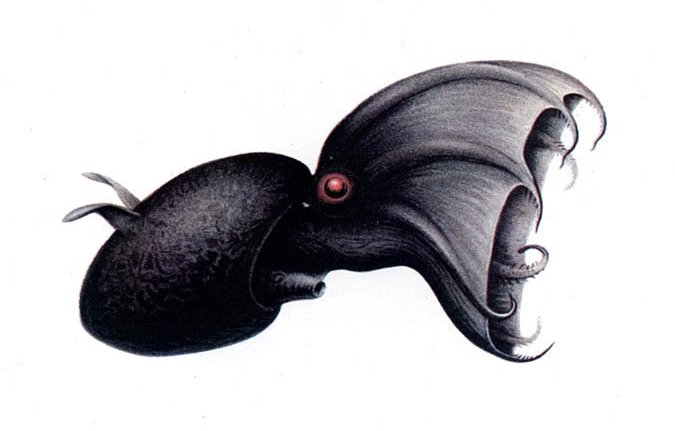
Scavenging Cephalopods: Mild-Mannered Vampire Squid Just Want To Eat Waste

A couple of weeks ago ago, a debate about the existence of scavenging cephalopods broke out on...

User picture.
picture for Hank Campbellpicture for Helen Barrattpicture for Josh Wittenpicture for Holly Moellerpicture for Alex picture for Becky Jungbauer
Danna StaafRSS Feed of this column.

Cephalopods have been rocking my world since I was in grade school. I pursued them through a BA in marine biology at the University of California, Santa Barbara, followed by a PhD dissertation at... Read More »

Blogroll
I've mentioned the Littlest Squid before: the genus Idiosepius, which contains only a handful of very small, very adorable species. And I commented that they have this habit of gluing themselves to seaweed, to hide from predators.

Well, today I'm here to explain how they do it, because a new paper just came out on the topic of itty-bitty squids and their glue organs.
Ambergris is a weird and wonderful thing. It has been tremendously valuable throughout human history, but its creation and functionality have been shrouded in myth and superstition. To this day, no one has ever seen a whale actually excrete the stuff.

But we know for sure that ambergris comes from sperm whales, because it's been found in their stomachs as well as floating freely in the sea. And since the waxy blobs are always full of squid beaks, we think they're probably the whale's way of dealing with these uncomfortable hard parts. 
Apparently, in the world of Omega-3 supplementation, squid is the new hotness. A Norwegian company producing "Calamarine" has struck deals to sell to a bunch of US food supplements.

It's a nice example of using every part of the buffalo, since the parts they're processing into oil are usually discarded in the process of turning squid into calamari.
What are the quintessential tools of the writer's trade? Why, a pen and ink, of course. Now, what modern writer in this day and age uses pen and ink? None. We all use keyboards and screens.
Where's the romance? The tradition? The glory?

It's all held in that unassuming marvel of molluscan engineering, the squid. The squid's pen is his internalized shell, the proteinaceous spear against which his muscles move. The squid's ink is his chemical defense, to be released in a blinding cloud or a deceptive pseudomorph.

Thus the squid is a more romantic, a more traditional, and a more glorious specimen of the writer than is your humble correspondent, who labors ingloriously on her computer.
The Cayman Islanders sure would!
Most people would prefer to vote for a box of frozen squid at the next election than the current government or the opposition. 50% of voters that had taken part in the on-line straw poll by Monday evening voted for the squid, 46% for the opposition People’s Progressive Movement and only 4% said they would vote for the ruling United Democratic Party.
Just in case that message wasn't clear,
Wait, what? Don't we know, like, almost nothing about colossal squid (Mesonychoteuthis hamiltonii)? How could we have any idea whether they need protection or not?

On the other hand, the fact that we've seen so few individuals rather suggests that there aren't that many of them to begin with. As with any scarce resource, perhaps caution is the better part of valor . . . or something like that. I might be getting my aphorisms mixed up.