




---
"The Trigger group meeting was the crowded arena where executive decisions were routinely taken on what data to take, how to set the trigger thresholds, and how to watch and reduce the system’s dead time. It was held every Wednesday afternoon in the Pump Room, a small conference room adjacent to the control room on the second floor of the B0 building. There I gave my debut as a speaker in CDF on December 2, 1992. The agenda on that occasion had been built around the issue of how to reduce the dead time in the data acquisition system produced by the recent increases in beam luminosity. That afternoon, I would learn that CDF was not always a place where controversies were resolved by the slow and painful formation of a consensual view. Sometimes, urgent decisions were required, and this involved the exercise of authority.
With the help of my thesis advisor Luca Stanco, I had studied how the collection of fully hadronic decays of top-quark pairs (ones only containing hadronic jets; see Chapter 4) would be affected by a proposal put forth to reduce the rate of accepted events and thus hopefully cut down the dead time to an acceptable level. The proposal involved bumping up to their maximum value (51 GeV) the transverse energy thresholds on localized readings in the plug and forward calorimeters. Those thresholds were used by the Level-1 trigger to accept events with forward jets, as the latter left
enough energy in those localized regions to pass the trigger selection. By studying the characteristics of simulated top-quark decays, I had come to the conclusion that only a very small fraction of reconstructable hadronic top events relied on the presence of forward jets to pass the Level-1 selection. In other words, top-pair production events were special enough that they would get collected anyway by other triggers; the implementation of the proposed change would not negatively affect our analysis.
My talk was the last one of several reports that had focused on the issue from different viewing angles. After I finished speaking, a heated discussion ensued around the big table at the center of the room. Melissa Franklin argued against the change. As mentioned in Chapter 4, in the past few years she had directed the commissioning of the plug calorimeter, which measured forward jets, and she was now using the early Run 1 data to study the performance of that system. The proposed change in threshold would seriously hamper her analysis. Others were also unhappy at the prospect of losing forward-jets data. One was Fermilab associate scientist Brenna Flaugher, who was at the time about to become a convener of the QCD group and was in the process of measuring the angular distribution of jet pairs. A few additional collaborators opposed the proposal by arguing that the higher thresholds would not even be sufficient to reduce the accept rate to safe values, and suggested that further studies had to be undertaken. Others suggested sacrificing other expendable data samples.
The Trigger group leaders looked unmoved by the objections. They considered that the main priority was to preserve the experiment’s chances to collect as many top-quark events as materially possible. They had verified that their opinion was shared by a large majority of the collaboration. A decision was urgent, since until one were taken, the CDF data acquisition system would continue to suffer a dead time of up to 30%. The dead time constituted a horizontal cut of 30% on all datasets across the board. Three out of 10 collectable top-quark events were going down the drain!
Rather than moving toward a compromise, the discussion became contentious, with physicists growing more and more radical in the expression of their own opinions. And this was in spite of the strict scientific rationale of the issues presented, on which they would have surely had to agree. The depth of disagreements had to do with politics, specific interests of different research groups, and personal rivalries. From behind a thick brown-and-white beard, Hans Jensen, the strongly built veteran of collider physics who chaired the meeting, finally cut it short.
“I think we need to close this discussion here. I have heard all of your objections but it seems to me that there is really no alternative to raising the plug and forward thresholds: any decision is better than no decision.”
Indeed, taking no decision would keep the dead time unaltered, hampering the discovery potential and the measurement precision of every single analysis. That would be a democratic, but also a rather meaningless and unscientific way to manage the data taking of the experiment.
Melissa did not find Jensen’s words convincing. She thought that the management was being stubborn and that there were better ways to handle the emergency. She rose from her chair and continued to argue as she walked around the large table in the direction of the door, explaining once
more that there were alternatives to killing the chance of calibrating the forward calorimeters. Somebody in the audience counter-argued that CDF had not been built with the primary goal of studying the physics of forward jets. As the volume of voices suddenly rose, Melissa understood
that the battle was lost. So she wished aloud a four-letter word to everybody and left the room, imparting to the door slightly more kinetic energy than that needed to close it. Melissa’s scorn was understandable: her reasons to disagree with the decision being taken were sound, but they were
not being valued as such by the management. The top-quark search was the absolute priority of the experiment. This was specifically clear in the mind of the managers, who organized the effort of all collaborators to maximize the chances of a discovery. Fortunately, similar arguments, even if bitter and heartfelt, did not significantly affect the general climate of cooperation within the experiment."
---
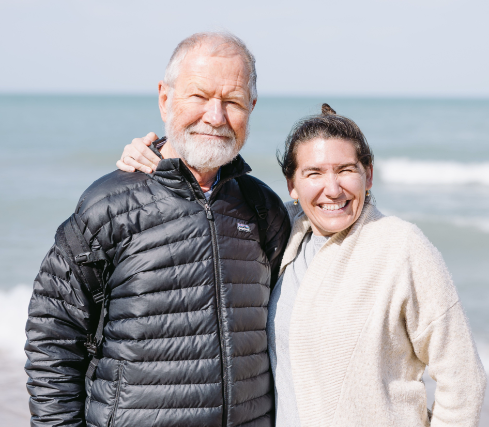
Above: Hans Jensen with his lifetime companion, his wife Tita
Apart from quoting the anecdote above, I can say I liked him - he was soft spoken and kind. We did not interact much during our collaboration in CDF but I will remember his big smile. Goodbye Hans!


Comments