


On October 8th, Octopus Day, I wrote about the incredibly strange Seven-arm Octopus, Haliphron atlanticus. I invoked its tremendous size, irregular arms, habitat flexibility, and peculiarly small body as proof positive of its weirdness.

But I didn't provide very satisfying pictures. 

Today I am here to fill that gap with a couple of beautiful photographs taken by Nan Hauser, director of the Cook Islands Whale Research Project. 
What does the future of science look like? 
About a year ago, I was asked this same question. My response was: Transdisciplinary collaboration. Researchers from a variety of domains—biology, philosophy, psychology, neuroscience, economics, law—all coming together, using inputs from each specialized area to generate the best comprehensive solutions to society's more persistent problems. Indeed, it appears as if I was on the right track, as more and more academic research departments, as well as industries, are seeing the value in this type of partnership. 
Networking and prompt sharing of knowledge are aspects commonly associated with the development of the Internet but intense intellectual exchange and joint work on projects over large distances happened as early as Habsburg times.

The manuscripts of Court Librarian Peter Lambeck, head of Vienna´s Hofbibliothek (Imperial Library), show he was an expert in content management and social networking. The evaluation of his life and work now traces Austria´s role in the "Republic of Letters" - the combined expertise of Europe´s intellectual elite - as early as the 17th century.
How can you test for disaster without freaking out all your co-workers?  Assume the best way to test for a disaster is to simulate it.  Now factor in that a typical co-worker, if they overhead that a chlorine tanker overturned in DC or that terrorists are storming the building, will likely freak out.  Is there a safe way to simulate an emergency?

Due to difficult economics and an aging population that needs social services, Finland is finding itself desperate for workers, but jobs cannot simply be created by giant corporations anymore and the only way to sustain the welfare state seems to be through new ventures and entrepreneurship.  Except government restrictions and regulations that discourage giant corporations hurt small businesses most, and Finns are conservative when it comes to risk anyway.

The Icebreaker Yermak

Vice-Admiral S. Makaroff of the Imperial Russian Navy was primarily an oceanographer.   His paper On some Oceanographic Problems, Proceedings of the Royal Society of Edinburgh Vol. XXII, contains, amongst detailed reports of his oceanographic investigations, an explanation of why the icebreaker Yermak* was built.  Quite simply, the ship was intended to promote seaborne commerce where Arctic ice had always been a barrier.  It seems that Makaroff had an idea that perhaps, one day, after much experience had been gained, an icebreaker might just possibly reach the North Pole.
"[W]ho you are depends on the sum total of your neurobiology." --David Eagleman


Modern neuroscience is making advances in knowledge that our society is not keeping up with, may not be able to keep up with. David Eagleman explores these new inroads in what we know about the brain, the conscious mind, and free will in the interesting (and at times frustrating) Incognito: The Secret Lives of the Brain.

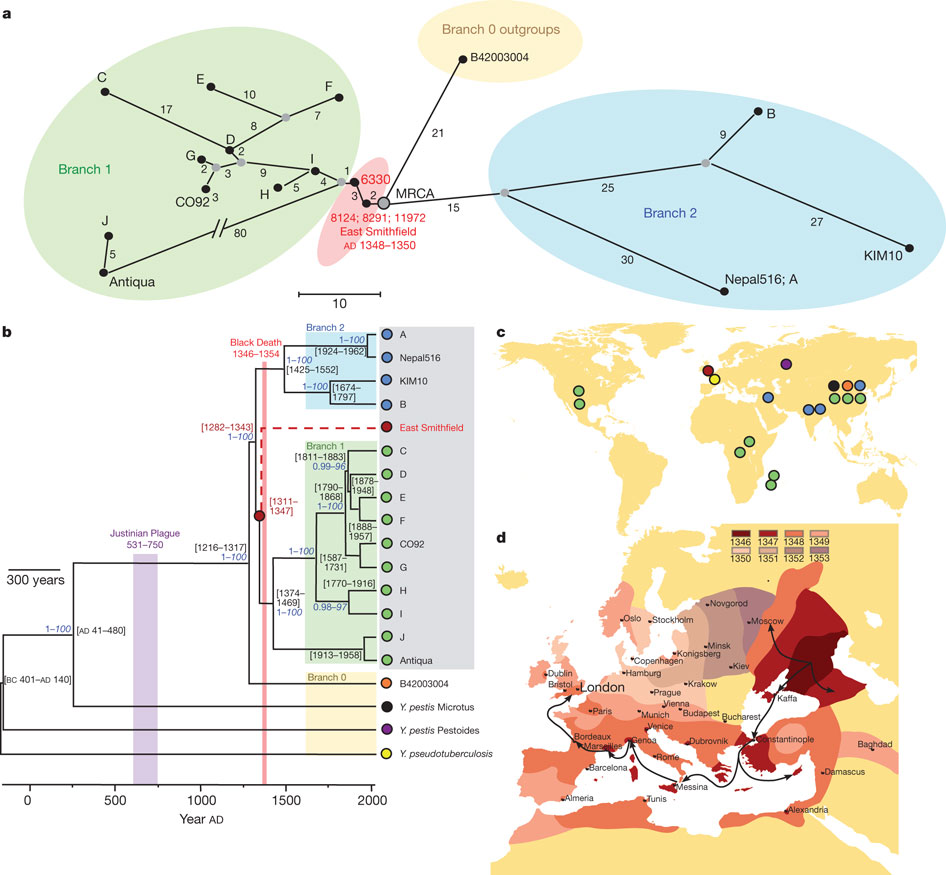
The genome of the medieval form of Yersinia pestis, the pathogen responsible for the Black Death in Europe between 1347 – 1351, has been reconstructed. A surprising finding is that the genes affecting its virulence apparently haven’t changed all that much between then and now.

A research team has used teeth gathered from a burial ground know to contain a lot of Black Death victims to reconstruct the genome of the medieval form of Y. pestis. After the genomic reconstruction, the researchers compared their ‘ancient pathogen’ to the extant forms of the bacterium (see figure 1). In their words:

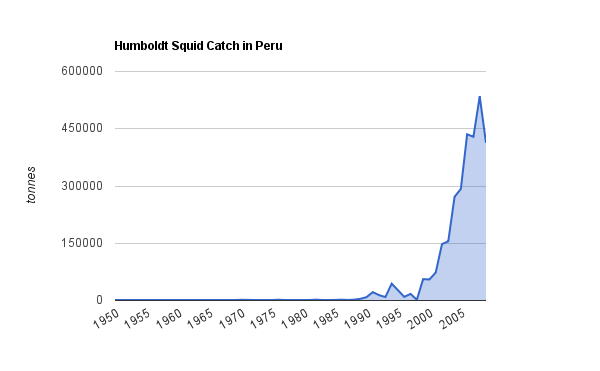
In an obituary for biologist Robert Clarke published recently in Marine Mammal Science, I read a rather curious passage about this scientist's observations of Humboldt squid:
At first sight, the hand held tablets and screens hosted on nurse tables and held dearly to the palms of able clinical staff, may appear to be incongruous with the functional obligations of their owners and you could be forgiven to mistake them for Apple’s new iPad.

Yet, it is not an uncommon sight, to find them as reverential backpacks and requisite arsenal in the hands of medical personnel, almost akin to the ubiquitous mobile phone. Electronic health records or EHRs as they are widely known across the medical community have largely served as useful substitutes of patient case pads and potentially replaced enormous paperwork with electronic file cabinets that could store a humungous amount of history around a patient.

