Despite the hopes of most and the preconceptions of many, news from the Lepton-Photon conference in Mumbay, India, report that the Standard Model is as alive and strong as it has ever been. Indeed, the recent searches for Supersymmetry by ATLAS and CMS, now analyzing datasets that by all standards must be considered "a heck of a lot of data", have returned negative results and have placed lower limits on sparticle masses at values much larger than those previously investigated (by experiments at the Tevatron and LEP II).
If you're one of those cultural mullahs who thinks smoking causes lung cancer - even a cigar or a pipe - you can stop reading. This article is not for you. I have never smoked a cigarette in my life but gradual efforts by the modern temperance movement to ban smoking everywhere(1) should be resisted by anyone claiming they care about independence, tolerance and diversity.(2)
Do you know what a creepmeter measures? Measurement is the heart of science. What distinguishes science from opinion or philosophy is measureables. The root of science is facts that are determined by actual observation, compared, then extended into predictions.
Any good measurement has three parts: the number value, the units you're using, and the error. If I say I am 6 feet tall, that's a number (6) and a unit (feet), with a presumed error of 'within an inch or two'. All three parts are crucial.
One of the stranger claims of anti-science hippies is that there is not only a difference between 'organic' food (and apparently 'inorganic' food, whatever that could be) in structure - and if you believe that, go read Huffington Post, I won't take it personally - but also in nutrition.
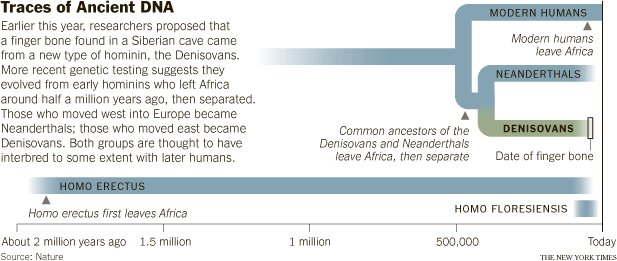
In 2008, a fossil tooth and finger bone were found in a cave in Siberia. After analysis it turned out to belong to a new species of human, now known as the Denisovans. In 2010, a draft of the Neanderthal genome was released, providing indications for potential interbreeding with our ancestors. In the same year, analysis of the Denisovan genome also revealed indications for potential interbreeding.
Now, a new study, published in Science, states that these interbreeding events could have boosted the human immune system.
Harry Lonsdale called me out of the blue last year,saying that he would be passing through Santa Cruz and wanted to discuss an idea he had. Well sure, I said, so we picked a day for him to visit. I had never heard of Harry, but when he showed up, right on time, we immediately hit it off. Harry turned out to be one of those rare people who are full of energy and ideas, generous and willing to share, someone who gets things done. He would have been wonderful in politics, and in fact ran twice as a Democrat for Oregon's senate seat, losing close races to Mark Hatfield. (He wrote a book about his experience: Running: Politics, Power and the Press, available from Amazon.)
Journalism as an occupation with ethical standards was a 20th century invention. For a brief, shining moment in time, journalists were interested in truth and newspapers flourished. Truth is subjective, of course, and so are editors who set the tone of newspapers and during the time when the press had power across all society, editors were on the left and the right. Newspapers reached everyone, multiple times each day.
Today, the 'fourth estate', as Edmund Burke termed it in the 18th century, still has considerable power - it makes presidents and brings down companies - but it is less trusted than it was two generations ago.
Most baseball general managers live in obscurity most of their careers. Its their first hire, the manager, that usually gets the red hot spotlight, after every win and loss, second-guessed by reporters with recorders and then later by fans. The GM puts the players on the field and lets the manager and his coaches take it from there.
If you work in experimental high-energy physics you soon acquire a particular sensitivity to the economical display of relevant information. Producing figures that convey the most meaning with the minimum effort is sort of an art, and it is a necessary consequence that HEP experimentalists -the smart ones- end up converging on the definition of graphs which are better than all others in this respect.
You ever wondered why it is that we share only 50% of our genes with a sibling but 98% with chimpanzees?
Humans are a freak of nature. We are in between a so called ‘tournament species’ and a ‘pair-bonding species’. In other words: naturally very aggressive primates constantly stressed in the pressure grip of macro evolution. These and many other important issues are touched on in Robert Sapolsky's lecture on Behavioral Biology, Biology 150.