

I confess.


I had cancer.


And stem cells might be to blame!


At the relatively young age of 42, I was diagnosed with what is supposed to be an older man’s disease: prostate cancer.


How could this happen to me?  It could be the fault of stem cells.


No, I don’t mean some rogue stem cells created in my own lab that attacked me, but rather I’m talking about my own perhaps slightly imperfect stem cells that might have gone rogue.


You see scientists are realizing that for many, but not all cancers, a unique type of stem cell called a “cancer stem cell” might be to blame.

In the last few days I described in some detail (here and here) the six searches for the Standard Model Higgs boson just produced by CMS, the experiment at the CERN Large Hadron Collider to which I proudly belong.
You know how you'll be swimming along (metaphorically), going, well geez, things are going pretty well, knock on wood? And then, bamm! You say those words, even invoking superstitious protections, and you're hit with anecdotal evidence that you spoke too soon?

I'm just saying, it seemingly never fails to happen. Of course, that might be more to do with the reality that life is constantly on an up and down roller coaster ride of events and when we're in a high or in a low, it can be hard to see that it's been something else and will be again.
There's a giant ceramic squid in a New York art gallery.
Walking into the gallery, you encounter the 16-foot-long, beached creature, its opalescent, slick-looking flesh seeming to putrefy, lying in a puddle of its own ink. You expect its tentacles to quiver in a final death-throe.
Despite the distraction of seeing the singular form of "throe" for the first time in my life, that's still a pretty striking image.
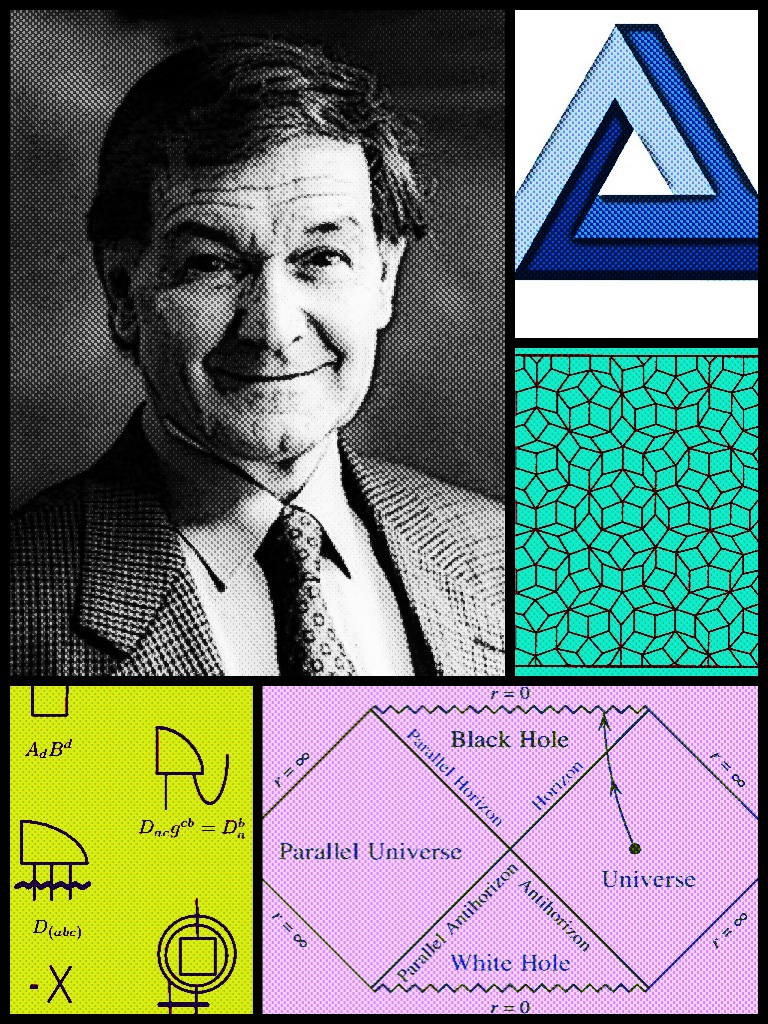
Equations don't sell. Pop science editors tell us that each equation added to a book halves its sales figure. If this is true, Sir Roger Penrose's Cycles of Time, which was recently released in the US, and which I can testify sold at least one copy, would have sold by the billions if only the editor would have scrapped half of the equations.
Norway just had a tragedy - the kind of random violence that social scientists, who we all wish would take a holiday during horrific events, will try and find correlation and causation for, like he was right wing or he was left wing or he was angry about farm prices or a video game store didn't having something he wanted or even that he didn't get enough sex, once evolutionary psychologists dive in.
 
In my short summary of analyses recently published by CMS, yesterday I left out one which had not yet been released. It is the search for the "golden channel" of Higgs decay, the one which motivated the construction of detectors with large acceptance to energetic leptons: the decay to two Z bosons, with a subsequent decay of the Z's to two charged leptons each.
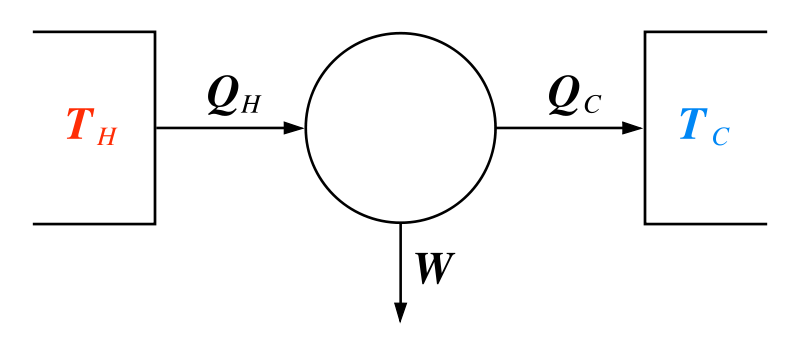
The synthesis of non-equilibrium thermodynamics and biology, pursued in fits and starts over the years by an eccentric cast of thinkers, has produced a few scientific red herrings, but the overall idea has expanded our biophysical horizons.  I'll summarize what I've come to understand about the development of biological thermodynamics and its implications, while trying to skirt the rabbit holes.
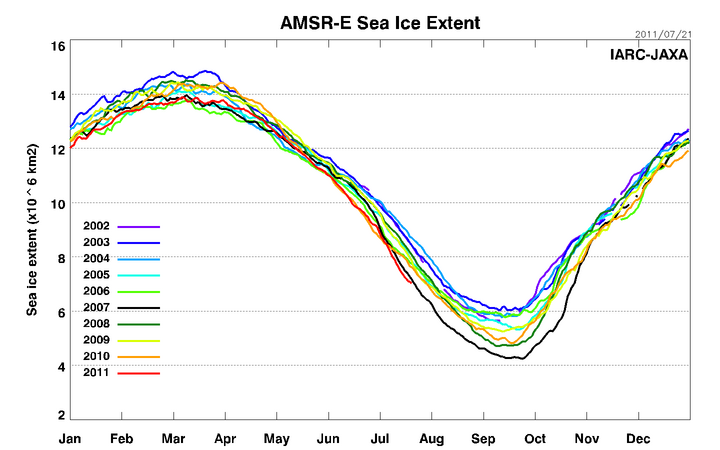
Arctic Ice July 2011 - Update

Are we headed for another 2007 style crash ?

In my Arctic Ice March 2011 - Update #1,  I gave these figures for September minimum -
an extent below 4 million km2 is highly probable.
an extent below 3 million km2 is entirely possible if Arctic weather continues to follow the overall trends of the last decade.
In April I revised that, based on some projections from IARC - IJIS figures to -
I project an end of season extent range between 3.9 million km2 and 4.5 million km2.

