




Nearly anything can be rationalized if the value is subscribed to an intangible like 'good will.' The Olympic Games are big business and generate substantial amounts of revenue for the International Olympic Committee (IOC) through lucrative television contracts and corporate sponsorship - yet they lose money for the hosts.
Confirmation bias prevents academia from giving Republicans a fair shake (global warming deniers!) but more objective people will scratch their heads wondering how a majority party that supposedly dislikes science drafts spending bills that increase funding for the National Science Foundation (NSF), the National Oceanic and Atmospheric Administration (NOAA), the National Institute of Standards (NIST) and Technology and the Food and Drug Administration (FDA).
Newtonian gravity binds us to this rock, while EM presents us with the messages from the heavens. The math of the EM is heavenly compared to Newtonian gravity. Let's review some of the flaws in that old but still useful approach to gravity.
There is a widespread misconception which is repeated often these days in the aftermath of the OPERA collaboration’s confirmation of faster than light neutrinos. The misconception is easily stated:
“Tachyons, if they actually exist, have imaginary mass, … blah blah blah … therefore OPERA is wrong!”
Let us explain what this means in layman’s terms, then see how this argument fails, and afterward discuss that it is one example for a common logical fallacy that basically underpins all the arguments against the OPERA results that we encountered recently.
I am sure it is old news to most if not all of Science 2.0's readers that NASA recruited Vint Cerf to help adapt Internet technology to space mission communications in 2000; and that they successfully tested a new protocol in 2008. I have no doubt that the engineers can put together a pretty reliable interplanetary network.
As I review journals and articles dealing with clinical trials I have found the most glaring problem that, I am sure, no one will address. Namely; quoting data "from the book."
So, what am I talking about? Specifically about researchers, I mean the real researchers, not "re-inventing the wheel" but being satisfied just pulling the data from a "trusted" source and running with it.
Best explanation I can give uses an example. In a clinical trial looking at the impact of ascorbic acid on tumor growth, the researching group, (medical team), noted the milligrams of dose given, adjustment for weight&sex, and then ran the trial.
Suppose you are given two measurements of the same physical quantity. Make it something easy to visualize, such as the length of a stick. They tell you that when measured with method 1 the result was x1=10 cm, with a estimated uncertainty s1=0.1 cm, and when measured with method 2 the result was x2=11 cm, with estimated uncertainty s2=0.5cm. Here is a question for you today: What is your best guess of the length of the stick ?
Sex helps in multiple ways, it seems. New research presented at The Gerontological Society of America's meeting, based on 2004 General Social Surveys, found that the more often older married individuals engage in sexual activity, the more likely they are to be happy with their lives and marriages.
Based on the survey responses of 238 married individuals age 65 years or older, the research showed that frequency of sexual activity was a significant predictor of both general and marital happiness. The association even remained after accounting for factors such as age, gender, health status, and satisfaction with financial situation.
What is the point of a fishery quota if, in the years when you actually reach it, you petition the government to increase it--because there are just so many darn fish, and it would be a shame not to catch them all?
The annual quota for California market squid is so high that usually it's never reached, and therefore the fishery stays open all year. But this is the second boom year in a row, and fishers have actually caught the full 118,000 tonnes. So, time to close the fishery.
Researchers have developed what they are billing as the world’s lightest material. With a density of 0.9 mg/cc, it is about one hundred times lighter than Styrofoam™.
The new material redefines the limits of lightweight materials because of its unique “micro-lattice” cellular architecture, they say - consists of 99.99 percent air by designing the 0.01 percent solid at the nanometer, micron and millimeter scales. The material’s architecture allows unprecedented mechanical behavior for a metal, including complete recovery from compression exceeding 50 percent strain and extraordinarily high energy absorption.
But a race for what? China heavily subsidizes ridiculously inefficient solar cells so heavily subsidized American companies can afford to buy them - but nobody really wants the product. It doesn't work.
In the first part of this look at magma chambers, I talked about some of the processes that dominate what goes on beneath an active volcano. The twin actions of fractionation and assimilation were what preoccupied the early researchers, however more recently we've realised things are a little more complicated than that. In this part I want to take a closer look at some of those intricacies.
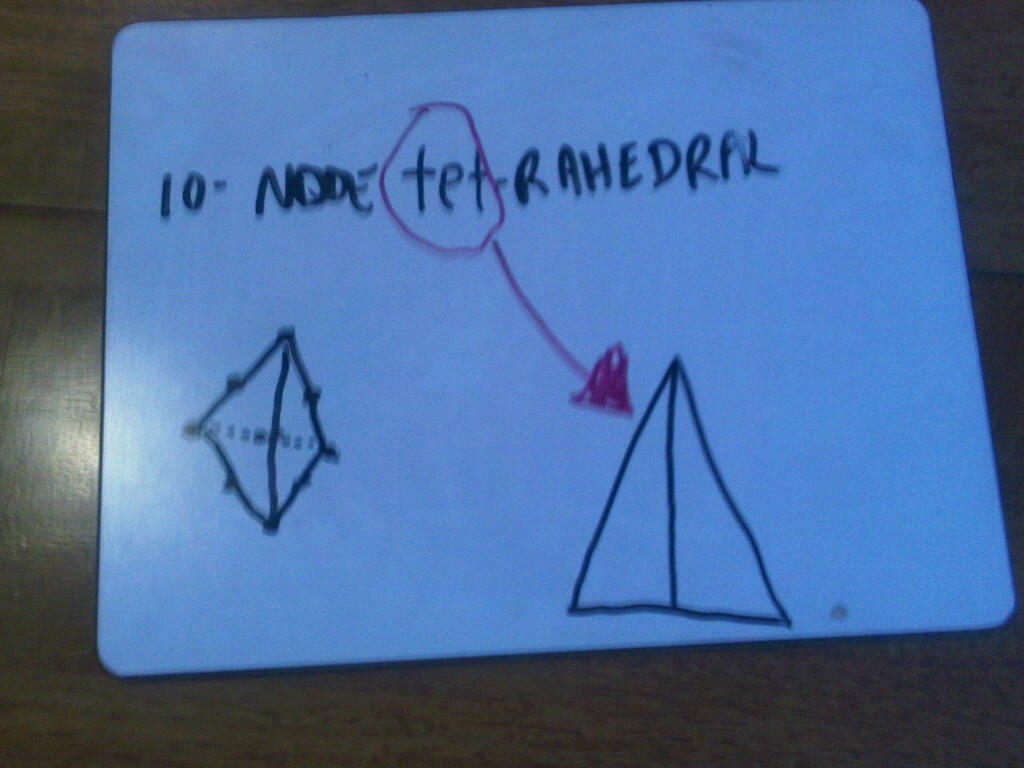
My younger kids each have a personal-sized dry erase white board and markers they use to draw things. They make Transformers or cities or cities full of Transformers.
Yesterday, my 8-year-old son drew a tetrahedron on his and the word 'tet' and I was intrigued by that. It was simple to be sure but it was a triangular-based period to me. Tetrahedra have a special place in my heart. As a young guy in finite element analysis, for a brief time in the mechanical world and then in electrical, creating a mesh is vital.
If neutrinos can move faster than light (FTL) it does not provide a means for FTL propulsion. In the last many days I have seen much written about the possibilities that faster than light (FTL) neutrinos would open up. One popular discussion is of "Faster than light propulsion". In short this would not work in any way that is practical for us because we are not made of neutrinos. Our bodies and everything around us, except, maybe neutrinos are made of particles that are well studied and have never ever been observed moving faster than light.
A study in the Quarterly Journal of Experimental Psychology by some folks at University of Notre Dame conducted three experiments and concluded that if you walk into a room and forget what you came to do, the doorway is responsible.
The environment can likely affect memory, we get that - I have often forgotten to take out the garbage even though my wife insists she told me to do so, because I was playing my PS3 - but doorways as 'event boundaries' means we can get away with almost anything. The doorway to a strip club can be attributed to forgetting you are not allowed to go to those, for example; "But honey, it was in a journal".
Whatever people may ascribe the reason for the long age in Japan I am of the opinion that the world must learn from Japan how to keep the environment clean and make healthy surroundings despite the lack of space, heavily congested colonies and heavy industrialization. Even the smallest areas have gardens, in different levels. No rocks are cut to make sculptures and food is as near to nature as possible.
Totally overshadowed by the news of the new Opera measurement of neutrino speeds, yesterday CERN officially released the combined result of ATLAS and CMS searches for the Higgs boson. The news has been given already in two prominent particle physics blogs (Resonaances and Not Even Wrong), so I think I am not obliged to do anything more than point you to those, who cover the matter quite accurately.

