



This video has become quite popular in the past month. Chances are you've already seen it. If so, my apologies, but it's just too funny. Here's a quick summary for you: cat barks, cat sees owner, cat meows.
Why does the cat bark, I wonder? Does it realize the barking might scare people, and is it just messing with people walking by? If so, smart cat. And more, since the cat changes its 'woof' to a 'meow' when it realizes it is caught by its owner, does it realize that it's doing something it isn't supposed to do? If so, smart cat. Either way, fascinating case of auditory mimicry.
Tomorrow, that is. On July 12th, 2011, Neptune will have completed exactly one orbit around the Sun since it was discovered on September 23rd, 1846. So,
The Many Worlds Wiener Sausage is the first step in understanding the Einstein-Podolsky-Rosen (EPR) paradox. However, there are still three steps missing until we can resolve the EPR paradox correctly. One important step: Although it is a many-worlds model, with parallel universes and all that, and although it can reproduce certain quantum factors, it is not yet a quantum world!
While other sources (voluntarily not linked here, to avoid pissing off my collaborators) choose to be "on the news" these days, with a brand new exclusion plot of the Higgs boson obtained using almost one full inverse femtobarn of collisions which is not yet public but was made accessible by mistake on a Fermilab site, I will meekly point you out today to another result, which is by all means public and freely reproducible here (no reproach to Phil intended here -he acted in good faith and the fault is not his).
The Columbian Mammoth, the official state fossil of Washington, crossed the Bering Land Bridge into North America some one million years ago and made a home roaming the vast grasslands that stretched from Alaska to Mexico, mirroring the great Rocky Mountains, and munching down about 300 pounds of vegetation each day. During the Pleistocene this extinct elephant extended his habitat down into Central America to modern day Nicaragua and Honduras before dying out around 12,500 years ago.
Much of the island of Crete is Miocene and filled with fossil mollusks, bivalves, gastropods who lived 5 to 23 million years ago in warm, tropical seas. They are easily collected from their pink limestone matrix and are often eroded out, mixing with their modern relatives.
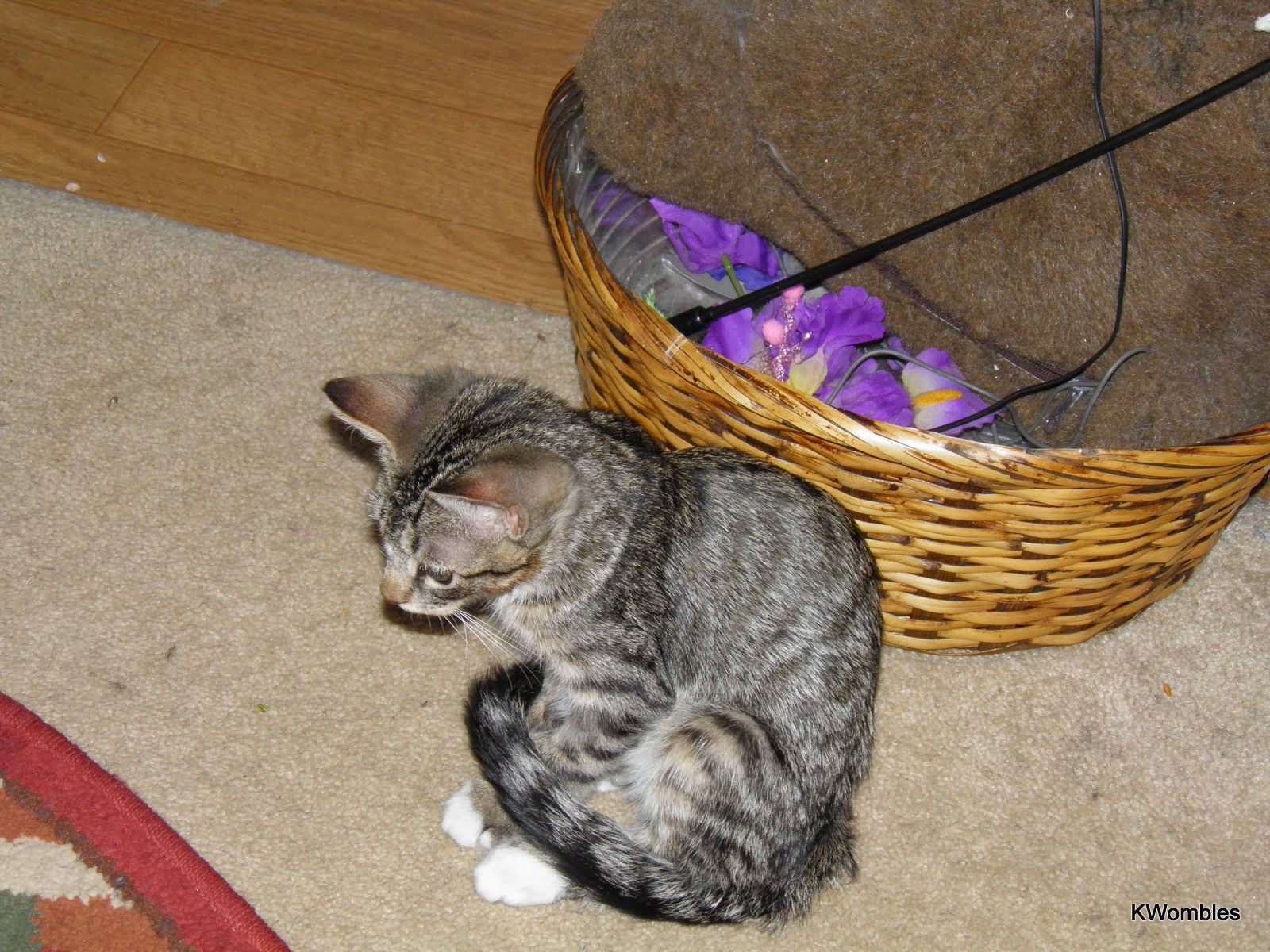
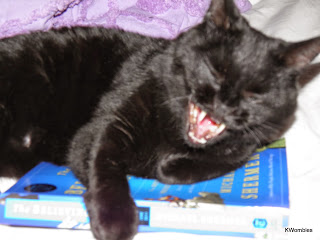
Maybe Nosferatu was a good name for this cat after all. He loves to leap at our legs, clamp on with his front claws and start chomping. Same for our arms.
Cujo the cat would have been a good name, too. Still, he's a lovely animal; even when his little teeth are trying to break your skin.
Sex is costly. Yet it is widespread throughout the animal kingdom, so there must be some advantages to it. And still, it seems easier to list disadvantages. Sexual reproduction is complicated, requires more time and uses more energy than its asexual counterpart. Partners have to find each other and coordinate their activities to produce the next generation. Another problem is the so-called ‘cost of meiosis’, meaning that, in sexual reproduction, only half of the genome is passed on. Compared to an asexually producing individual which passes on its entire genome, this is a high cost indeed. Another cost is the production of males that will not all succeed in reproducing, and thus waste resources.
I stumbled upon the song “Conquistador” today and was stunned by the parallels between Procol Harum’s lyrical references to the Vietnam War and current US military actions.
How many decisive victories can the United States claim since WWII? The only clear success I can think of was the invasion of Grenada in 1983 to protect and evacuate American medical students after a military coup. We were in Grenada for a total of 52 days. Our forces invaded, did their job, and then left.
“Conquistador, a vulture sits upon your silver shield”
This short story is about a surprising effect: you put something on the web without much advertising for it - and it might find perhaps more users than if you publish it in a traditional Journal. Here I talk about scientific or educational text. I often find similar cases the other way - things I am looking for might be at private pages and not in Journals. Often because some pieces of information which really are useful do not fit policies of any Journal, or the "referees" throw such trivial information away. This might be a long discussion, so let us rather go to my own little story.
According to Peter Freuchen, writing of his travels in Siberia, circa 1936, the tundra coast near Tiksi in the Lena Delta was fringed with logs and the sea bottom contained "hundreds of thousands of years of sawdust". To the best of my knowledge, this remarkable phenomenon - a Siberian 'sawdust coast' - has never been studied scientifically.
Peter Freuchen
Peter Freuchen was a scientist. However, for much of his life he was known to various people according to the various talents which make him seem like a character from a work of fiction.
Once upon a time, tool use was considered to be a uniquely human feature, setting us apart from the rest of the animal kingdom. But, when Jane Goodall observed chimpanzees using sticks to ‘fish’ for termites (see video 1) in the 1960’s, this idea received a serious blow. Since then, tool use has been observed in a variety of animals, ranging from the usual primate suspects, to less expected critters, such as crows, dolphins, elephants, otters and even octopuses (see video 2).
Video 1: Chimpanzees using tools to 'fish' for termites.
“I am going Nuts” introduced a misunderstood little gem, the Nutmeg, and expounded a little on its preparation.
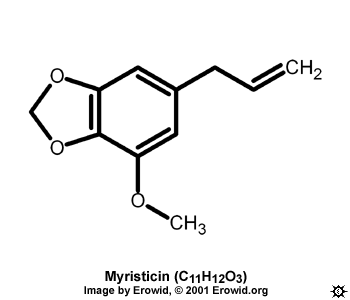
Pure myristicine without safrole, elemicin, and likely unknown ones inside nutmeg, does not result in the same effects as freshly ground nutmeg. Ground powders lose their best molecules to evaporation and oxidation in air. Thus, it is best to use fresh nuts.
Life is hard when you're cutting edge. Coming up with a good topic and title for a Science 2.0 article is not easy. Today I tried to conceive of a unique and insightful piece about a little-talked about topic. Specifically, the topic of the last space shuttle flight, which just occurred today.
But what title could really capture this epic yet unreported event? 'The Day America Cried'? Or maybe 'The Day America Shrugged', or perhaps 'The Day America Clicked on FB for, like, the 50th Time Today' might work better. But perhaps that issue itself is too niche. In the end, I abandonded that topic in favor of a new article. But what to write about?
Just as struggling calculus students wonder if they will ever actually use their new proof-finding skills in real life, developing athletes may be curious if their endless practice drills will ever serve them off the field or court? Well, researchers at the University of Illinois have found at least one real life task that will benefit from an athlete’s unique cognitive abilities; crossing the street.
I've long said that what NASA needs is not a James Webb Space Telescope but an actual James Webb for the 21st century.
Webb, if you are not familiar with NASA lore, was a bold leader rather than a bureaucrat tasked with perpetuating funding, and it was due to his leadership that NASA launched 75 missions into space, including putting a man on the Moon.
In a letter to Nature, Mark Ptashne, Oliver Hobert, and Eric Davidson question an editorial that appeared in the journal (Nature).
The editorial, focused on the International Human Epigenome Consortium, and says that it is “clear that epigenetics … could explain much about how similar genetic codes are expressed uniquely in different cells, in different environmental conditions and at different times.”
However, Ptashne, Hobert, and Davidson say that epigenetic marks stem from the DNA sequence and its interations with RNA and proteins. “They are thus directly dependent on the genomic sequence,” they write.
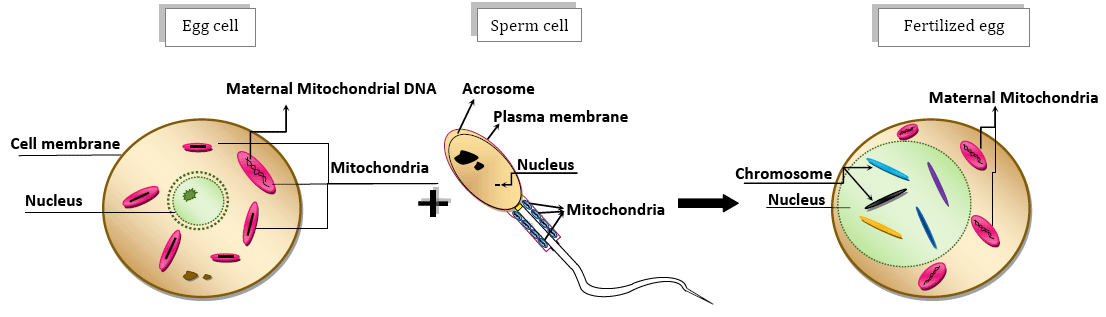
Apparently, the female ancestor of present-day polar bears was a brown bear, living in what presently corresponds to Ireland. An international research team has used mitochondrial DNA (see figure 1) to trace back the polar bears (maternal) ancestry. And it turns out that, 20,000 to 50,000 years ago, they interbred with brown bears.
Figure 1: During fertilization, the sperm cell does not contribute mitochondria to the egg.
Although it's admittedly very pretty, Mesolimulus is actually a friday fossil because, if you were to wander along the Northwest Atlantic coast, you be forgiven for thinking Mesolimulus had become depetrified, had crawled out of the museums it was held in and had returned to the oceans once again.