Fake Banner
A Great Year For Experiment Design

While 2025 will arguably not be remembered as a very positive year for humankind, for many reasons...
Living At The Polar Circle

Since 2022, when I got invited for a keynote talk at a Deep Learning school, I have been visiting...

Conferences Good And Bad, In A Profit-Driven Society

Nowadays researchers and scholars of all ages and specialization find themselves struggling with...
USERN: 10 Years Of Non-Profit Action Supporting Science Education And Research

The 10th congress of the USERN organization was held on November 8-10 in Campinas, Brazil. Some...

User picture.
picture for Hank Campbellpicture for Patrick Lockerbypicture for Heidi Hendersonpicture for Bente Lilja Byepicture for Sascha Vongehrpicture for Johannes Koelman
Tommaso DorigoRSS Feed of this column.

Tommaso Dorigo is an experimental particle physicist, who works for the INFN at the University of Padova, and collaborates with the CMS and the SWGO experiments. He is the president of the Read More »

Blogroll
On my first day at the Erice School of Science Journalism this past week I attended a lecture by Alessio Cimarelli, who discussed "When Data Journalism meets Science: a "Hackathon"". The speaker (who owns the site called "dataninja") showed several examples of how to mine the web to construct databases and display results on several topics. It was quite interesting to see the techniques he used, but I felt compelled to interrupt him at some point, in the interest of the school participants.
I have spent the last few days at a School of Science Journalism in the pleasant town of Erice, in western Sicily. The school, held at the Ettore Majorana Centre for Scientific Culture, brought together science communicators, freelance writers, magazine editors and press office consultants to listen to a small set of lectures, which this year (the fifth of the school) centered on the topic of "the digital world".

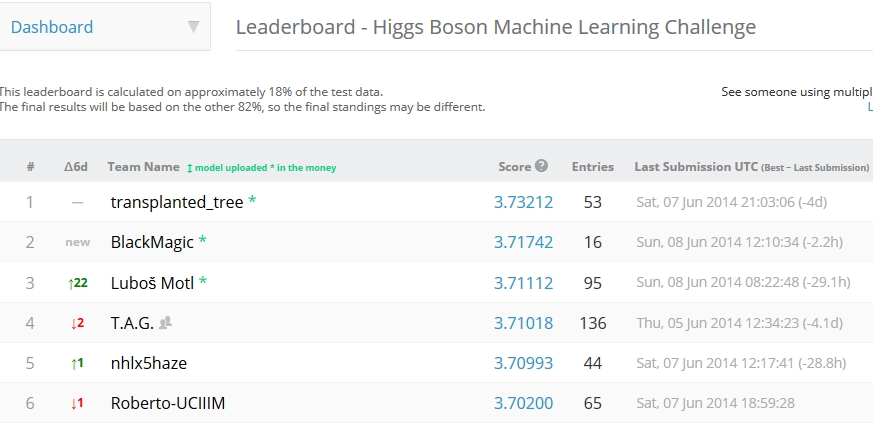
Today among the three top players -those in the money- at the Higgs challenge we see the appearance of Lubos Motl, whom I had signalled as a participant in an earlier posting. We all know that Lubos is a smart guy, but I doubted whether he would take this very seriously. However, it seems he is. As we speak he has submitted almost 100 solutions (you can submit up to 5 solutions per day, so that means having worked at this at least 20 days in a row).

In the clip below you see the top standers from the challenge site's leaderboard:

You are the first to arrive to a dinner party and must choose the table where to sit, relying on your past experience of how handsome members of the opposite sex (you're straight) usually choose their seat. You need to buy stocks based on past performances and trends. You travel to some distant location and would like to know what's the weather like there, but there is no forecast for that particular place. What do you do ?
Programmers may not be the guys with the best sense of humor around, but I found it quite entertaining to read a web page with a collection of source code comments arising a smile.

The one I liked the most is the following - not even a comment, but the way the guy called the object he instantiates:

"After the 1974 London Conference, with its strong confirmation of the quark model, a general change of view developed with regard to the structure of hadrons. [...] the quark structure of hadrons became the dominant view for developing theory and planning experiments. A crucial element of this change was the general acceptance of QCD, which eliminated the last paradox, namely, why are there no free quarks ? The conjectured infrared slavery mechanism of QCD provided a reason to accept quarks as physical constituents without demanding the existence of free quarks. The asymptotic freedom property of QCD also provided a ready explanation of scaling [...].