Fake Banner
A Great Year For Experiment Design

While 2025 will arguably not be remembered as a very positive year for humankind, for many reasons...

Living At The Polar Circle

Since 2022, when I got invited for a keynote talk at a Deep Learning school, I have been visiting...

Conferences Good And Bad, In A Profit-Driven Society

Nowadays researchers and scholars of all ages and specialization find themselves struggling with...
USERN: 10 Years Of Non-Profit Action Supporting Science Education And Research

The 10th congress of the USERN organization was held on November 8-10 in Campinas, Brazil. Some...

User picture.
picture for Hank Campbellpicture for Patrick Lockerbypicture for Heidi Hendersonpicture for Bente Lilja Byepicture for Sascha Vongehrpicture for Johannes Koelman
Tommaso DorigoRSS Feed of this column.

Tommaso Dorigo is an experimental particle physicist, who works for the INFN at the University of Padova, and collaborates with the CMS and the SWGO experiments. He is the president of the Read More »

Blogroll
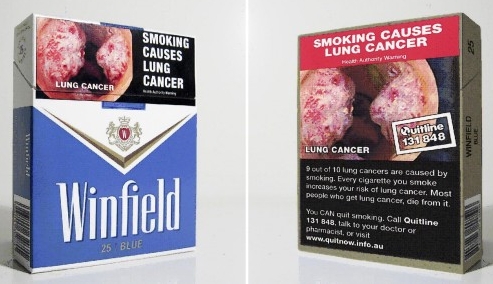
I cannot but be happy about the decision of the Australian government led by Kevin Rudd to further tighten the moral suasion against smoking. They decided that starting in 2012, the name of the brand of cigarettes and other logos will be moved away from the front of the pack, making all the packs of cigarettes look equal in their appearance: the one of the picture below. On the left how packs look like now, on the right the new look.


"The basic goal for CDF is to measure the energy, momentum, and, where possible, the identity, of particles produced at the Tevatron collider over as large a fraction of the solid angle as practical. Our strategy to accomplish this was to surround the interaction region with layers of different detector components. Starting at the interaction point, particles encounter in sequence: a thin wall Be vacuum chamber, charged particle tracking chambers, sampling calorimeters, and muon detectors."

F. Abe et al., The CDF Detector: an Overview, NIM A271 (1988) 387.
Last Monday Stephen Hawking gave a lecture at the George Washington University for the 50th anniversary of NASA. There he discussed the chance of a contact between our civilization and an extraterrestrial one. And he warned about the risks we may be facing.
My friend Peppe Liberti, a physicist and blogger from southern Italy, sent me today a amusing list of essential biographies of scientists. I wish to share them with you here, after I explain what this is about.

The rules of the game are quite simple: find an amusing way to summarize as succintly as possible (usually not exceeding two lines of text) the life and works of a well-known scientist.

Here is Peppe's bid: five really good ones.


  • Ludwig Boltzmann was one that sought an equilibrium. He died in an irreversible manner.


  • Georg Cantor tried to order the infinities. Ended in a closed set.


Researchers who blog are a rare and endangered species.

As far as rarity is concerned, it is easy to understand why that is so. Scientific research is a round-the-clock occupation, not your regular nine-to-five job. If a researcher has spare time, he or she is expected to invest it in doing more research: for Science is a mission, not a job! Because of that, finding the time to do outreach in a blog, broadcasting recent scientific results, or just expressing one's views is a demanding challenge, especially when one also has a family to attend to.
"Every great man nowadays has his disciples, but it is always Judas who writes the biography."

Oscar Wilde